












Why choose an eco-friendly mattress topper? Because sleep is, arguably, one of the most important things you’ll do in a day.
A good night’s rest sets the tone for your mood, brain performance, and overall health. But often, conventional toppers are filled with petroleum-based foams, synthetic fibers, chemical flame retardants, or even fiberglass. That means you’re spending eight hours a night surrounded by off-gassing and toxins. Hardly a recipe for restorative sleep!
A non-toxic mattress topper offers a safer, more sustainable alternative. By using certified organic and natural materials like cotton, wool, and natural latex, they not only reduce chemical exposure but also cut down on the waste and pollution created by synthetic foams and fabrics.
When selecting the best options, we didn’t just stop at materials. We also looked at brands prioritizing ethical manufacturing, climate action, charitable giving, and relevant certifications. It turns out that what’s better for our bodies is better for the natural environment and the people who make the toppers too!
You’ll likely notice a couple of “rated” brands on our list of comforters below. This means these brands have opted in to be assessed through our Brand Rating System which includes a wide range of sustainability-related criteria including chemical use, circularity, health & safety, biodiversity impact, climate action, and more. You can find other rated brands in our directory.
Related Guides: What Is Natural & Organic Latex?, Non-Toxic Mattresses, Non-Toxic Pillows, Non-Toxic Bedding, Non-Toxic Living, Non-Toxic Bed Frames
We independently research all featured brands, and we ask them to confirm their claims. In many cases we personally review recommended products. This post contains affiliate links which means we may earn a commission if you buy something. We explain this further in our Terms of Use.
The Best Non-Toxic Mattress Toppers
PlushBeds offers three non-toxic mattress toppers, including a 100% vegan option made from GOLS-certified organic latex. Each topper is backed by trusted third-party certifications for safety and low chemical emissions. PlushBeds has been comprehensively rated by us on their sustainability credentials – see the full rating.
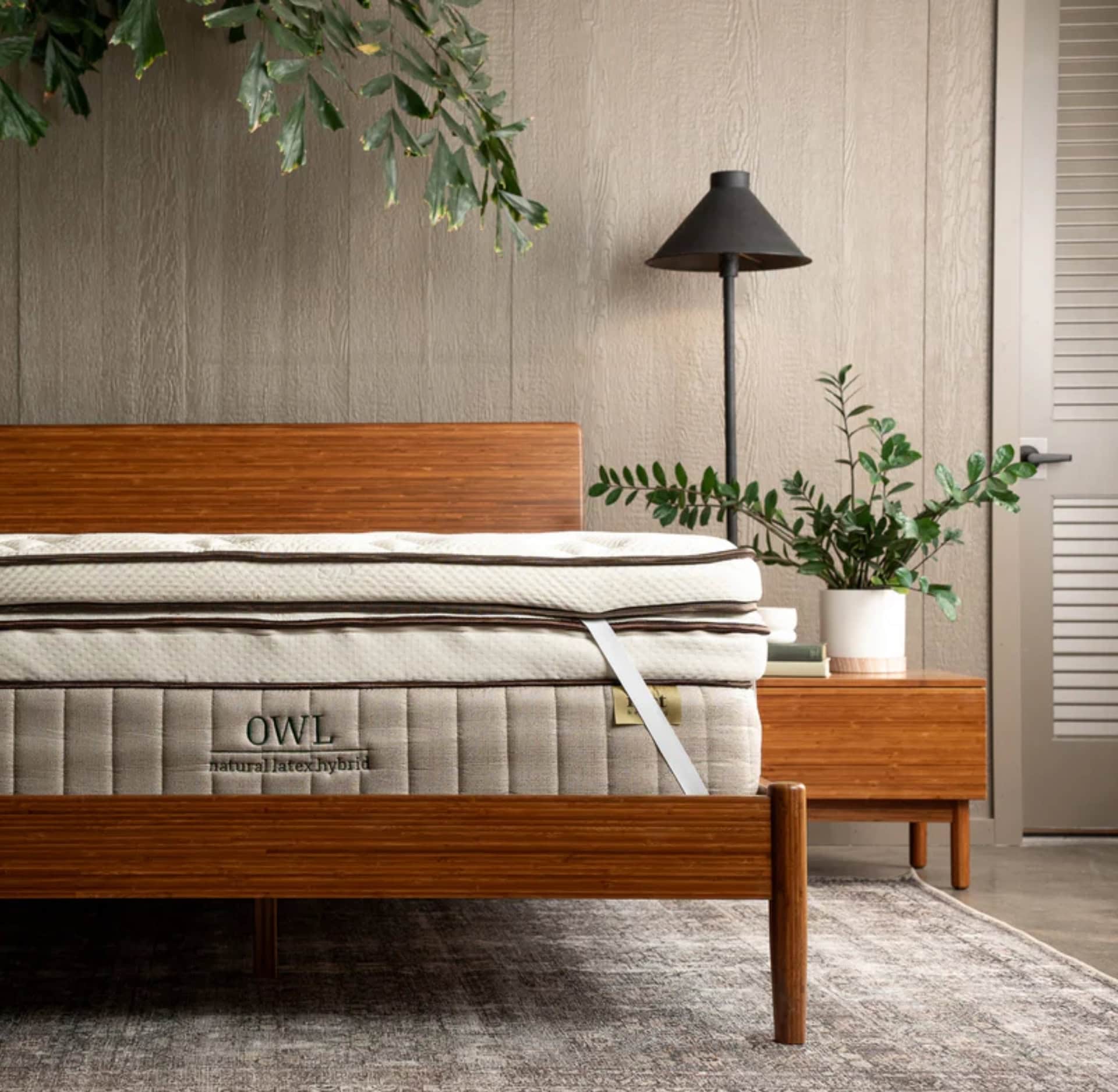
Nest Bedding’s soft natural latex mattress topper is CertiPUR-US® certified for safer, low-emission foam. It’s made with Talalay latex and finished with a Fair Trade Certified organic cotton and Joma wool cover, with the wool sourced from New Zealand. Nest Bedding has been comprehensively rated by us on their sustainability credentials – see the full rating.
Avocado makes some of the most certified eco-friendly mattress toppers on the market, including latex and alpaca wool options. With GOTS, GOLS, OEKO-TEX®, MADE SAFE®, and even EWG VERIFIED® certifications, their toppers balance non-toxic comfort with rigorous sustainability standards.
Index: Eco-Friendly Mattress Topper Brands
- PlushBeds Jump to brand
- Nest Bedding Jump to brand
- Savvy Rest Jump to brand
- Avocado Jump to brand
- Naturepedic Jump to brand
- Birch Jump to brand
- Happsy Jump to brand
- Saatva Jump to brand
- Brentwood Home Jump to brand
PlushBeds



Ethical Sourcing
Raw materials have been sourced ethically with people and planet in mind.
Locally Made
Products are made local to the brand's headquarters.
Made To Order
Products can be made to order, thus limiting unnecessary production
Non-toxic
All products are made with ingredients or materials that are currently considered non-toxic
Organic
Products are made from organic materials.
Sustainable Materials or Ingredients
Either all or most products are made with sustainable materials or ingredients.
Arpico
CertiPUR
eco-INSTITUT
FSC®
GOLS
GOTS
Green America
Greenguard
OEKO-TEX®
Rainforest Alliance
USDA Organic
CertiPUR
The CertiPUR-US® certification applies to flexible polyurethane foam used in mattresses, pillows, and upholstered furniture. It ensures the foam is made without harmful chemicals like ozone depleters, formaldehyde, heavy metals, PBDE flame retardants, or phthalates, and that it meets strict standards for low VOC emissions.eco-INSTITUT
The eco-INSTITUT certification, issued by the independent German testing body eco-INSTITUT Germany GmbH, verifies that products meet rigorous standards for low emissions and pollutant-free materials. It’s commonly used for mattresses, furniture, flooring, and building materials, ensuring they are free from harmful chemicals like VOCs, formaldehyde, and heavy metals, and are safe for indoor air quality.FSC®
The FSC® (Forest Stewardship Council) certification ensures that wood, paper, and other forest-based materials come from responsibly managed forests that provide environmental, social, and economic benefits. Products bearing the FSC® label support biodiversity, protect the rights of forest communities and workers, and promote sustainable forestry practices.GOLS
The GOLS (Global Organic Latex Standard) certification ensures that latex products contain more than 95% certified organic raw material and meet strict environmental and social criteria throughout production. Managed by Control Union, GOLS verifies that latex is sourced from organically managed plantations without harmful chemicals and that processing facilities uphold fair labor practices and sustainable manufacturing standards.GOTS
The GOTS (Global Organic Textile Standard) certification is the world’s leading standard for organic fibers. It covers every step of production, from harvesting raw fibers to environmentally and socially responsible manufacturing, and prohibits toxic dyes, GMOs, and harmful chemicals. GOTS also enforces fair labor practices.Green America
The Green America Certified Business seal recognizes companies that meet high standards for social and environmental responsibility. Administered by Green America, the certification evaluates businesses on their commitment to fair labor, environmental sustainability, community impact, and ethical business practices.Greenguard
The GREENGUARD Certification, issued by UL Solutions, ensures that products meet strict chemical emissions limits to help reduce indoor air pollution and exposure to VOCs (volatile organic compounds). Commonly applied to furniture, mattresses, paints, and building materials, it verifies that products contribute to healthier indoor environments.OEKO-TEX®
The OEKO-TEX® Standard 100 certification ensures that every component of a textile product (threads, buttons, zippers, and fabrics) has been independently tested for harmful substances. Managed by the International Association for Research and Testing in the Field of Textile and Leather Ecology, it guarantees products are safe for human health, meeting strict global limits for chemicals such as pesticides, heavy metals, formaldehyde, and PFAS.Rainforest Alliance
The Rainforest Alliance Certified™ seal ensures that products are made according to rigorous standards for environmental, social, and economic sustainability. The certification supports biodiversity conservation, climate resilience, and fair livelihoods by promoting responsible farming, forestry, and supply chain practices.USDA Organic
The USDA Organic certification, regulated by the U.S. Department of Agriculture’s National Organic Program (NOP), verifies that products are made with ingredients grown and processed according to strict organic standards. It prohibits synthetic pesticides, fertilizers, GMOs, and harmful additives, while requiring practices that promote soil health, biodiversity, and animal welfare.Price Range: $288–$1,249
PlushBeds may inspire restful, restoring shut-eye, but they don’t turn a blind eye to the problems of the bedding industry.
And it’s only natural that one of our favorite bedding brands (yep, we’ve tested a bunch of their products and can’t say enough about this brand – here’s our dedicated PlushBeds review) also makes some of the best non-toxic mattress toppers, including:
- Natural Wool Mattress Topper: Handmade in the USA with wool and a GOTS-certified organic cotton cover. Plush say this wool sourced from farmers who ensure sustainable land use and humane wool shearing.
- Organic Latex Mattress Topper: Made from 100% GOLS-certified organic latex and certified by OEKO-TEX® and GREENGUARD Gold, it offers supportive pressure relief.
- Quilted Organic Mattress Topper: A blend of GOTS-certified cotton, organic wool, and GOLS-certified latex, this quilted topper adds cushioned comfort, durability, and natural temperature regulation.
PlushBeds also offers an Alternative Down Topper made with microfiber polyester fill, along with CertiPUR-US® and GREENGUARD Gold certified synthetic options like the Cooling Gel Mattress Topper and Memory Foam Mattress Topper. Given these use synthetic materials, we’d recommend choosing one of the natural toppers above instead for a healthier, non-toxic sleep surface.
All PlushBeds toppers are handcrafted in California, with any overseas sourcing limited to farms that meet their workplace standards. The brand also runs a Scholarship Program, awarding two annual scholarships to students pursuing eco-friendly degrees.
PlushBeds has been rated by Sustainable Jungle. See the full rating.
Nest Bedding


Ethical Sourcing
Raw materials have been sourced ethically with people and planet in mind.Made To Order
Products can be made to order, thus limiting unnecessary productionNon-toxic
All products are made with ingredients or materials that are currently considered non-toxicOrganic
Products are made from organic materials.
Recycled materials
Some or all products are made with recycled materials
Thoughtful packaging
Product packaging has been designed and created with the end of life outcome in mind and can be easily recycled or composted.
Woman Owned
This brand is owned by a woman or a group of women.
CertiPUR
Fair Trade
FSC®
CertiPUR
The CertiPUR-US® certification applies to flexible polyurethane foam used in mattresses, pillows, and upholstered furniture. It ensures the foam is made without harmful chemicals like ozone depleters, formaldehyde, heavy metals, PBDE flame retardants, or phthalates, and that it meets strict standards for low VOC emissions.Fair Trade
The Fair Trade certification ensures that products are made according to rigorous social, environmental, and economic standards that protect workers and the planet. Overseen by organizations such as Fair Trade USA and Fairtrade International, it guarantees fair wages, safe working conditions, environmental sustainability, and community development funds, helping producers build more equitable and resilient supply chains.FSC®
The FSC® (Forest Stewardship Council) certification ensures that wood, paper, and other forest-based materials come from responsibly managed forests that provide environmental, social, and economic benefits. Products bearing the FSC® label support biodiversity, protect the rights of forest communities and workers, and promote sustainable forestry practices.Price Range: $379–$709
Nest Bedding’s soft natural latex mattress topper is made with Talalay natural latex and an organic knit cotton and Joma wool cover.
All their foams are CertiPUR-US certified and are allowed a curing period before entering your home, which is said to dissipate any off-gassing that may occur. Their fire barrier is made with hydrogenated silica, a non-toxic alternative to traditional barriers.
Nest’s organic cotton is Fair Trade certified and Nest ensures all their own workers, as well as any workers on partner farms or factories, are also delivered a fair wage free of any harassment. Their Joma wool is sourced from New Zealand, where mulesing is not practiced. Sheep are gently shorn, and roam freely across remote farms. The wool is also OEKO-TEX® certified.
Nest Bedding has been rated by Sustainable Jungle. See the full rating.
Savvy Rest


Savvy Rest has not been rated.
Price Range: $499–$2,249
Savvy Rest is an employee-owned B Corp that takes natural sleep seriously, from latex toppers to wool comfort layers, with all products made in GOTS-certified facilities. Their four all natural mattress toppers include:
- Vitality: A 3″ layer of soft natural Talalay latex wrapped in organic cotton knit, certified GOTS, FSC®, Cradle to Cradle GOLD, and Eco Institut. It provides contouring comfort comparable to memory foam without synthetic chemicals.
- Harmony: One 3″ layer of natural latex (Talalay or Dunlop) encased in organic cotton, available in Soft, Medium, or Firm. Highly customizable, this topper adds cushioning and pressure relief to any mattress.
- Organic Savvy Woolsy: A 3″ topper filled with GOTS-certified organic wool and finished with organic cotton sateen for pillowy comfort, better airflow, and natural temperature regulation.
- Natural Savvy Woolsy: Filled with US sourced natural wool and finished with an organic cotton sateen cover, this 3″ topper offers plush comfort, corner straps for a secure fit, and year-round breathability. (Note: Savvy Rest does not disclose specific animal welfare certifications for this wool.)
All Savvy Rest toppers are GREENGUARD Gold certified for low emissions. Their latex is Eco Institut certified, with Talalay latex also carrying Cradle to Cradle GOLD certification.
As a Green America Gold-level business, Savvy Rest embeds social and environmental responsibility into every stage of production. They offset carbon emissions through ClimeCo and have been employee-owned since 2012.
Avocado



Carbon Neutral
Brand has been certified as Carbon Neutral.Ethical Sourcing
Raw materials have been sourced ethically with people and planet in mind.Non-toxic
All products are made with ingredients or materials that are currently considered non-toxicOrganic
Products are made from organic materials.Sustainable Materials or Ingredients
Either all or most products are made with sustainable materials or ingredients.
Zero Waste
Products are made with a low or zero waste approach where ideally no or limited waste is created throughout the production process or at the end of life.
1% for the planet
B Corp
Certified Vegan
eco-INSTITUT
EWG
FSC®
GOLS
GOTS
Green America
Greenguard
MADE SAFE®
OEKO-TEX®
PETA
RWS
The Climate Label
USDA Organic
1% for the planet
Certified Environmental Giving — Businesses give 1% of their annual sales directly to vetted environmental partners.B Corp
The B Corp Certification, administered by the nonprofit B Lab, recognizes companies that meet high standards of verified social and environmental performance, transparency, and accountability. Certified B Corps balance profit with purpose, committing to responsible practices that benefit workers, communities, customers, and the planet while embedding sustainability into their business model.Certified Vegan
The Certified Vegan logo, managed by the Vegan Awareness Foundation (Vegan Action), ensures that products contain no animal ingredients or by-products and have not been tested on animals. It’s one of the most recognized vegan certifications, helping consumers identify items that meet strict vegan and cruelty-free standards across food, cosmetics, clothing, and household products.eco-INSTITUT
The eco-INSTITUT certification, issued by the independent German testing body eco-INSTITUT Germany GmbH, verifies that products meet rigorous standards for low emissions and pollutant-free materials. It’s commonly used for mattresses, furniture, flooring, and building materials, ensuring they are free from harmful chemicals like VOCs, formaldehyde, and heavy metals, and are safe for indoor air quality.EWG
The EWG Verified® mark, issued by the Environmental Working Group, identifies products that meet the organization’s strictest standards for health and transparency. To earn the label, products must avoid ingredients of concern, fully disclose all ingredients (including fragrance components), and follow good manufacturing practices.FSC®
The FSC® (Forest Stewardship Council) certification ensures that wood, paper, and other forest-based materials come from responsibly managed forests that provide environmental, social, and economic benefits. Products bearing the FSC® label support biodiversity, protect the rights of forest communities and workers, and promote sustainable forestry practices.GOLS
The GOLS (Global Organic Latex Standard) certification ensures that latex products contain more than 95% certified organic raw material and meet strict environmental and social criteria throughout production. Managed by Control Union, GOLS verifies that latex is sourced from organically managed plantations without harmful chemicals and that processing facilities uphold fair labor practices and sustainable manufacturing standards.GOTS
The GOTS (Global Organic Textile Standard) certification is the world’s leading standard for organic fibers. It covers every step of production, from harvesting raw fibers to environmentally and socially responsible manufacturing, and prohibits toxic dyes, GMOs, and harmful chemicals. GOTS also enforces fair labor practices.Green America
The Green America Certified Business seal recognizes companies that meet high standards for social and environmental responsibility. Administered by Green America, the certification evaluates businesses on their commitment to fair labor, environmental sustainability, community impact, and ethical business practices.Greenguard
The GREENGUARD Certification, issued by UL Solutions, ensures that products meet strict chemical emissions limits to help reduce indoor air pollution and exposure to VOCs (volatile organic compounds). Commonly applied to furniture, mattresses, paints, and building materials, it verifies that products contribute to healthier indoor environments.MADE SAFE®
The MADE SAFE® certification is a comprehensive non-toxic seal that verifies products are made with safe ingredients not known or suspected to harm human health, animals, or ecosystems. Overseen by the MADE SAFE nonprofit, it screens every ingredient against a database of toxicological and environmental science criteria.OEKO-TEX®
The OEKO-TEX® Standard 100 certification ensures that every component of a textile product (threads, buttons, zippers, and fabrics) has been independently tested for harmful substances. Managed by the International Association for Research and Testing in the Field of Textile and Leather Ecology, it guarantees products are safe for human health, meeting strict global limits for chemicals such as pesticides, heavy metals, formaldehyde, and PFAS.PETA
The PETA-Approved Vegan certification verifies that a brand’s certified products are completely free from animal-derived materials and that no animal testing is conducted at any stage of production. Managed by People for the Ethical Treatment of Animals (PETA), the label helps consumers easily identify fashion, beauty, and lifestyle products that align with a fully vegan and cruelty-free standard.RWS
The Responsible Wool Standard (RWS) is a global certification that ensures wool comes from farms that protect animal welfare and practice progressive land management. It also tracks the certified wool through every stage of production to maintain transparency and traceability.The Climate Label
The Climate Label certifies companies that measure and publicly disclose their greenhouse-gas emissions, set a financial commitment (a “climate transition budget”) tied to those emissions, and allocate verified funding for projects that reduce or remove emissions from their operations, supply-chain and beyond. Unlike a simple “carbon-neutral” claim, the label emphasises actual investment in the transition to a low-carbon future, not just offsets, and is designed to increase transparency and credibility for climate action by businesses.USDA Organic
The USDA Organic certification, regulated by the U.S. Department of Agriculture’s National Organic Program (NOP), verifies that products are made with ingredients grown and processed according to strict organic standards. It prohibits synthetic pesticides, fertilizers, GMOs, and harmful additives, while requiring practices that promote soil health, biodiversity, and animal welfare.Price Range: $279–$1,759
LA-based Avocado is as green as their representative fruit with their complete bedroom collection, including non-toxic furniture, mattresses, sheets, and alpaca throws. Their luxurious and yet affordable organic mattress topper (the Eco Organic Mattress Topper) comes in different depths and a range from Twin to California King.
Materials used in this eco-friendly mattress topper vary based on depth. They’re made from either GOLS-certified organic latex rubber sourced from their own rubber tree farms (Dunlop Latex) or premium FSC® certified Pure Talalay latex. Whatever the fill, they’re covered in GOTS-certified organic cotton. This topper is about as non-toxic as you can get being OEKO-TEX® STANDARD 100, EWG Verified®, and MADE SAFE® certified. It’s also certified vegan.
If you need a latex-free mattress topper, their Alpaca Wool Mattress Topper wool suit you best. It comes in both luxury plush (made with baby alpaca fiber) and standard versions. Avocado says the alpaca wool is ethically sourced. Materials for this topper also include GOTS-certified organic wool, and GOTS organic certified cotton.
GOTS-certified organic wool replaces toxic fire retardants; it’s also antimicrobial, resistant to dust mites, and helps with temperature control. GreenGuard-certified, each sustainable mattress topper is free of VOCs, formaldehyde, or phthalates.
As a Certified B Corp, this brand holds firm to ILO’s fair labor standards. They are also Climate Label certified and certified by UL Solutions for a landfill diversion rate of 85% through their Project Zero Waste.
As a member of 1% for the Planet, Avocado donates 1% of proceeds to vetted nonprofits that support the fight against climate change and support healthy food systems.
Naturepedic


Naturepedic has not been rated.
Price Range: $349–$959
With beginnings in creating a baby mattress for his son, Barry Cik takes creating natural fiber mattress toppers very seriously. Today, Naturepedic offers four non-toxic mattress toppers:
- Alpaca Mattress Topper: A 2″ topper made with alpaca fiber and wrapped in OCS-certified organic cotton, offering natural temperature regulation and softness. Naturepedic says their alpaca wool is sourced from a small array of herders in the “highlands of Peru with the utmost care for the animals’ well-being“
- Box-Stitched Organic Latex Topper: Constructed with GOLS-certified latex and covered in organic cotton, this topper adds buoyant support and pressure relief with a quilted, box-stitched design for durability.
- Adagio 2″ Organic Latex Topper: A simple, streamlined latex topper with organic cotton, designed to add gentle contouring and pressure point relief.
- Wooly 3″ Organic Wool Topper: Plush and cozy, this pillow-top style topper uses organic wool to create a hotel-like sleep surface that’s naturally flame-resistant and breathable.
All Naturepedic toppers are made in the USA with support from local Amish craftsmen, combining traditional handcraft with modern certifications. Materials are GOTS-, GOLS-, and GREENGUARD Gold-certified, with additional MADE SAFE approval to ensure you’re sleeping free of toxic chemicals.
Naturepedic also participates in The Chemical Footprint Project and publish their product in the Health Product Declaration (HPD) database. Their Sustainability Reports (see the 2024 report) outline a constantly evolving approach to safe, responsible production. Naturepedic is also a member of 1% for the Planet.
Birch


Birch has not been rated.
Price Range: $372–$652
Birch Living’s Plush Organic Mattress Topper is made with natural latex sustainably tapped from the Hevea Brasiliensis rubber tree in Sri Lanka and covered with Fair Trade Certified organic cotton. Free from synthetic latex, polyurethane foams, and chemical flame retardants, it’s GREENGUARD Gold and Rainforest Alliance certified.
The topper comes with a 100-night sleep trial, financing options, and discounts for students, teachers, and first responders. It’s also won recognition from major outlets — including Wired (Overall Best Topper 2025), The Strategist (Best Latex Topper 2025), Forbes Vetted (Best Organic Mattress Topper 2025), and Architectural Digest (Best Plush Mattress Topper 2025).
Birch is part of 3Z Brands, which publishes an annual ESG Report outlining environmental, social, and governance practices across its portfolio of sleep brands.
This non-toxic bed frame brand also offers mattresses, protectors, sheets, and more.
Happsy


Happsy has not been rated.
Price Range: $249–$499
Happsy keeps things simple with just one affordable non-toxic mattress topper. Made with 2″ of GOLS-certified latex wrapped in GOTS-certified organic cotton, it delivers plush pillow-top comfort without polyurethane foam, animal materials, or chemical flame retardants.
It’s designed to instantly upgrade any mattress, softening overly firm beds, relieving pressure points, and adding breathable support that doesn’t trap heat like memory foam. Certified organic and MADE SAFE®, it’s one of the most accessible non-toxic toppers on the market.
Happsy’s certified organic factory is in the US and they have an impressive array of certifications for their non-toxic mattresses and bedding products including: GOTS (Global Organic Textile Standard), GOLS (Global Organic Latex Standard), OCS (Organic Content Standard 100), FSC (Forest Stewardship Council®), GREENGUARD Gold, MADE SAFE®, EWG VERIFIED®, eco-INSTITUT, UL Validated Formaldehyde Free, Green America Certified Business, and NonToxU.
To encourage broader industry change, Happsy is also a member of the Sustainable Furnishings Council, the American Sustainable Business Network, and the Organic Trade Association (OTA), and contributes to environmental causes through 1% for the Planet.
Saatva


Saatva has not been rated.
Price Range: $245 – $1,295
Saatva, the original DTC mattress disruptor, now offers eco mattress toppers to match their certified organic mattresses. Their two most sustainable options are:
- Organic Quilted Mattress Topper: The most eco-friendly option, combining GOTS-certified organic latex, wool batting, and cotton for breathable comfort and plush pressure relief. Quilted construction adds durability while keeping materials naturally moisture-wicking and temperature-regulating.
- Natural Latex Topper: Made with FSC®-certified, eco-INSTITUT® certified natural latex and covered in breathable organic cotton. This topper provides buoyant support and pressure relief without polyurethane foams or chemical flame retardants.
Both toppers include Saatva’s Guardin™ botanical antimicrobial treatment. It’s made from a proprietary blend of essential oils and mineral (including thyme, geranium, lemongrass, and mint). It’s designed to inhibit the growth of bacteria, mold, and mildew. It is free from hazardous substances like fluorocarbons, silver nanoparticles, triclosan, formaldehyde, and phthalates.
All Saatva products are handcrafted in the USA with globally sourced materials. The brand’s factories run on solar power, recycle manufacturing scraps, and operate within 100 miles of most delivery points, reducing carbon impact. Saatva is also a member of the Sustainable Furnishings Council and partners with Evertreen to plant trees worldwide.
Brentwood Home


Brentwood Home has not been rated.
Price Range: $199–$499
Brentwood Home offers “healthy & luxurious” home essentials—including yoga mats—for an exceptionally affordable price. Their non-toxic Memory Foam Mattress Topper is an affordable way to upgrade your mattress with plush body-contouring comfort. It’s available in 2″ or 3″ thicknesses, infused with cooling gel swirls and made with up to 20% plant-based BioFoam®, reducing reliance on petrochemicals.
The breathable Tencel® cover adds softness and helps regulate temperature, though the rest of the topper does rely on polyester. While it’s certified by CertiPUR-US®, GREENGUARD Gold, and eco-INSTITUT, making it one of the safer memory foam options out there, those concerned primarily with avoiding synthetics may prefer the natural fiber toppers featured earlier in this list.
Why Consider a Sustainable AND Non-Toxic Mattress Topper
Why buy a mattress topper in the first place? It’s often the easiest and most affordable way to improve your sleep surface without buying a whole new mattress. This choice is in itself is a more sustainable approach if you just need a minor sleep refresh.
So while a mattress topper may not seem like a life-changing purchase, it’s important to consider its impact on both your health, the health of the people who made it, and the impact on the natural environment. Since it’s in direct contact with our bodies for hours every night, the materials inside can have just as much impact on our wellbeing and indoor air quality as the mattress itself.
Toxins in Conventional Mattress Toppers
Many mainstream toppers are made from memory foam, polyurethane, or synthetic fiber fills that can off-gas volatile organic compounds (VOCs). That “new topper smell” is typically the release of:
- Chemical flame retardants (sometimes even fiberglass) that are linked to respiratory irritation and hormone disruption.
- PFAS (‘forever chemicals’) used for stain or liquid resistance, which are associated with cancer, fertility issues, and immune system effects.
- Phthalates, formaldehyde, and other VOCs, all of which degrade indoor air quality and may cause headaches or disrupt hormones.
This is particularly concerning for children or anyone with respiratory sensitivities, making the case for non-toxic mattress toppers all the stronger.
Environmental Footprint of Mattress Toppers
Conventional toppers aren’t just questionable for health — they also come with an environmental cost. Petrochemical-based foams and synthetic fiber fills are resource-intensive to produce and break down slowly, often ending up in landfills alongside millions of discarded mattresses each year.
Even natural fibers like cotton, wool, or latex can be unsustainable if sourced irresponsibly. That’s why it’s worth choosing toppers made with certified organic or recycled materials. Natural latex in particular is durable, renewable, and biodegradable, giving toppers a longer life while reducing waste. See below for more on mattress topper materials and relevant certifications we recommend.
Animal Welfare Concerns
Many eco-friendly mattress toppers use natural animal fibers like wool, down, or alpaca. While these can be renewable, breathable, non-toxic, and durable, the way they’re sourced matters enormously.
- Conventional wool production often involves painful practices such as mulesing, tail docking, and castration, sometimes performed without anesthesia, under the guise of preventing parasitic infections like flystrike. Choosing organic or RWS-certified wool helps ensure higher animal welfare standards.
- Down production is rife with welfare concerns. The most disturbing include live-plucking and, in some cases, force-feeding of ducks and geese. Responsible Down Standard (RDS) certification is the most reliable way to ensure animals are not subjected to these inhumane practices.
- Alpaca: While alpacas are generally shorn in a way similar to sheep, their welfare still depends on how they are handled. Certifications are less common, but brands that highlight small-scale, humane farming practices provide greater assurance of ethical treatment.
When animal fibers are involved, certifications and transparency are key but not perfect so we would recommend avoiding animal products if possible.
What To Look For (And Avoid) in a Healthier, Eco-Friendly Mattress Topper
When shopping for a non-toxic, eco-friendly mattress topper, these are the factors we recommend keeping in mind, and in fact have formed the framework for our own search for this list.
Materials
We generally prefer natural and organic fibers over synthetic textiles, since they reduce chemical exposure and are more sustainable overall. Some of the most common and trusted options for mattress toppers include:
- Organic Cotton: Breathable, soft, and grown without toxic pesticides or synthetic fertilizers. Safer for you and less resource-intensive than conventional cotton farming.
- Wool: Naturally flame-resistant and temperature-regulating, so it doesn’t require added chemical treatments. Look for organic or RWS-certified wool to ensure high animal welfare standards.
- Down: Exceptionally warm and lightweight, but only responsible when certified under the Responsible Down Standard (RDS). This ensures no live-plucking or force-feeding, two major animal welfare concerns.
- Alpaca: Softer and warmer than wool, naturally hypoallergenic, and free from lanolin (so it’s less irritating for sensitive skin). Ideally sourced from farms practicing humane and sustainable land management.
- Natural Latex: A renewable, biodegradable material that’s durable and supportive. Make sure it’s certified organic (GOLS) to avoid synthetic blends made from petrochemicals. See more on this below.
- Plant-Based Alternatives (TENCEL™ Lyocell, Bamboo, Modal): Semi-synthetic fibers made in closed-loop systems that minimize solvent and water waste. They’re hypoallergenic, moisture-wicking, and petroleum-free, offering a cleaner alternative to polyester.
- Kapok: Sometimes used as a down-alternative fill. It’s naturally silky, hypoallergenic, and grows wild without fertilizers or pesticides.
Some brands also use recycled fibers (like recycled polyester) to reduce waste. While this keeps plastic out of landfills, recycled synthetics can still carry toxicity concerns (like residual BPA). That’s why we lean toward organic and natural fibers where possible.
Talalay and Dunlop Natural Latex
You’ll notice these two names come up a lot on this list and are used as the dominant material in most of the toppers. Both Talalay and Dunlop latex are derived from the sap of the Hevea brasiliensis rubber tree, a renewable resource. When certified by GOLS, FSC, or eco-INSTITUT, natural latex avoids petrochemicals, supports sustainable forestry, and biodegrades at the end of its life. Here’s a high level explainer of the two:
- Dunlop Latex: The more traditional method, Dunlop latex is poured in one go and allowed to settle naturally. This creates a denser, firmer foam that’s durable, supportive, and less energy-intensive to produce. Because of its simpler process, it’s usually considered the more sustainable of the two natural latex products. A leading supplier is Latex Green, who produce GOLS and eco-INSTITUT certified natural Dunlop latex in Sri Lanka.
- Talalay Latex: Talalay goes through additional steps (freezing, vacuum expansion, and baking) to create a softer, more consistent feel. It tends to be bouncier and more breathable than Dunlop, making it popular for comfort layers. While the process requires more energy, responsibly sourced Talalay (like FSC® and Cradle to Cradle GOLD certified) still offers a safe, non-toxic, and long-lasting material. A leading supplier is Radium Foam (Vita Talalay) in the Netherlands, which produces FSC-certified, Cradle to Cradle GOLD Talalay latex.
Fire Safety Without Toxins
- Steer clear of toppers that use fiberglass fire barriers, chemical flame retardants, or PFAS coatings.
- Safer options use natural flame resistance from wool or other plant-based alternatives
Green Business Practices
Beyond materials, we love to see brands going further with:
- Transparent sourcing and ethical labor.
- Packaging that minimizes or avoids plastic.
- Consideration of circularity or ways to reduce waste to landfill.
- Efforts to reduce carbon emissions, like certifications or verified climate programs.
- Giving back with charitable giving.
We have a few brands on this list who have received a brand rating from us, which assesses them against 22 different sustainability-related criteria. These brands need to opt in to be rated so we believe their transparency makes them a good choice if you’re focused on both sustainability and safety.
Certifications, Memberships & Testing
Materials:
- GOTS (Global Organic Textile Standard) for cotton or wool.
- GOLS (Global Organic Latex Standard) for latex.
- RDS (Responsible Down Standard) for down from animals that have not been live-plucked or force-fed.
- RWS (Responsible Wool Standard) for higher standards of animal welfare and land management.
- OEKO-TEX 100 for fabrics tested against harmful substances.
- CertiPUR-US® for any poly foams to ensure they are low-VOC and free of harmful chemicals.
- MADE SAFE® requires products to be free from known toxins.
- Greenguard Gold and eco-INSTITUT are additional rigorous indicators of low-toxicity and safer indoor air.
Other certifications or memberships that indicate additional care or responsibility for environmental and social issues:
- B Corp verifies a brand meets high standards of social and environmental performance, transparency, and accountability.
- Fair Trade Certified certifies safe working conditions and fair wages in agricultural products like cotton.
- 1% for the Planet ensures the company donates at least 1% of annual sales to environmental causes.
- The Climate Label certifies that a product’s carbon footprint has been measured, verified, and transparently communicated.
Customer Experience & Durability
A topper can only be “sustainable” if it actually performs. Poor quality toppers wear down quickly, meaning more waste and replacement costs. Real customer reviews (and our own testing, where possible) help us confirm comfort, durability, and whether a topper really enhances sleep. Longer-lasting toppers save money, resources, and help you sleep better.
Editor’s note: We first published this article in August 2023, originally focused on organic mattress toppers. Since then, we’ve refreshed it so the brands, certifications, and the issues that matter most to you, like sustainability and toxin exposure, reflect the latest information available.

Joy has been a passionate advocate for the environment since she was a small child. She grew up in South Africa and has been lucky enough to be exposed to the wonders of nature not just in Africa but all over the world. She founded Sustainable Jungle (together with her husband Lyall) back in 2017 after becoming enraged by the devastating impact of palm oil. She then founded the Sustainable Jungle Podcast and together with Lyall interviewed remarkable people from all over the world who were finding ways to create positive impact. Outside of Sustainable Jungle, Joy has always worked in the corporate world, starting out as an auditor and later moving into management consulting. More recently she specialized in Climate Investing for the Asia Pacific region. Given her experience, her current passion is Brand Ratings. She is very much enjoying going deeper on what it really means to drive sustainability performance and true impact through business operations.