















In the ever-evolving world of textiles, there exists a fabric that feels like a gentle caress against the skin. Enter: modal fabric, a darling of the sustainable fabrics world, celebrated for its luxurious comfort. Yet, beneath its vegan silky surface, there’s a knot of controversy waiting to be unraveled.
Modal is a more refined form of rayon fabric that delivers silky softness and impressive durability, while also being relatively soft on the planet (at least when it comes from the right producer). But is modal sustainable? And with growing questions about carbon disulfide and chemical safety, is modal fabric toxic?
We’re separating fact from fiction, comfort from controversy, and discovering whether this fabric is as soft on the planet as it is on the skin. If you’ve been wondering how that favorite pair of modal underwear was produced, whether it’s actually safe to wear, and how to care for it, we’ll help you get to the bottom of those modal bottoms.
Related reading: What Is Lyocell?, Vegan Fabrics, What Is Bamboo Fabric?
Watch our video explainer below on modal fabric and its sustainability credentials:
Contents: Modal Fabric
- What Is Modal Fabric? Jump to section
- How Is Modal Made? (And How Does It Compare To Viscose?) Jump to section
- Is Modal Toxic? Is It Safe To Wear? Jump to section
- Is Modal Fabric Sustainable? Jump to section
- Modal Advantages & Disadvantages Jump to section
- What Is Modal Used For? Jump to section
- How To Wash Modal Material Jump to section
- Modal Vs. Cotton, Viscose, Lyocell & Polyester Jump to section
- Key Players: Who Makes Modal? Jump to section
- How To Identify Sustainable Modal Material Jump to section
- Modal Fabric FAQs Jump to section
- Final Thoughts On Modal Material Jump to section
What Is Modal Fabric?
Modal rayon fabric, also known as High Wet Modulus (HWM) rayon, was first developed in Japan in 1951 as an alternative to silk and later commercialized by Austrian company Lenzing AG in the 1960s. It belongs to the broader family of man-made cellulosic fibers (MMCFs), alongside viscose and lyocell, but it’s produced through a modified process that creates a stronger, softer, and more durable fiber than standard viscose.
So is modal natural or synthetic? The answer is neither, exactly. Modal is a semi-synthetic fiber. It starts from a natural raw material (beechwood pulp) but is transformed into fiber using chemical processes, as opposed to purely natural fibers like hemp fabric, which can be processed into textiles using mechanical means.
Because modal starts with plant cellulose but is processed using synthetic chemicals, it’s considered a processed cellulosic fiber. It’s breathable, moisture-wicking, and exceptionally soft, which is why it shows up in everything from underwear and sleepwear to activewear and bedding.
Today, the largest and most prominent producer is Lenzing AG (Austria), which markets its modal fibers under the TENCEL™ Modal brand. But modal is also produced by other manufacturers around the world, and the sustainability and safety profile varies significantly depending on who made it.
What Is Modal Material Made Of?
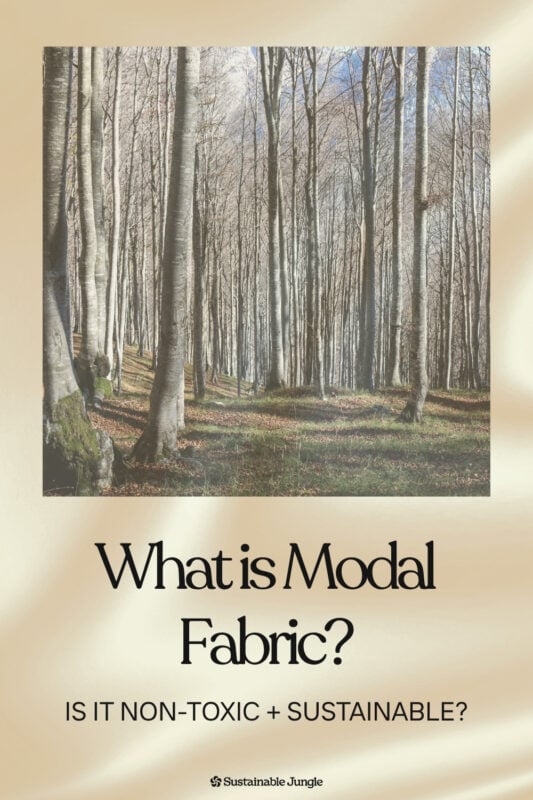
Modal is made from beechwood pulp, primarily from European beech (Fagus sylvatica). Beech trees are valued for modal production because they regenerate naturally (they don’t require replanting or irrigation) and can grow on land that isn’t suitable for food crops.
Because modal fibers are essentially regenerated wood cellulose, they’re naturally biodegradable. LENZING™ Modal standard fibers are certified by TÜV Austria as biodegradable in soil, freshwater, and marine environments, and compostable under both home and industrial conditions.
How Is Modal Made? (And How Does It Compare To Viscose?)
The modal production process is where both the sustainability story and the toxicity questions begin. Sounds nice and natural so far, right? Beechwood trees, regenerative forestry, soft fabric? Well, the raw wood fibers don’t stay natural for long, because turning stiff wood chips into silky-soft underwear requires some serious chemistry.
Modal uses a modified viscose process, which means it still involves some of the same chemistry as viscose, but with important improvements.
Here’s how it works, step by step.
Step 1: Wood pulp preparation
Beech trees are harvested and chipped into small pieces. The chips are cooked and chemically treated to separate cellulose from lignin and other compounds, then bleached and pressed into dissolving pulp sheets. At Lenzing’s integrated facility in Austria, pulp and fiber production happen at the same site, which saves energy and materials.
Step 2: Dissolving the cellulose
The dissolving pulp is steeped in sodium hydroxide (caustic soda) solution to create alkali cellulose. After aging, this material reacts with carbon disulfide (CS₂) in a process called xanthation. The resulting substance dissolves in more sodium hydroxide to create a deep orange, highly viscous solution, which is where viscose gets its name.
This is the step that raises the most questions, because carbon disulfide is a well-documented toxic chemical. We cover the toxicity question in detail in the next section.
Step 3: Fiber formation
The viscose solution undergoes ripening and deaeration, then gets forced through tiny holes called spinnerets into a sulfuric acid bath. This solidifies the filaments into long, continuous fibers. The fibers are then stretched, washed, and finished.
Modal fibers follow a similar path to viscose, but with specific modifications to the spinning solution and process settings that result in fibers with characteristically high wet strength. This is what makes modal stronger and more durable than standard viscose, and what separates it as a distinct fiber type.
Step 4: Chemical recovery (the closed loop)
This is where the quality of production matters enormously.
In older, open-loop viscose production, the chemicals used (particularly carbon disulfide and hydrogen sulfide gas) were released into the environment, causing serious harm to workers and surrounding communities. According to the ATSDR Toxicological Profile for Carbon Disulfide, the most common cause of mortality associated with exposed viscose rayon workers in historical studies was cardiovascular disease.
Modern closed-loop systems are designed to capture these gases and recover them for reuse rather than releasing them. According to Lenzing’s chemicals page, in their viscose and modal production, carbon disulfide and hydrogen sulfide gases “are not released into the environment but are recovered, converted and returned to the production process to be used as raw materials.”
How much gets recovered depends on the producer. Newer closed-loop technologies can recover 90-95% of the carbon disulfide used. Some sources indicate Lenzing’s TENCEL™ Modal process achieves up to 95% solvent recovery but we can’t find a clearly disclosed number directly published by Lenzing. This is a meaningful improvement over older open-loop processes, but it’s also worth noting that modal’s chemical recovery rate is lower than lyocell’s 99.8% NMMO recovery rate, because modal and lyocell use fundamentally different chemistry.
So what happens to the other 5-10%?
The unrecovered portion of carbon disulfide (and a related byproduct, hydrogen sulfide) is primarily released as air emissions. This is the main environmental output of viscose and modal production, and it’s significant enough that the ZDHC MMCF Guidelines specifically set limits on sulphur-to-air emissions and require facilities to report their recovery rates. The guidelines track this using a sulphur mass balance approach. The CS₂ added to the process is measured against the CS₂ (and other sulphur compounds) recovered, and the difference is what escapes to the atmosphere.
Once in the atmosphere, carbon disulfide has a relatively short lifespan. According to peer-reviewed research cited in the ATSDR Toxicological Profile, CS₂ has a 12 day lifetime in the atmosphere before breaking down. It doesn’t accumulate persistently in the way that greenhouse gases, forever chemical, or microplastics do.
However, the local impact can be meaningful. A 2022 study published in Atmospheric Pollution Research estimated global CS₂ emissions from the viscose fiber industry at approximately 577.9 gigagrams in 2017, with China (65.7%) and India (11.1%) accounting for the largest shares. The ATSDR has documented elevated carbon disulfide levels in communities near viscose production facilities.
For context, Lenzing’s integrated Austrian facility operates under EU environmental regulations, which are among the strictest in the world for industrial air emissions. The company has achieved ZDHC’s Progressive level for chemical management across its viscose and modal facilities, meaning it meets the highest tier of the industry’s chemical recovery, wastewater, and air emission standards. But not all modal producers operate under the same regulatory framework or invest in the same level of emission controls.
The bottom line is that even at 90-95% recovery, the unrecovered CS₂ from modal production is released into the air. At well-managed facilities in tightly regulated jurisdictions, these emissions are controlled and monitored. At facilities with weaker oversight, they can pose real risks to workers and surrounding communities.
So how does this compare to lyocell?
Modal uses a modified viscose process (sodium hydroxide + carbon disulfide). Lyocell uses an entirely different chemistry (NMMO, a non-toxic organic solvent) in a closed-loop process that recovers more than 99.8% of the solvent.
In plain language, modal is the improved second generation of the viscose family, while lyocell is the third generation built on completely different technology. Modal is better than standard viscose, but it still uses carbon disulfide, a chemical that lyocell avoids entirely.
So lyocell is more sustainable and less toxic than modal.
Is Modal Toxic? Is It Safe To Wear?
This is one of the fastest-growing questions about modal material (and a fair one given the chemistry involved). The short version: modal fabric is not toxic to wear, and it’s one of the safer fabrics for skin contact when sourced from a reputable, certified producer. But “safe to wear” and “made with totally harmless chemicals” are different questions so let’s discuss:
Is carbon disulfide toxic?
Yes, carbon disulfide (CS₂) is classified as a neurotoxin. According to the ATSDR’s Toxicological Profile (published by the U.S. Agency for Toxic Substances and Disease Registry), the documented health effects of occupational carbon disulfide exposure include peripheral neuropathy, cardiovascular disease, neuropsychiatric symptoms, and reproductive harm.
A peer-reviewed review published in the journal Critical Reviews in Toxicology examined decades of research on viscose rayon workers and found that the most important health effects of carbon disulfide exposure include coronary heart disease, retinal damage, effects on peripheral nerves, and psychophysiological effects. The review noted that occupational exposure limits vary between 1 and 10 ppm worldwide.
This is a real and serious occupational hazard in viscose and modal production. The risk is primarily to factory workers in facilities that lack proper chemical recovery and ventilation systems.
Does any carbon disulfide end up in the finished fabric?
This is the question that matters most for consumers. The evidence strongly suggests that the answer is effectively no.
Carbon disulfide is highly volatile (it evaporates readily at room temperature), and the fiber production process includes multiple washing, desulfurizing, and finishing steps that remove process chemicals from the finished fibers. By the time modal yarn reaches a textile mill, the cellulose has been thoroughly washed and the CS₂ has either been recovered in the closed loop or has evaporated during processing.
Finished TENCEL™ Modal from Lenzing carries OEKO-TEX® STANDARD 100 certification, which independently tests for harmful substances against criteria more stringent than most national regulations. The fibers also hold the EU Ecolabel for textile products. These certifications test the actual finished product, not just the production process, and they set strict limits on residual chemicals.
Does modal shed microplastics?
No. Modal is plastic-free. It’s made entirely from cellulose (wood) and contains no petroleum-derived polymers. According to a 2023 study published in PLOS ONE by researchers at the Scripps Institution of Oceanography, cellulose-based fibers (including Lenzing’s modal fibers) fully biodegraded on the seafloor and in closed bioreactors within 28 days, while polyester remained essentially intact.
That means modal doesn’t shed microplastics into waterways during washing, and it doesn’t leave persistent fragments behind at the end of life.
This of course assumes the modal is not blended with microplastic shedding fibers like polyester.
Is modal safe for sensitive skin?
Generally yes. Modal’s smooth fiber surface, high moisture absorbency, and breathability make it less irritating than rougher or synthetic fabrics. The lack of harsh chemical residues in certified modal (OEKO-TEX 100 tested) makes it suitable for sensitive skin, and it’s also naturally less hospitable to odor-causing bacteria.
So is modal non-toxic overall?
For the wearer, yes, when it comes from a certified producer like Lenzing. The key caveats mirror those for lyocell:
- Blends matter. A “modal” garment blended with elastane, polyester, or nylon will shed microplastics from those synthetic components, even if the modal portion doesn’t.
- Dyes and finishes matter. The base fiber being clean doesn’t mean the final garment is, if it’s been dyed with heavy metals or treated with formaldehyde-based wrinkle-release finishes. Look for OEKO-TEX 100 certification on the finished garment (not just the fiber).
- Generic modal varies. Not all modal is made by Lenzing, and some producers in regions with weaker environmental regulation have less robust chemical recovery and worker safety standards.
Production chemistry is different from wearer safety. Carbon disulfide is genuinely dangerous for factory workers exposed to it, and the history of the viscose industry includes well-documented harm. Modern closed-loop systems have dramatically reduced this risk at responsible facilities.
Is Modal Fabric Sustainable?
Is modal a good fabric from a sustainability perspective? The answer, as with most things in sustainable fashion, is that it really depends on who made it. Here’s a few considerations from a sustainability perspective:
Beech Tree Sourcing
Modal starts with beech trees, so the first question is whether those trees are logged responsibly. According to Canopy’s 2024 Hot Button Report, three companies tied for the top “dark green shirt” rating: Lenzing (Austria), Aditya Birla (India), and Tangshan Sanyou (China). In other words, these producers represent leadership in eliminating ancient and endangered forests from their supply chains.
Lenzing sources its beechwood from FSC® or PEFC™ certified forests under its Wood and Pulp Policy. Beech trees regenerate naturally after harvesting (they don’t require replanting), require no irrigation, and can grow on land unsuitable for food crops.
Modal made by non-rated producers might not have the same sustainable sourcing approach. The viscose supply chain (which includes all fabrics of the viscose family, modal included) has been linked to logging in tropical rainforest areas, which is why forestry certifications matter.
Water & Carbon Impact
According to the Higg Materials Sustainability Index data referenced on Lenzing’s TENCEL™ Modal page, TENCEL™ Modal has a significantly lower environmental impact than generic modal: up to 60% lower water consumption, up to 71% lower global warming potential, and up to 68% lower fossil fuel depletion.
Lenzing’s integrated production facility in Lenzing, Austria, manufactures both pulp and modal fiber at the same site. The pulp production is energetically self-sufficient while supplying a significant amount of bioenergy for the entire fiber production process. According to Lenzing’s 2024 Annual and Sustainability Report, Lenzing’s modal fibers generate around 70% less greenhouse gas emissions in production than generic modal fibers.
Biodegradability and End-Of-Life
LENZING™ Modal standard fibers are certified by TÜV Austria as biodegradable in soil, freshwater, and marine environments, and compostable under both home and industrial conditions, as confirmed by Lenzing using independent testing by Organic Waste Systems (OWS) in Belgium and verified by TÜV Austria.
The 2023 Scripps Institution of Oceanography study published in PLOS ONE confirmed that Lenzing’s modal fibers biodegraded fully in marine conditions.
But this only applies to 100% modal garments (or 100% cellulosic blends). Blend it with polyester or elastane and the biodegradability claim collapses, because the synthetic components won’t break down.
What about the chemical footprint?
Modal’s modified viscose process is cleaner than standard viscose, but it’s not as clean as lyocell. The carbon disulfide chemistry is the main concern, and while modern facilities recover the vast majority of it, modal production will always carry a higher chemical burden than lyocell production.
For brands and consumers who want the absolute lowest chemical footprint in a semi-synthetic cellulosic fiber, lyocell is the better choice. But modal material has properties that lyocell doesn’t, including superior softness retention through washing so if choosing modal, TENCEL™ Modal from Lenzing is the best, most sustainable option.
Modal Advantages & Disadvantages
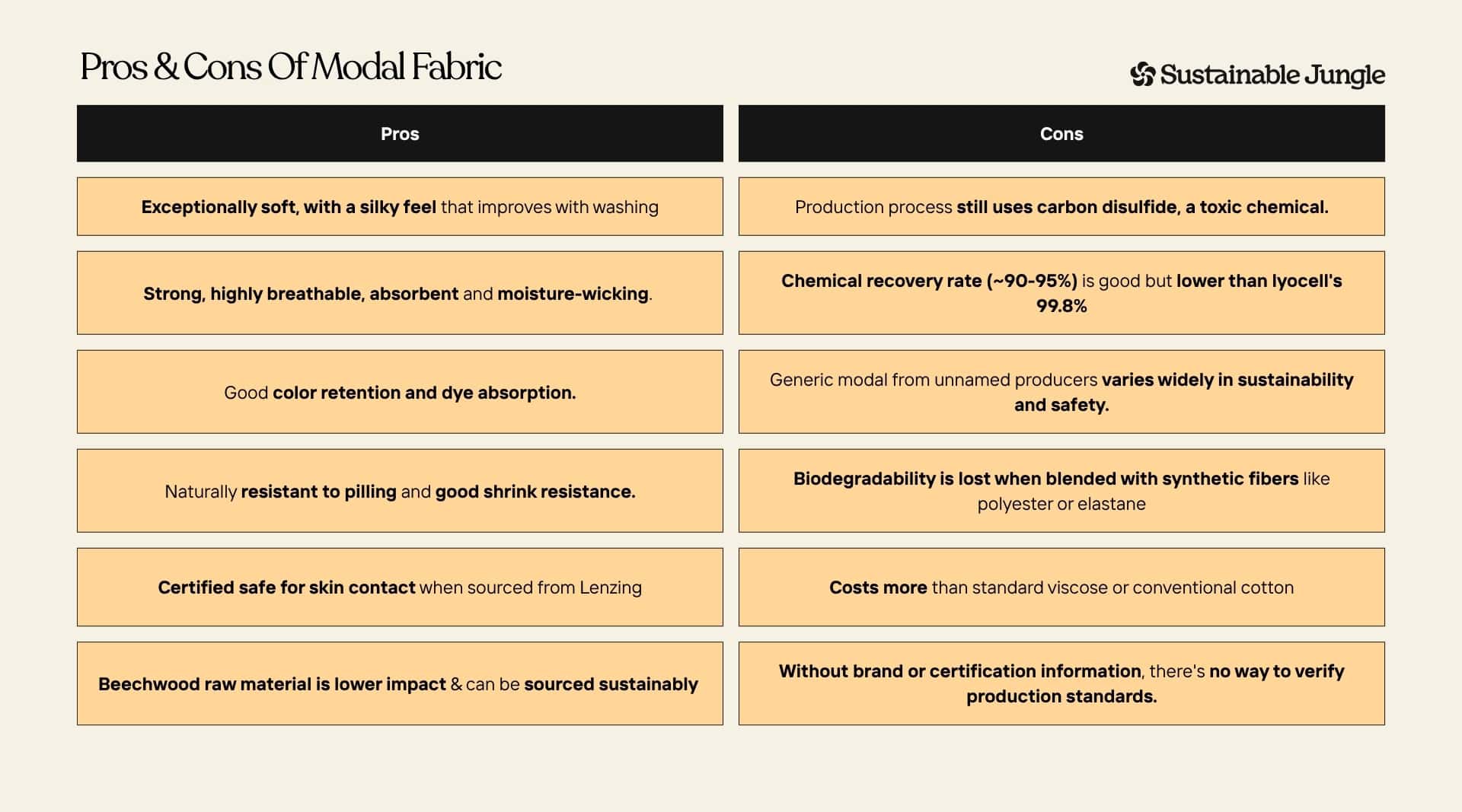
Here are the key pros and cons of modal fabric:
Advantages of modal fabric:
- Exceptionally soft, with a silky feel that improves with washing
- Highly breathable and moisture-wicking (ideal for underwear, sleepwear, and activewear)
- About 50% more absorbent than cotton
- Stronger when wet than standard viscose or rayon
- Good shrink resistance
- Biodegradable and compostable (100% modal)
- Plastic-free (no microplastic shedding during washing)
- Good color retention and dye absorption
- Naturally resistant to pilling
- Certified safe for skin contact when sourced from Lenzing
- Beechwood raw material is lower impact & sourced sustainably (by Lenzing)
Disadvantages of modal fabric:
- Production process still uses carbon disulfide, a toxic chemical
- Chemical recovery rate (~90-95%) is good but lower than lyocell’s 99.8%
- Generic modal from unnamed producers varies widely in sustainability and safety
- Biodegradability is lost when blended with synthetic fibers like polyester or elastane
- Costs more than standard viscose or conventional cotton
- Without brand or certification information, there’s no way to verify production standards
What Is Modal Used For?
Modal is genuinely versatile, but it really shines in applications where softness, moisture management, and next-to-skin comfort matter most.
- Underwear: One of the most popular uses. Modal’s softness, breathability, and moisture-wicking make it a top choice for ethical underwear and sustainable men’s underwear
- Sleepwear and loungewear: Sustainable pajamas and loungewear frequently use modal, often blended with organic cotton
- Activewear: Its stretch, breathability, and odor resistance make it suitable for ethical activewear and sustainable yoga clothes
- Bedding: Sustainable bedding brands use modal for sheets and duvet covers, prized for thermoregulation
- Everyday clothing: T-shirts, dresses, scarves, and casual wear
What Does Modal Feel Like?
Silky, smooth, and cool against the skin. Modal has a subtle sheen and drapes beautifully. It’s often described as feeling like a softer, lighter version of cotton with a touch of silk’s smoothness. The cross-section of TENCEL™ Modal fibers is specifically engineered to favor fabric softness, according to Lenzing’s technical data.
Is Modal Stretchy?
Modal has a natural flexibility and good recovery, which is why it works well in fitted garments. But it’s not highly elastic like spandex. For high-stretch applications (leggings, fitted activewear), it’s usually blended with a small percentage of elastane.
Is Modal Breathable?
Modal efficiently absorbs and releases moisture, supporting a drier microclimate against the skin. This moisture management also makes it naturally less hospitable to odor-causing bacteria, which is why modal garments often need fewer washes.
How To Wash Modal Material
Modal is more forgiving than standard viscose (which can be a diva in the wash), but a bit of care still goes a long way.
- Wash cold on a gentle cycle, or hand-wash. Cold water protects the fibers and uses less energy.
- Skip the dryer where possible. Hang dry instead. This is gentler on the fibers and helps maintain softness. More sustainable too 🙂
- Use a mild eco-friendly detergent. Avoid bleach and harsh enzymatic cleaners.
- Iron on low if needed, but modal resists wrinkles well so ironing is rarely necessary.
Does Modal Shrink?
Modal has good dimensional stability and shrinks far less than cotton, especially when washed cold. But hot water and tumble drying may cause some shrinkage.
Does Modal Wrinkle?
Modal resists wrinkles better than cotton or linen, and it drapes well without creasing. It’s one of the lower-maintenance fabrics in terms of wrinkle care.
Does Modal Pill?
Modal material is naturally resistant to pilling, which is one of its advantages over cotton and some other cellulosic fibers. It maintains a smooth surface through repeated wear and washing.
Modal Vs. Cotton, Viscose, Lyocell & Polyester
Modal Vs. Polyester
Polyester is petroleum-derived, sheds microplastics. In other words, it’s a synthetic through and through. Modal is derived from plants, it’s fully biodegradable, and does not shed microplastics.
Polyester is generally far cheaper and is more durable. Modal is also far more breathable and moisture-absorbent, which is why it outperforms polyester in many clothing applications.
Modal Vs. Cotton
Cotton is 100% natural and modal is made with chemical processing. Modal is about 50% more absorbent than cotton, softer, more wrinkle-resistant, and shrinks less.
From a sustainability perspective, modal (when produced by Lenzing) requires significantly less water and land than conventional cotton. It’s competitive with organic cotton on water and land use, though organic cotton is better for processing simplicity since it doesn’t require chemical dissolution.
Modal Vs. Lyocell
Lyocell uses a non-toxic solvent (NMMO) in a closed-loop process with 99.8% solvent recovery. Modal uses a modified viscose process with carbon disulfide and achieves roughly 90-95% chemical recovery. Lyocell has a lower environmental and chemical footprint overall.
However, modal has properties that lyocell doesn’t match. Modal is softer and retains its softness better through repeated washing. Lyocell is stronger (particularly when wet) and has a lower environmental impact.
Modal Vs. TENCEL™
TENCEL™ is Lenzing’s brand name that covers both lyocell and modal fibers. So TENCEL™ Modal is simply Lenzing’s branded version of modal. All TENCEL™ Modal is modal, but not all modal is TENCEL™. Generic modal from other producers may use different (and potentially less sustainable) production methods.
Modal Vs. Viscose
Both are made from a type of wood pulp and both use a variant of the viscose process, but modal is the improved version. Modal material uses less sodium hydroxide, has higher chemical recovery rates, and produces a stronger, lighter, more durable fiber.
Standard viscose is cheaper but uses more toxic chemicals and generates significantly more waste. We recommend avoiding generic viscose from unknown producers.
Key Players: Who Makes Modal?
Knowing who made your modal matters more than almost anything else. Think of it this way: “modal” without a producer name is like “wine” without a region. It could be excellent, or it could be questionable. Here are the key modal producers:
Lenzing AG (Austria)
The original developer and the dominant producer of branded modal. Lenzing produces modal at its integrated facility in Lenzing, Vöcklabruck, Austria, which has a capacity of 284,000 tonnes of viscose and modal.
The integrated plant produces both pulp and fiber on-site, powered significantly by bioenergy from the biorefinery process. Lenzing markets its modal as TENCEL™ Modal (for textiles) and LENZING™ Modal (for nonwoven and industrial applications).
Aditya Birla Group / Birla Cellulose (India)
A major global MMCF producer that manufactures modal alongside viscose. Birla Cellulose has held Canopy’s top ranking in the Hot Button Report for five consecutive years and operates closed-loop facilities.
Tangshan Sanyou (China)
Also earned Canopy’s dark green shirt rating in 2024.
Other producers
These include various manufacturers in China, India, Indonesia, and Pakistan, some with significantly less robust sustainability credentials. The 2024 Hot Button Report found that 71% of rated MMCF producers achieved green shirt status or higher, representing 53% of the global supply. This means a substantial portion of global modal and viscose production still comes from producers with lower ratings.
What about MicroModal?
MicroModal is a finer, softer version of modal made through the same chemical process but with a finer fiber denier. It’s produced by Lenzing and marketed as TENCEL™ Modal with Micro technology. The sustainability and toxicity profile is the same as standard modal.
Certifications to look for in modal products
- EU Ecolabel:The European Union’s official environmental label, awarded to TENCEL™ Modal fibers. See Lenzing’s certifications page.
- OEKO-TEX® STANDARD 100: Tests for harmful substances in finished textiles. See our OEKO-TEX guide for details on what it covers.
- FSC® and PEFC™: These certify that wood comes from responsibly managed forests.
- TÜV Austria biodegradability and compostability certifications: Verify that the fiber biodegrades in soil, freshwater, and marine environments.
- Canopy Hot Button Report dark green shirt: The highest rating for forest sourcing responsibility.
- USDA BioPreferred® Program: Certifies that the product is made from renewable biological ingredients.
Industry bodies and initiatives
- Canopy: Rates MMCF producers on forest sourcing (Hot Button Report)
- ZDHC (Zero Discharge of Hazardous Chemicals): Sets chemical management standards for MMCF facilities, including modal
- Textile Exchange: Tracks fiber market data and sustainability benchmarks
How To Identify Sustainable Modal Material
- Look for “TENCEL™ Modal” (or equivalent): Generic “modal” tells you nothing about who made it or how. The TENCEL™ brand indicates Lenzing production with its specific sustainability standards.
- Check the sustainability of the blend: “100% modal” is biodegradable. But even a small percentage of synthetic fiber makes it a microplastic problem (see our guide to microfiber filters).
- Certifications on the finished garment: OEKO-TEX 100 on the finished garment is better than on the fiber, because it also covers dyes and finishes.
- Transparency: Brands sourcing from Lenzing usually name their supplier. Vagueness about fiber sourcing is a red flag.
- Be cautious with “modal” from fast fashion: The cheapest modal on the market almost certainly didn’t come from a producer with a dark green Canopy rating. If the price seems too good to be true, the sustainability probably is too.
For more on finding the most sustainable products and fibers, see our guide to reading clothing tags and our greenwashing guide.
Modal Fabric FAQs
Is modal a natural fiber?
Not exactly. Modal is classified as semi-synthetic (or a regenerated cellulosic fiber). The raw material is natural (beechwood), but producing the fiber requires chemical processing that fundamentally transforms the cellulose. Think of it as sitting between cotton (fully natural) and polyester (fully synthetic) on the spectrum.
Is modal fabric plastic?
No. There’s no petroleum in modal. It’s derived entirely from wood cellulose, which means it won’t shed microplastics when you wash it and it will biodegrade at end of life, unlike polyester or nylon.
Is modal fabric toxic?
The finished fabric is safe to wear, depending on who makes it. TENCEL™ Modal carries OEKO-TEX 100 certification, which independently verifies that the fiber meets strict limits for harmful substances. The concern with modal is the production side in that the process uses carbon disulfide, a known neurotoxin. At modern facilities with closed-loop recovery systems, 90-95% of it is captured and reused. The unrecovered portion is released as air emissions, which is why the producer and their regulatory environment are very important from a toxicity perspective.
Is modal biodegradable?
Yes, provided it’s 100% modal (or blended only with other cellulosic fibers). LENZING™ Modal standard fibers hold TÜV Austria certification for biodegradability in soil, freshwater, and marine environments, plus compostability under home and industrial conditions. Add polyester or elastane to the blend, though, and that certification no longer applies.
Is modal good for underwear?
It’s one of the best fabrics for it. Modal absorbs about 50% more moisture than cotton, stays soft wash after wash, and resists odor-causing bacteria naturally. That combination of softness, breathability, and moisture management is why so many underwear brands have adopted it.
Is modal better than cotton?
They each have strengths. Modal wins on softness, moisture absorption, wrinkle resistance, and shrink resistance. When produced by Lenzing, it also uses less water and land than conventional cotton. But cotton (especially organic) has a simpler, more transparent production chain that avoids toxic solvents altogether. The best choice depends on what matters most to you.
Does modal shrink in the wash?
Modal holds its shape well, particularly if you wash it cold on a gentle cycle. It’s noticeably more stable than cotton in this regard. Tumble drying on high heat is the main thing to avoid as some shrinkage can happen.
Is modal material good for summer?
Absolutely. It’s lightweight, breathes well, wicks moisture away from the skin, and feels cool to the touch. It’s ideal for warm-weather basics and sleepwear.
What is the difference between modal and TENCEL™?
TENCEL™ is Lenzing AG’s brand name, and it covers both their modal and lyocell fibers. So TENCEL™ Modal is Lenzing’s branded modal, produced at their integrated Austrian facility with specific sustainability standards and certifications. Generic “modal” on a label could come from any producer, and the sustainability credentials may be very different.
Final Thoughts On Modal Material
Modal is a material that occupies an interesting middle ground in the sustainable textile universe. It’s the darling of the underwear drawer because it’s softer and more comfortable than almost any other cellulosic fiber, with biodegradability credentials backed by independent testing and peer-reviewed marine science.
But modal isn’t without its knots (pun intended). The modified viscose process still relies on carbon disulfide, a chemical with a well-documented history of harming factory workers when poorly managed. Modern closed-loop systems have dramatically reduced the risk, and Lenzing’s integrated Austrian facility meets the highest tier of ZDHC’s chemical management standards. Still, the 5-10% of CS₂ that escapes as air emissions is a chemical impact that lyocell’s NMMO process avoids altogether.
So where does that leave the conscious consumer? We’d put it like this. TENCEL™ Modal is a strong choice if you’re after that particular silky softness that only modal delivers. The production is cleaner than standard viscose by a wide margin, the beechwood sourcing is independently audited, the finished fiber is certified safe for skin contact, and it will biodegrade when you’re done with it (assuming you haven’t blended it with polyester).
But we’d recommend avoiding modal that has no producer or certification information. And where you can, choose lyocell over modal.
If this guide helped unravel the modal mystery for you, share it with someone who’s been wondering what that silky fabric tag actually means. The more people understand what goes into their clothes, the better choices we can all make.
Editor’s Note: This article was originally published May 2020. It has been updated April 2026 with a new in-depth section on modal toxicity and wearer safety, with citations to peer-reviewed research on carbon disulfide; expanded explanation of the modified viscose process and how it compares to lyocell’s NMMO process; updated Lenzing chemical recovery data; a new quick-glance pros and cons section; new comparisons with lyocell and polyester; an expanded “Key Players” section reflecting Canopy’s 2024 Hot Button Report; and more.

Joy has been a passionate advocate for the environment since she was a small child. She grew up in South Africa and has been lucky enough to be exposed to the wonders of nature not just in Africa but all over the world. She founded Sustainable Jungle (together with her husband Lyall) back in 2017 after becoming enraged by the devastating impact of palm oil. She then founded the Sustainable Jungle Podcast and together with Lyall interviewed remarkable people from all over the world who were finding ways to create positive impact. Outside of Sustainable Jungle, Joy has always worked in the corporate world, starting out as an auditor and later moving into management consulting. More recently she specialized in Climate Investing for the Asia Pacific region. Given her experience, her current passion is Brand Ratings. She is very much enjoying going deeper on what it really means to drive sustainability performance and true impact through business operations.










Am new in fabrics world, thanks to modal !
I bought a t shirt, and the moment i wore it, i liked the feeling of it on my skin.. so soft and cool. I then started to search about this fabric, getting to know more. This article is so useful and fruitful of information, I’m happy that i found your page.. cheers!
My main concern about modal rayon would be shrinking. I’ve not had very good luck with rayon garments, they have been a waste of good money because of them shrinking 😬
So glad to hear about Modal. I’m impressed with Lenzings’ ethics and processes. I have some Modal pj’s and they feel wonderful! They have all the attributes listed above. I don’t know yet who made the cloth, but I will be looking into that, as well as the clothing sources referenced in this article. Thank you, Lenzing, for what you are doing for planet Earth!
I’ve recently bought a modal nightie to try to combat hot and cold ight sweats. I had a nightie especially for menopausal women before, but I found a thin cotton nightie was better, but didn’t wick moisture, and I wanted a fabric more sustainable than cotton. The modal nightie is the best! I am not waking up in the night and it’s sooo comfy! I love this fabric.
Great to hear Carol!
I’m buying a scarf that’s 90% modal and it says dry clean only. This article says it’s not good for the fabric to dry clean. I’m totally confused.
That is confusing! Would recommend sticking to the manufacturer’s instructions Julia!
Would have liked to know the names of brands that use Lenzing Modal.
Thanks for the feedback Janita, we’ll look to include a list when we next refresh the article. In the meantime, we feature tons of brands on our site that use modal, suggest using our search function to take a look 🙂
I thought I knew about fabrics but was stumped on Modal!! This information is excellent tells you all you need to know thank you.