













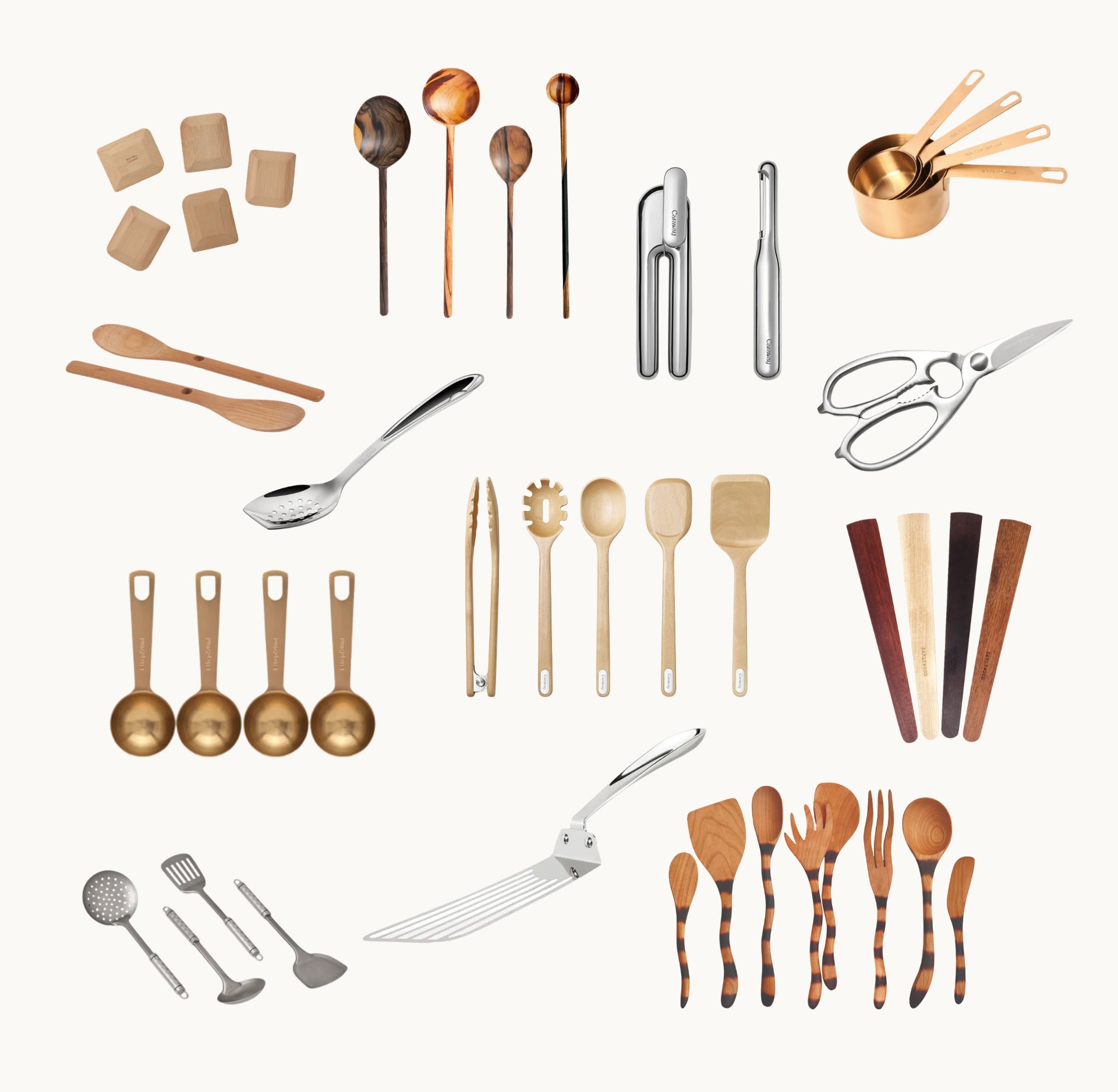
You’re careful about what goes into the pan. Organic veggies, pastured eggs, the good olive oil.
But what about the tools touching all that food?
Turns out, many common kitchen utensils are quietly contaminating the very meals we’re trying to keep clean. Black plastic spatulas can contain flame retardants linked to cancer and hormone disruption. Nylon turners shed microplastics with heat and friction. Even some wooden spoons come coated in mystery lacquers nobody can identify.
Swapping to non-toxic cooking utensils is one simple change you can make in the kitchen. We’re talking wood, stainless steel, bamboo, and titanium: materials that have been feeding families safely for centuries (well, maybe not titanium, but you get the idea).
What We Looked For
- Materials free from BPA, PFAS, phthalates, and chemical coatings
- Natural finishes like beeswax, mineral oil, or food-safe varnish (no mystery lacquers)
- FSC-certified or responsibly sourced wood
- Stainless steel that meets food-grade standards (18/10 or higher)
- Brands with transparent supply chains and sustainability practices
- Durability (we want buy-it-once utensils, not landfill-bound ones)
Our Research, Ratings & Reviews
We researched and reviewed over a dozen non-toxic cooking utensil brands, comparing materials, certifications, sourcing, and real-world performance. For brands we work with through our sustainability rating system, we evaluate initiatives across 22 criteria. See rated brands in our sustainable brand directory.
We personally tested the Caraway beechwood utensil set and have hands-on experience with Our Place cookware accessories. Where we haven’t tested a product firsthand, we say so.
Related Guides: Non-Toxic & Sustainable Cookware, Non-Toxic Cutting Boards, Sustainable Kitchen Products, Sustainable Cutlery Sets, Non-Toxic Dish Soap, Non-Toxic Food Storage, What Are Forever Chemicals (PFAS)?, How To Avoid Microplastics, Is Stainless Steel Non-Toxic?
We independently research all featured brands, and we ask them to confirm their claims. In many cases we personally review recommended products. This post contains affiliate links which means we may earn a commission if you buy something. We explain this further in our Terms of Use.
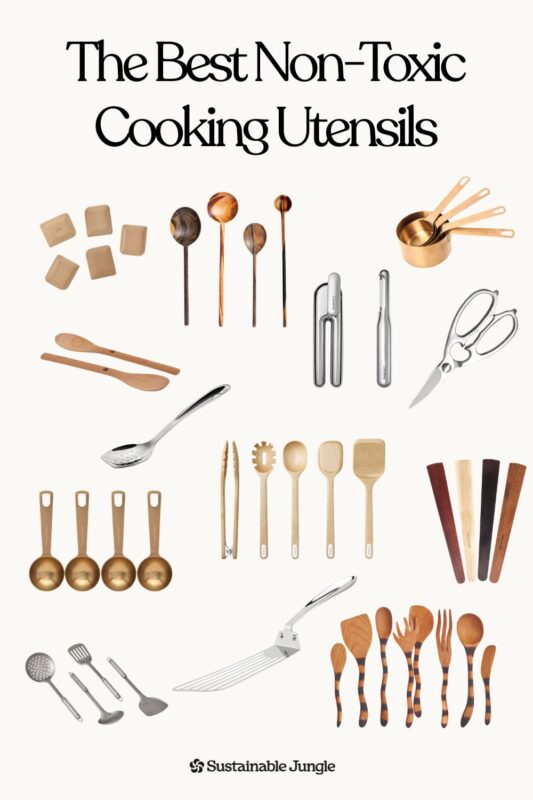
The Best Non-Toxic Cooking Utensils
Best wooden utensil set | Caraway | FSC-certified birch wood, named one of TIME’s Best Inventions of 2024, third-party tested for 200+ PFAS types. And tested by Sustainable Jungle.
Best made in USA | Earlywood | Heirloom-quality hardwood utensils handcrafted in Montana with a lifetime guarantee and reforestation commitment.
Best bamboo utensils | Bambu | Certified B Corp making FSC-certified bamboo utensils from single pieces of wild-grown bamboo, free of glues or lacquers.
Best stainless steel utensils | All-Clad | Premium 18/10 stainless steel utensils from one of the most trusted names in professional kitchenware.
Best multi-material kitchen tools | Our Place | Beechwood utensils and German stainless steel knives alongside their well-known cookware line.
Best artisan wooden utensils | Itza Wood | Handcrafted from sustainably harvested exotic woods in Guatemala, with a social impact story that’s as beautiful as the grain.
Best handcrafted spoons | Jonathan’s Spoons | Over 40 years of hand-carving cherry wood utensils in Pennsylvania, including left-handed designs.
Best beechwood set | Seed & Sprout | FSC-certified and LFGB-approved beechwood finished with natural beeswax, biodegradable at end of life.
Best titanium utensils | Taima Titanium | Pure titanium utensils that are lightweight, non-reactive, and naturally antibacterial.
Table of contents: The Best Non-Toxic Kitchen Utensils
- Caraway Jump to section
- Earlywood Jump to section
- Bambu Jump to section
- All-Clad Jump to section
- Our Place Jump to section
- Itza Wood Jump to section
- Jonathan's Spoons Jump to section
- Seed & Sprout Jump to section
- Taima Jump to section
Caraway
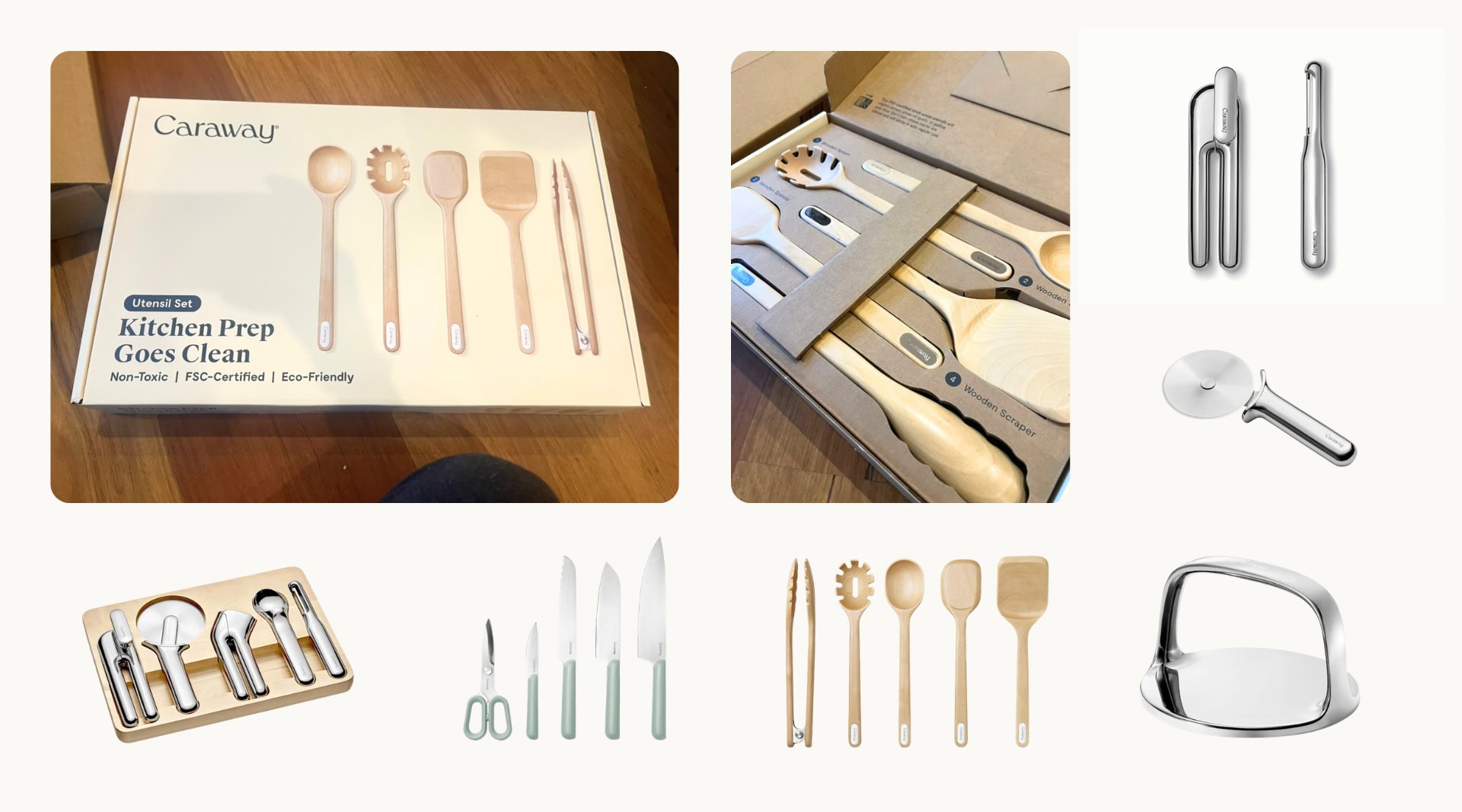
Caraway’s Plastic-Free Cooking Utensils
Caraway has built a reputation for non-toxic kitchen tools that look as good as they perform, and their wooden utensil set is no exception. Named one of TIME’s Best Inventions of 2024, the 5-piece set includes a spoon, server, scraper, spatula, and tongs, all designed to fit with their ceramic cookware.
- Material: FSC-certified birch wood with a food-safe varnish
- What’s included: 5-piece set (spoon, server, scraper, spatula, tongs) with storage organizer. Also available as a 9-piece set with mini utensils.
- What makes it non-toxic: Third-party tested for PFAS and heavy metals. Free of plastics, BPA, BPS, and forever chemicals. Complies with California’s AB1200.
- Where it’s made: Manufactured in BSCI-certified factories, packaged with recycled materials and low-impact dyes
- What we love: Every edge, curve, and angle is shaped to fit the slopes and corners of cookware, so there’s no awkward scraping or food left behind. They’re also gentle on all cooking surfaces, including ceramic non-stick. Plus, Caraway has expanded into a full stainless steel kitchen gadgets line (peeler, can opener, garlic press, pizza wheel, and bottle opener) for those who want a completely plastic-free kitchen toolkit.
- Price: ~$145 for the 5-piece birchwood set; various bundles available
Performance Review of the 5-piece Birchwood Cookware Utensil Set
“We’ve been testing Caraway’s 5-piece birchwood utensil set for about three months now, and at least one item gets used almost every day, mostly the spatula and spoon for actual cooking. They work beautifully and look elegant doing it. The one adjustment? They’re trickier to clean than the old plastic (toxic) utensils we used to toss in the dishwasher without a second thought, since these need to be hand-washed. We’ve accidentally put them through the dishwasher a couple of times (don’t do that), and they survived fine, though I’m conscious they’re due for a re-oil as a result. Overall, we’re very happy with the set. I do like having a stainless steel spatula on hand for more precision jobs like pancakes, which I think works better than wood for that purpose. But for everyday cooking (stir fries, bolognese, the usual), Caraway’s spatula handles it well. The tongs add an elegant but functional touch to serving salad, and the server is perfect for staples like pasta.”
Review by Joy McConnochie, SJ Co-Founder
Earlywood
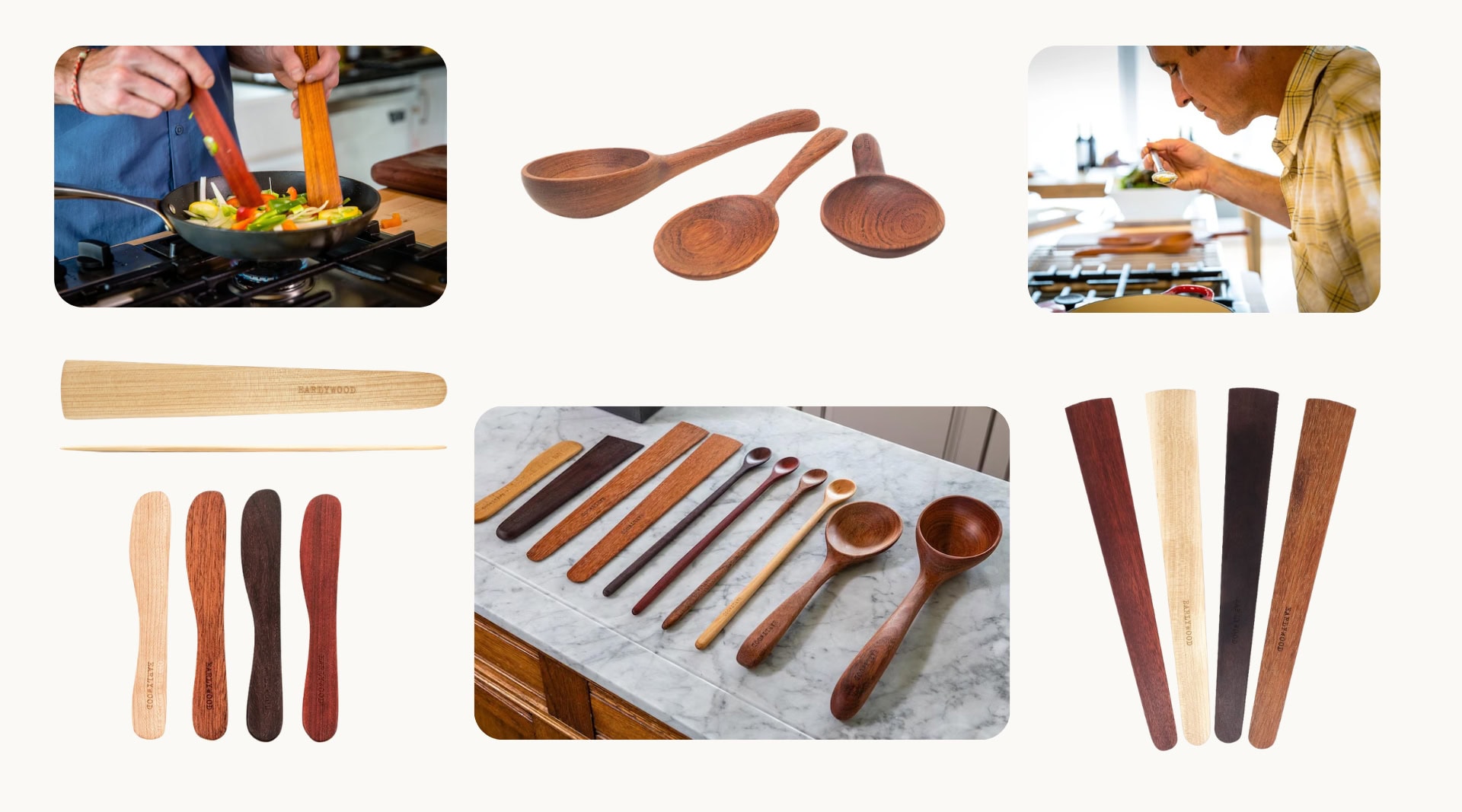
Earlywood’s Eco Cooking Utensils
For those who want their non-toxic cooking utensils made in the USA, Earlywood is a standout. Founded by mechanical engineer-turned-woodworker Brad Bernhart at the base of Montana’s Beartooth Mountains, every utensil is handcrafted from ethically sourced hardwoods and backed by a lifetime guarantee.
- Material: Jatoba, maple, bloodwood, Mexican ebony, and ironwood (selected for durability in kitchen use)
- Varieties: Flat sauté spatulas, scrapers, spreaders, tongs, spoons, ladles, plus rolling pins and baby spoons
- What makes it non-toxic: All-natural hardwoods finished with 100% food-safe mineral oil. No coatings, no chemicals.
- Where it’s made: Handcrafted in Red Lodge, Montana, USA
- What we love: Earlywood’s designs are deliberately minimalist, stripping away unnecessary features to let form follow function. Their scraper, for example, doesn’t look like a traditional wooden spoon, but it handles 99% of what you’d use a wooden spoon for (and more). The hardwoods they select are among the densest available, meaning these tools won’t crack, splinter, or warp. They also contribute $1 from every order to the Nature Conservancy’s Plant a Billion program.
- Price: Individual utensils from ~$15; $271 for their full set
Bambu
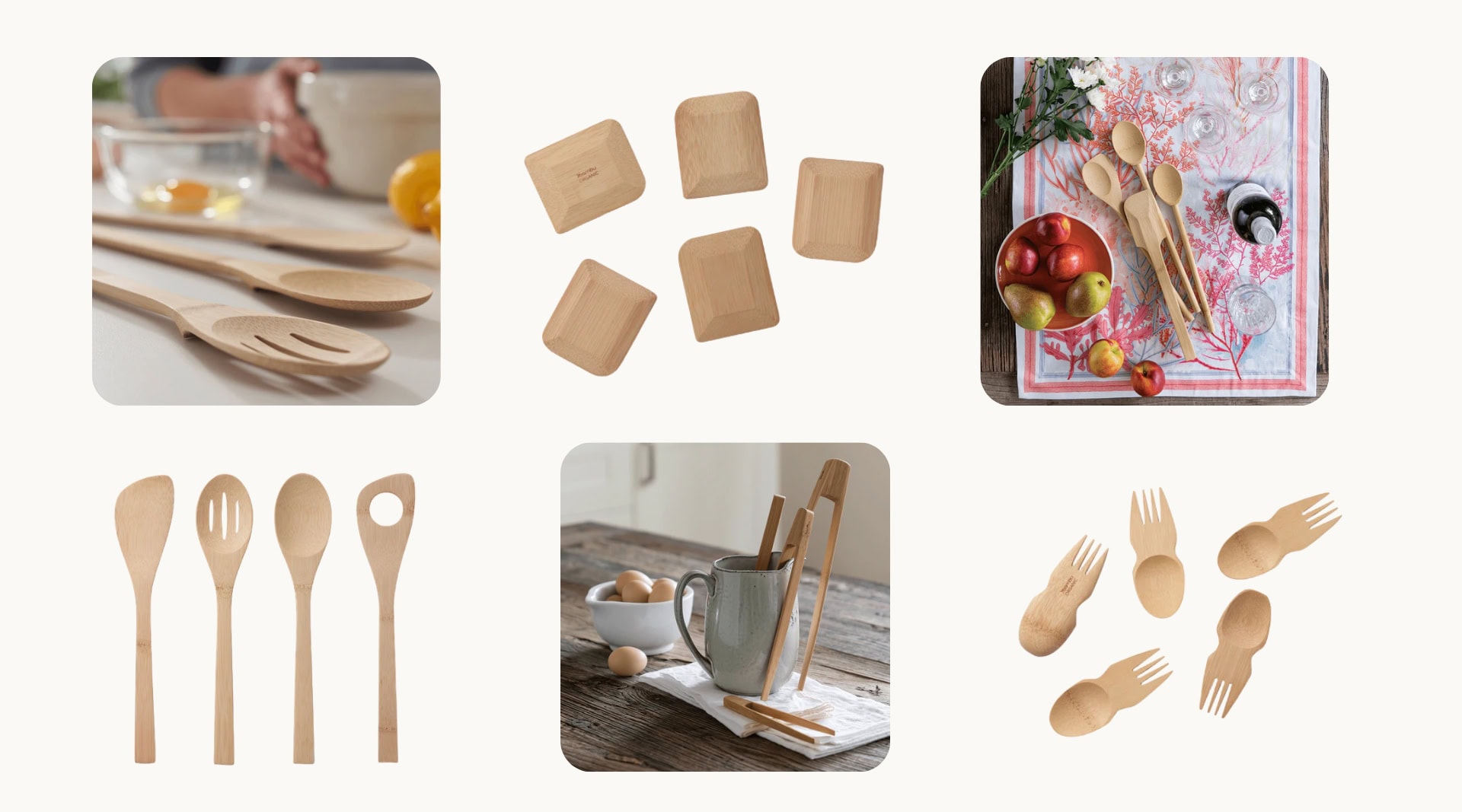
Bambu’s Toxin-Free Cooking Utensils
If certifications were currency, Bambu would be one of the wealthiest brands on this list. They’re a Certified B Corp, Biobased certified, a member of 1% for the Planet, and women-owned. But what we really love is the simplicity of their products: each utensil is crafted from a single piece of FSC-certified wild-grown bamboo.
- Material: FSC-certified 100% bamboo (single piece, no joins)
- Varieties: Cooking utensil sets, individual spoons, spatulas, spreaders, their patented Give It a Rest line, plus outdoor/disposable options
- What makes it non-toxic: Free of glues, lacquers, or chemicals of any kind. Finished with a plant-based food-grade finishing oil
- Where it’s made: Bamboo sourced from the Fujian Province of China. Produced in BSCI (Business Social Compliance Initiative) certified factories.
- What we love: The patented Give It a Rest line uses the natural shape of bamboo to form a “bump” that lifts the utensil edge off the countertop. No more sauce splotches. Bambu utensils are also incredibly durable (they claim decades of life with proper care) and fully compostable at end of life.
- Price: Starting from ~$8 for individual utensils; ~$33 for a 4-piece set
All-Clad
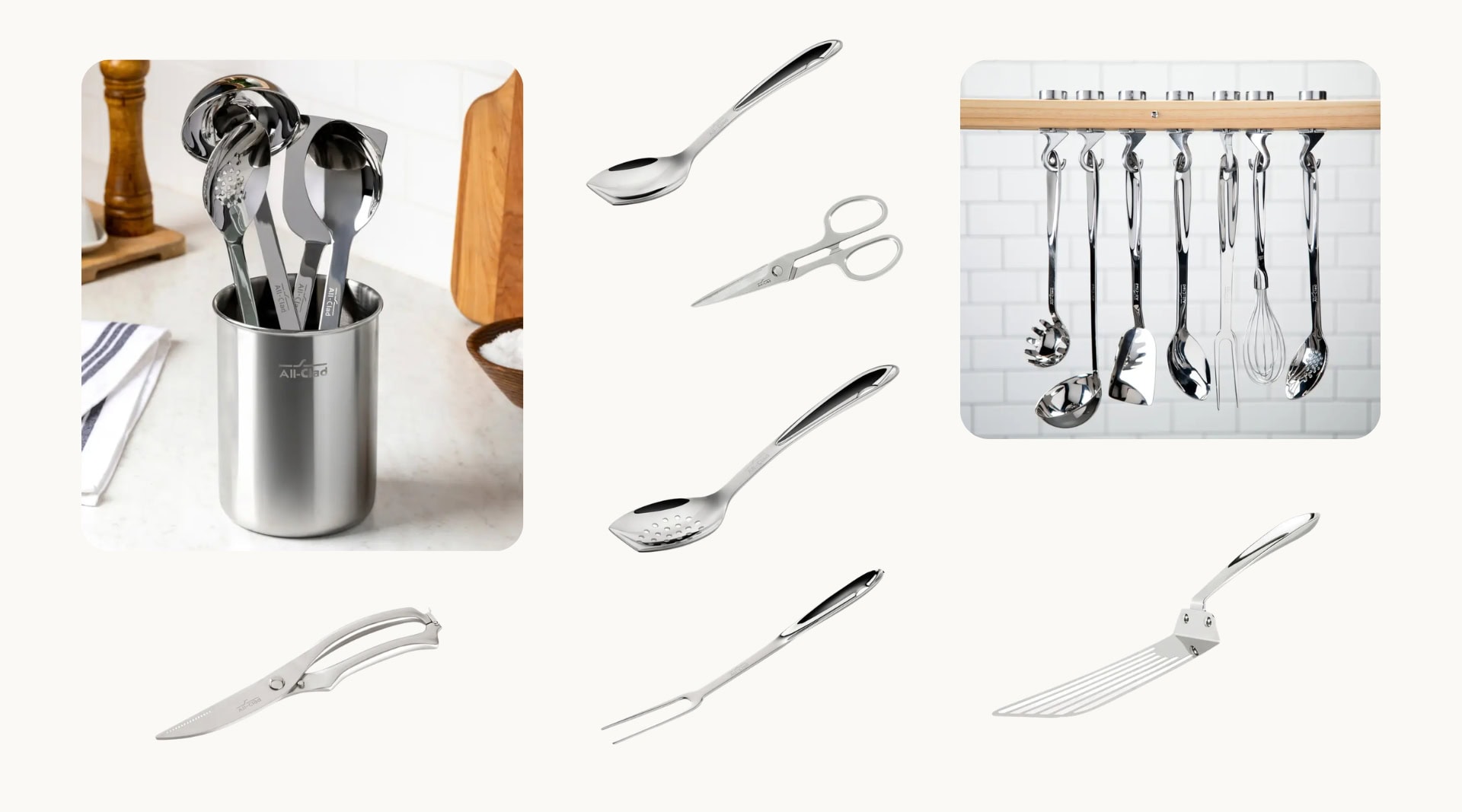
All Clad’s Non-toxic Stainless Steel Cooking Utensils
When it comes to non-toxic stainless steel cooking utensils, All-Clad is the name that keeps coming up. The brand has been making professional-grade kitchenware since 1971, and their utensil line brings the same quality standards to your everyday cooking tools.
- Material: 18/10 stainless steel (food-grade)
- Varieties: Comprehensive range including 100% stainless steel utensils including cooking spoons, slotted spoons, ladles, turners, tongs, pasta forks, spatulas, and whisks. Available individually or in sets.
- What makes it non-toxic: 18/10 stainless steel is non-reactive, non-porous, and free from chemical coatings. No BPA, PFAS, or plastics.
- Where it’s made: All-Clad’s cookware is famously made in Canonsburg, Pennsylvania, but their utensils and tools are manufactured overseas in partner factories, predominantly in China.
- What we love: The single-piece construction for some pieces (no plastic handles or joints where bacteria can hide) means these are built to last decades. Stainless steel is also fully recyclable at end of life, making it one of the most sustainable material choices for utensils that see heavy use. They’re dishwasher safe and essentially maintenance-free. One caveat: stainless steel utensils can scratch non-stick and ceramic cookware surfaces, so pair them with wooden or bamboo utensils if you cook with ceramic-coated pans.
- Price: Individual utensils from ~$25; 8-piece set is ~$300
Our Place
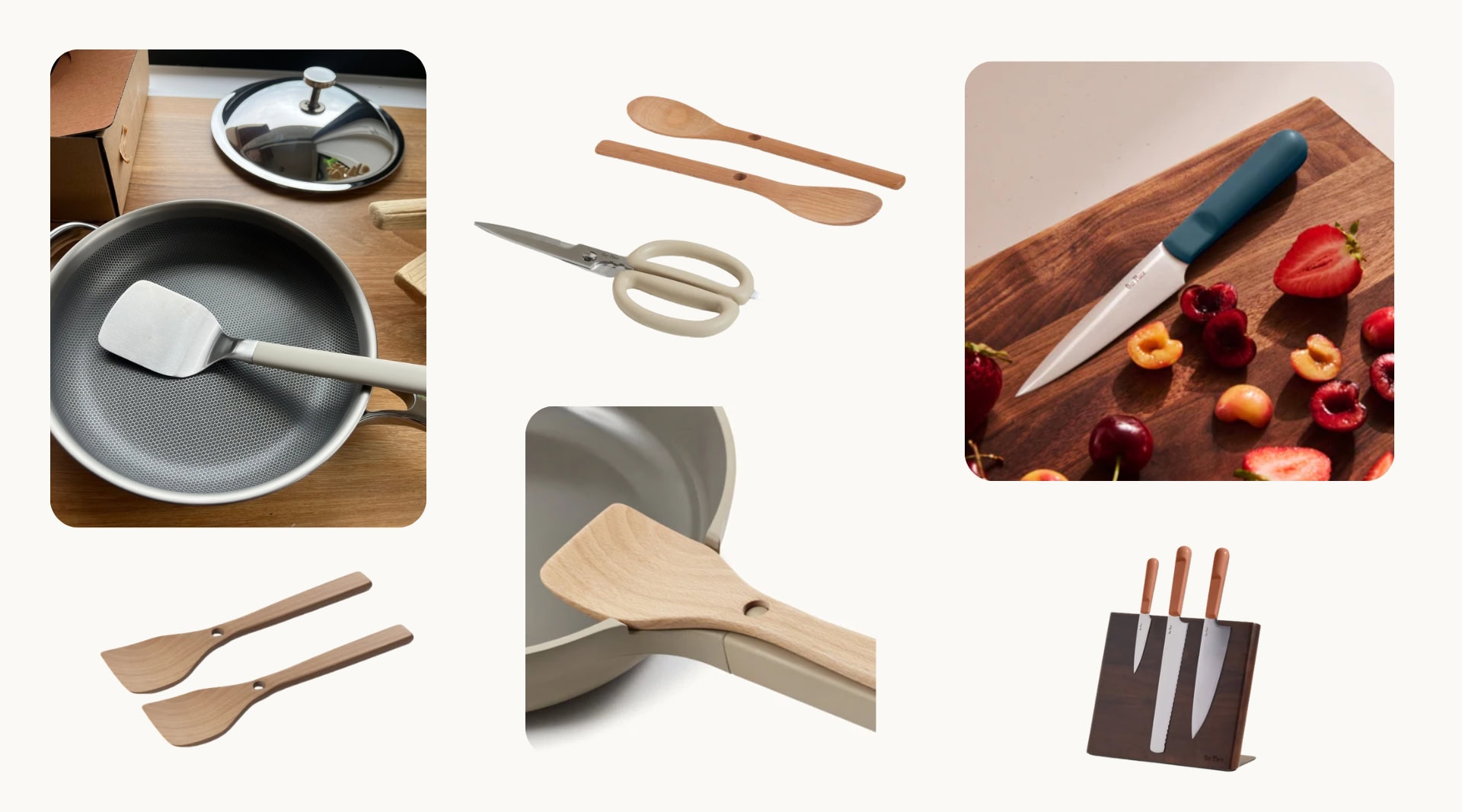
Our Place’s Non-Toxic Cooking Utensils
You might know Our Place from their viral Always Pan (we’ve tested it and their stainless steel version has earned a permanent spot in our kitchen). Their utensil lineup extends the same non-toxic philosophy to prep and cooking tools, with options in beechwood, stainless steel, and silicone.
- Material: Beechwood utensils and German stainless steel knives. Also offer silicone utensil essentials (BPA, BPS, and phthalate-free).
- Varieties: Beechwood spatula, wooden spoon, and spork. Knife sets in German stainless steel. Silicone utensil essentials (6 pieces).
- What makes it non-toxic: Beechwood utensils use food-safe materials. Silicone line is free of BPA, BPS, phthalates, lead, and cadmium.
- Where it’s made: Our Place is not super clear on where their utensils specifically are made but they have factory partners in the US, Thailand, China, India, Morocco, Mexico and more.
- What we love: If you already cook with Our Place pans, their beechwood utensils are designed to complement them perfectly. The German stainless steel knives are also worth a look. We personally prefer the wood and metal options over silicone for everyday cooking. But if you specifically want silicone utensils, Our Place’s are a solid choice (they’re platinum-cured and heat-resistant to 450°F).
- Price: Beechwood utensils from ~$20; sets from ~$99
Itza Wood
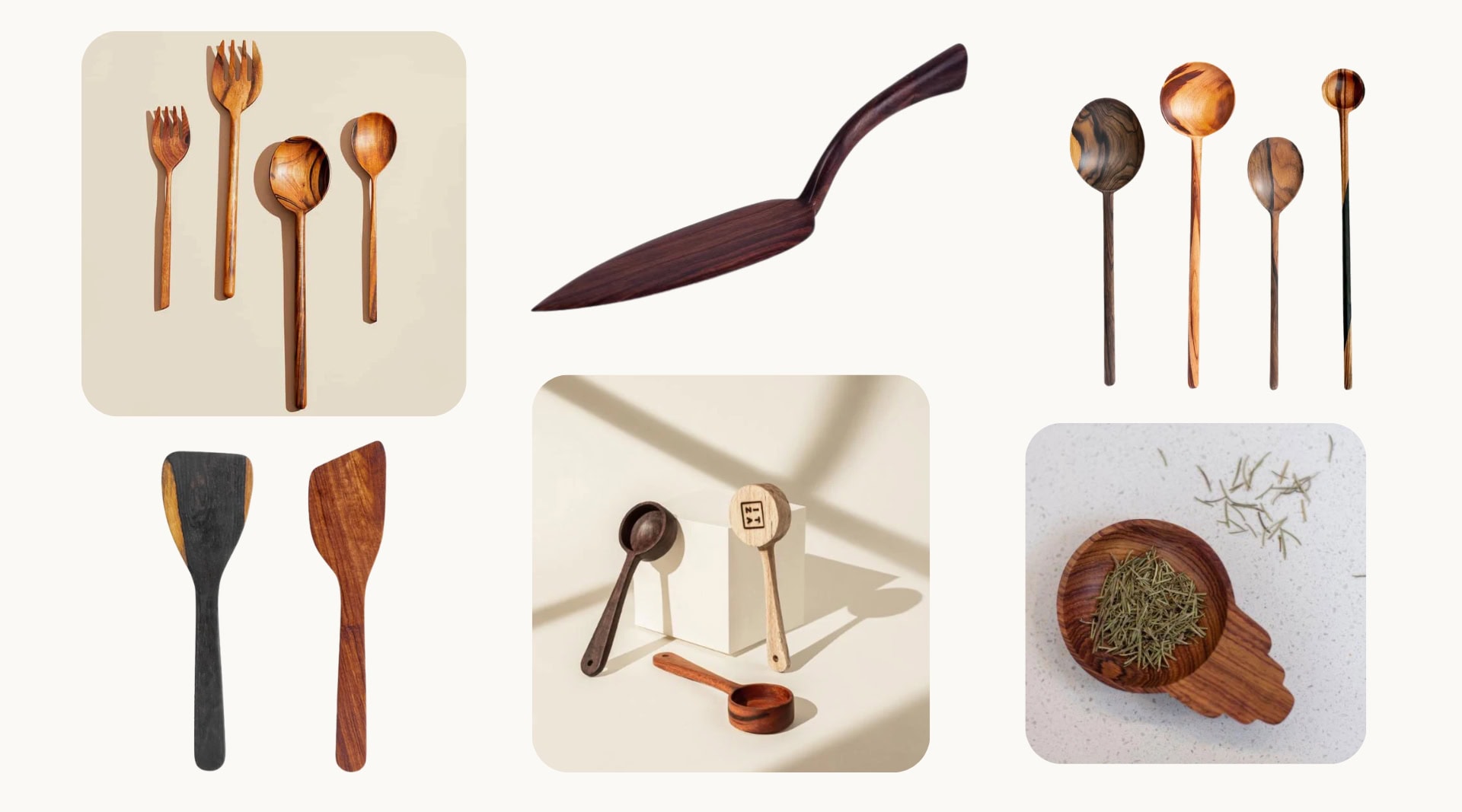
Itza Wood’s Non-Toxic Wooden Cooking Utensils
We have a soft spot for Itza Wood. We interviewed founder Eliza Babarczy on our podcast, and their story is as compelling as the grain patterns on their spoons. Led by a mother-and-daughter team, Itza Wood employs artisan carvers in the Petén region of Guatemala, home to Central America’s largest remaining tropical forest.
- Material: Sustainably harvested exotic hardwoods (Ziricote, Jobillo, Granadillo) from the Petén jungle
- Varieties: Cooking spoons, spatulas, servers, cutting boards, and decorative home items in varying lengths and shapes
- What makes it non-toxic: All kitchen utensils are finished with a non-toxic, food-safe beeswax paste. No chemical treatments or synthetic coatings.
- Where it’s made: Hand-crafted and hand-finished in the Petén region of Guatemala
- What we love: Every purchase directly supports Guatemalan education and employment. Itza Wood donates 10% of profits to The Jungle School and employs graduates from their community programs. The wood itself is FSC-certified, and many utensils are created from off-cuts, making use of material that would otherwise go to waste. Each piece has natural differences in color and grain, making it one-of-a-kind.
- Price: $20-$75 for sets
Jonathan's Spoons
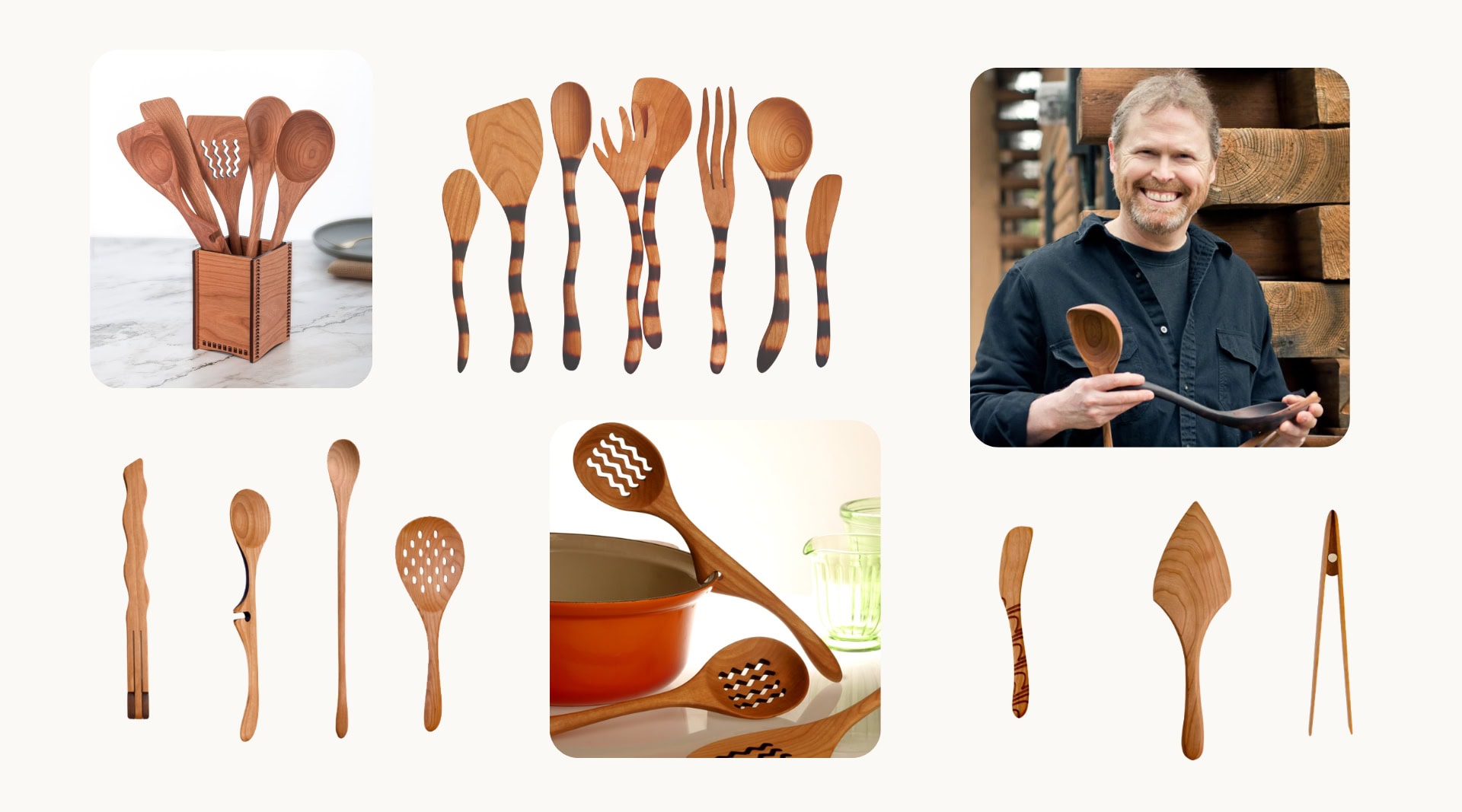
Jonathan’s Spoons’ Sustainable Kitchen Utensils
Jonathan’s Spoons is about as far from mass production as you can get. Jonathan Simons has been hand-carving cherry wood utensils in Pennsylvania for over 40 years, and each piece reflects that experience. These wooden kitchen tools are functional art with a tactile quality that makes you want to pick them up.
- Material: FSC-certified cherry wood sourced from responsibly harvested forests in Pennsylvania, New York, and New Jersey
- Varieties: Spoons, spatulas, tongs, spaghetti forks, spreaders, whisks, and more. Available in natural cherry and flame-blackened finishes. Left-handed and right-handed designs available.
- What makes it non-toxic: All-natural cherry wood finished with food-safe mineral oil.
- Where it’s made: Handmade in Kempton, Pennsylvania, USA
- What we love: The left-handed and right-handed designs are a thoughtful touch you rarely see. Each utensil is ergonomically shaped to work at the most comfortable angle for how you actually hold and use it. The flame-blackened finish option adds visual character while being completely food-safe. Jonathan’s “Spootle” (a spoon-spatula hybrid) won the “best wooden spoon” award from America’s Test Kitchen.
- Price: Individual spoons from ~$20; sets from ~$83
Seed & Sprout
Seed & Sprout’s Non-Toxic Kitchen Utensils
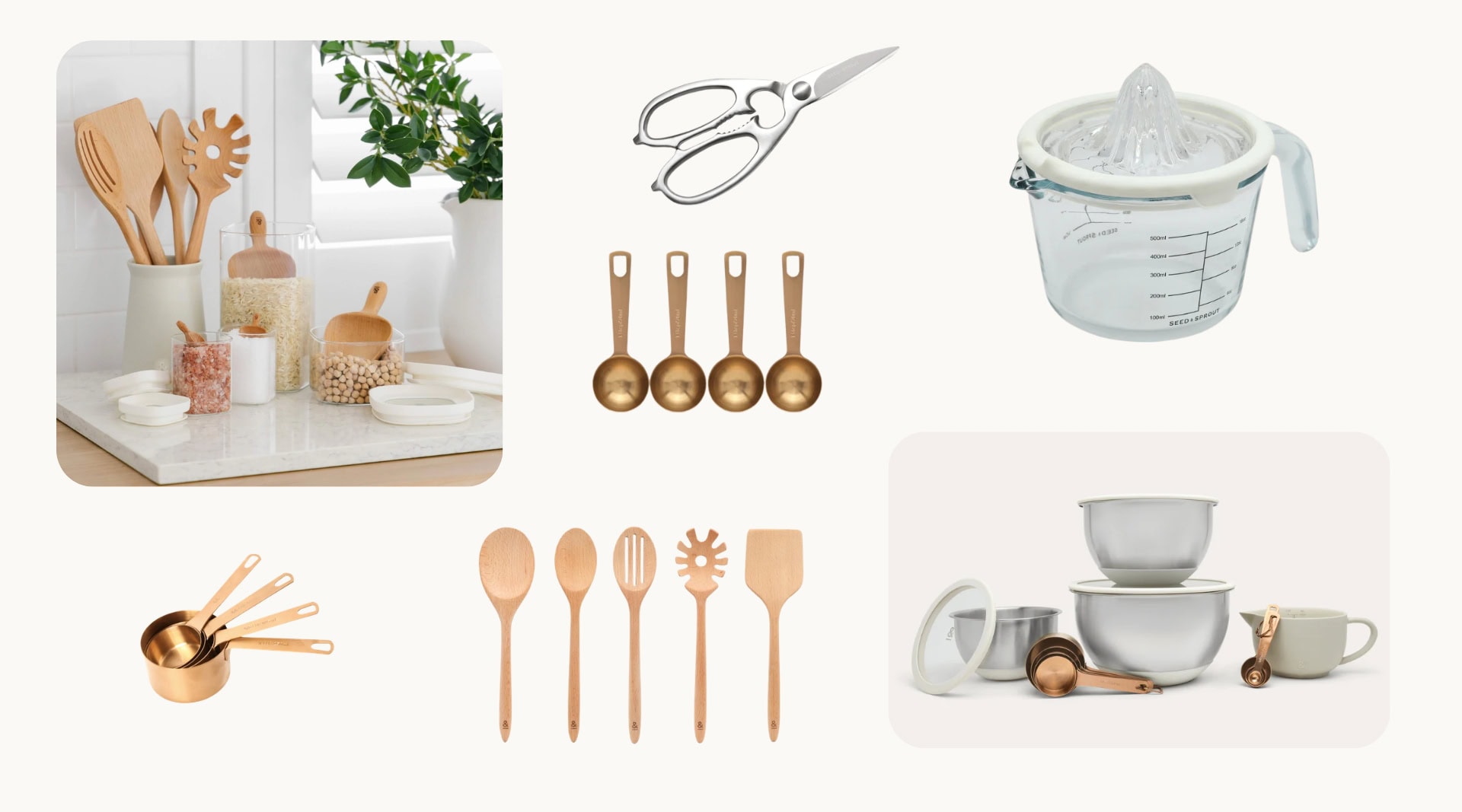
Australian brand Seed & Sprout takes the “what’s it made of and who certified it?” question seriously. Their beechwood cooking utensils carry both FSC certification (for responsible forestry) and LFGB certification (a rigorous German food safety standard), making them one of the most thoroughly vetted wooden utensil options out there.
- Material: FSC and LFGB-certified beechwood, finished with natural beeswax
- What’s included: Available as individual utensils or a set. Also offer stainless steel kitchen items and chopping boards.
- What makes it non-toxic: LFGB certification means the wood meets some of the strictest food-contact safety requirements globally. Natural beeswax finish only.
- Where it’s made: China. Seed & Sprout say their products are ethically manufactured.
- What we love: Many wooden utensil brands rely on FSC alone (which covers sourcing but not food safety), so the added LFGB testing is a meaningful differentiator. The utensils are non-reactive, won’t conduct heat, and are safe for all cookware surfaces. At end of life, they’re fully biodegradable. Seed & Sprout also runs a silicone take-back program for their other products, showing a commitment to circularity.
- Price: Beechwood utensils start at ~$19, the full set is ~$106
Taima
Taima’s Non-toxic Titanium Kitchen Utensils
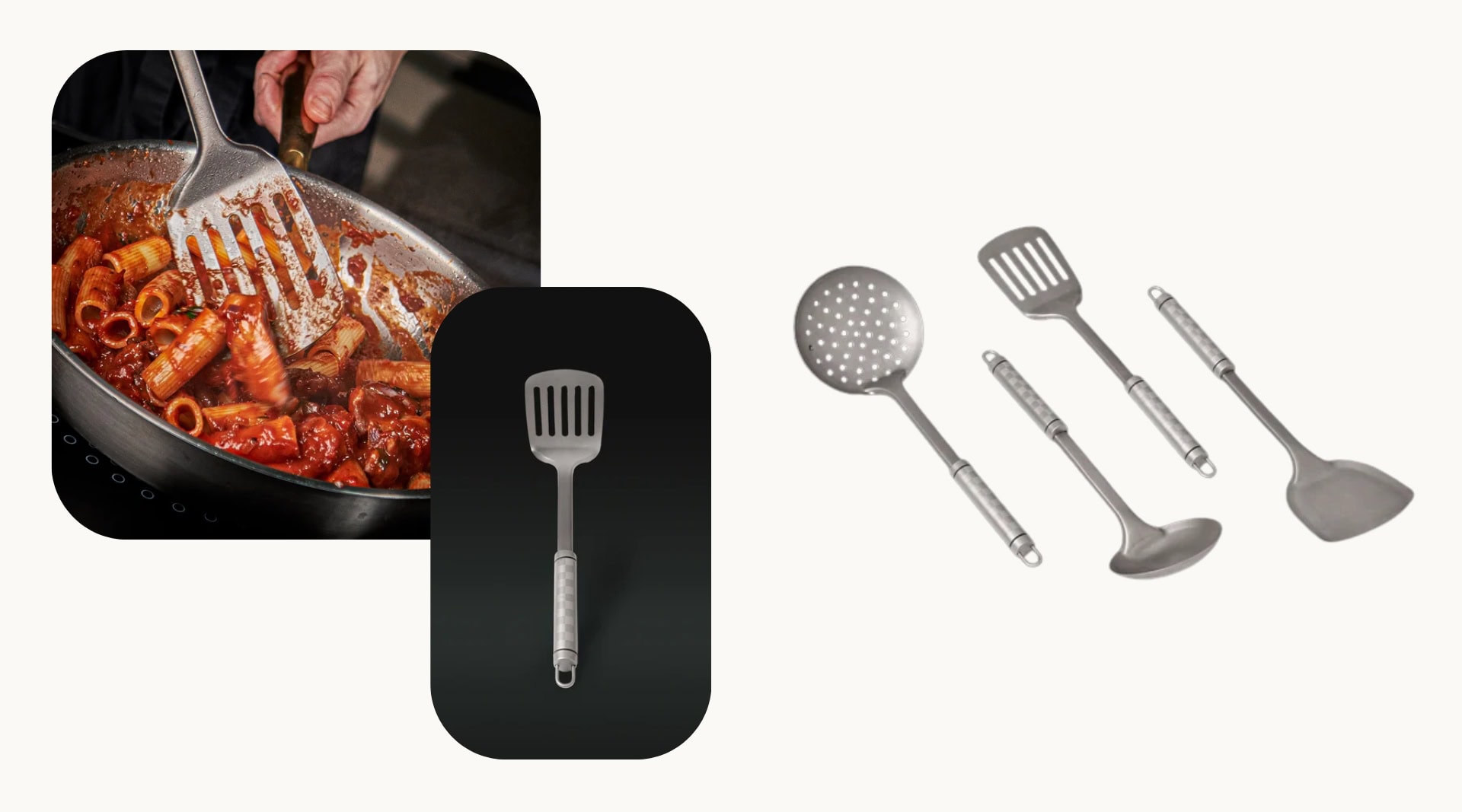
Titanium is the newcomer on the utensil scene, and Taima offers a 4-piece set in pure titanium that’s worth considering if you want something virtually indestructible.
A note on transparency: Taima appears to be a reseller of white-label titanium products manufactured in China, and similar products are available under other brand names. We include them because the material itself (pure titanium) is genuinely non-toxic, non-reactive, and naturally antibacterial, and their products have been third-party tested. But we want to be upfront that this isn’t an artisan brand with its own factory.
- Material: 100% pure titanium
- What’s included: 4-piece set or an individually sold spatula
- What makes it non-toxic: Titanium is 100% free from BPA, PFAS, and heavy metals. It’s non-reactive (won’t interact with acidic foods), naturally antibacterial, and doesn’t require any coating.
- Where it’s made: China
- What we love: Titanium is a lot lighter than steel but just as strong, so these utensils feel almost weightless. They’re also extremely durable (you’ll hand these down to your grandkids), fully recyclable, and rust-proof. For those with nickel sensitivities who can’t use standard stainless steel, titanium is an excellent alternative. But titanium utensils cost more than any other material on this list.
- Price: 4-piece set ~$299 or $89 for the spatula (though they are often on sale)
Why Your Kitchen Utensils Might Not Be Safe
If you’ve seen headlines about black plastic spatulas over the last couple of years and wondering what that’s all about, let us explain:
A September 2024 study published in Chemosphere found that black plastic kitchen utensils frequently contain toxic flame retardants, including deca-BDE (which the EPA banned in 2021). These chemicals were detected because recycled black plastic is often made from shredded electronics, and the contamination carries over into kitchen products. Flame retardants were found in 85% of the products tested.
The flame retardants found are linked to thyroid dysfunction, endocrine disruption, neurotoxicity, and cancer, according to the National Institute of Environmental Health Sciences. They also bioaccumulate, meaning they build up in our bodies and persist in the environment. (The study’s authors later corrected a calculation error that had overstated estimated daily exposure levels, but the core findings about the presence of these chemicals in household products remain unchanged.)
But the problem isn’t limited to black plastic. All plastic kitchen utensils are petroleum-based and rely on numerous additives (plasticizers, antioxidants, stabilizers, flame retardants, pigments). Of the more than 16,000 chemicals associated with plastics, at least a quarter are considered hazardous to human health and the environment, according to the PlastChem Report.
Heat and friction accelerate the problem. Every time you stir a hot pan with a plastic or nylon utensil, there’s potential for microplastic release, especially with lower-quality materials or utensils that are worn, scratched, or heat-damaged.
The simplest fix? Switch to materials that have been safely feeding people for centuries like wood, metal, and bamboo. And while you’re at it, consider swapping out plastic food storage too.
The Safest Materials for Non-Toxic Cooking Utensils
Not all “non-toxic” utensils are created equal. Here’s what to know about each material.
Stainless Steel
The workhorse of non-toxic kitchens. Food-grade stainless steel (look for 18/10 or 18/8) is non-reactive, non-porous, and inherently free from chemical coatings. It’s also fully recyclable, dishwasher safe, and essentially maintenance-free.
It also lasts forever. We’ve found several stainless steel utensils in thrift stores that look like they’re in near perfect condition (and they’ve probably had several lives already).
The only real downsides: stainless steel can scratch non-stick and ceramic cookware, and handles can get hot if left in a pan. If you cook with ceramic or enamel-coated cookware, pair it with wooden or bamboo utensils instead to protect the surface.
For those with nickel sensitivities, standard 18/10 stainless steel does contain nickel. Titanium is a good alternative in that case.
Wood
Wooden utensils have been kitchen staples since long before plastic existed. When made from untreated, food-safe wood and finished with natural oils or beeswax, they’re completely non-toxic.
Look for utensils finished with food-grade mineral oil, beeswax, or plant-based oils. Avoid anything with an “undisclosed lacquer” or mystery coating, as these can contain chemicals you don’t want near your food. FSC certification ensures the wood was responsibly sourced.
Popular choices include cherry, maple, beech, olive, acacia, and various hardwoods. Each has slightly different characteristics, but all share the advantage of being gentle on cookware, naturally heat-resistant, and biodegradable at end of life. They do require hand washing and occasional oiling to maintain.
Bamboo
Technically a grass rather than a wood, bamboo shares most of wood’s benefits: it’s naturally non-toxic, heat-resistant, gentle on cookware, and biodegradable. It’s also harder than many hardwoods and grows remarkably fast, making it one of the most sustainable raw materials available.
The same finish rules apply in that we’d recommend looking for natural oil, food-safe or beeswax finishes rather than synthetic lacquers. FSC certification matters for bamboo too, as uncertified bamboo farming can displace natural forests and harm biodiversity. Most bamboo is sourced from Asia, so transportation adds to its carbon footprint.
Titanium
The premium option. Pure titanium is completely non-reactive (even with acidic foods), naturally antibacterial, lightweight, and extraordinarily durable. It’s also free from any coatings, because it simply doesn’t need them.
Titanium is more expensive than any other utensil material, and the supply chain can be harder to trace. But for those who want a practically indestructible, fully recyclable, zero-maintenance option (or who need to avoid nickel), it’s worth considering.
What About Non-Toxic Silicone Cooking Utensils?
We chose to focus this guide on wood, stainless steel, bamboo, and titanium because these materials have the clearest safety profiles and the strongest sustainability credentials.
Silicone occupies a middle ground. High-quality, platinum-cured, food-grade silicone is generally considered safe and is free from many of the chemicals found in plastic. It’s flexible, heat-resistant, and great for specific tasks like scraping bowls or flipping foods on non-stick surfaces.
That said, silicone is a synthetic material. It’s not biodegradable, not widely recyclable, and the quality varies significantly between brands. Lower-quality silicone may contain plastic fillers and can degrade over time.
If you specifically need silicone utensils (for tasks where flexibility matters), look for platinum-cured, pharmaceutical-grade options from transparent brands. We’ve included Our Place above, which offers a BPA and phthalate-free silicone line. Brands like GIR also get strong marks from independent reviewers for their platinum-cured silicone.
Read more about silicone in our guide: Is Silicone Safe?
What to Look for When Buying Non-Toxic Kitchen Utensils
Materials and Finishes
A beautiful olive wood spatula can be a problem if it’s coated in an undisclosed synthetic lacquer. Always check what finish or treatment has been applied. The safest options are food-grade mineral oil, beeswax, plant-based oils, or food-safe varnish that has been independently tested.
Certifications Worth Looking For
- FSC (Forest Stewardship Council): Confirms wood or bamboo was responsibly sourced from well-managed forests
- LFGB: A rigorous German food safety certification (stricter than FDA requirements for food-contact materials)
- B Corp: Indicates the brand meets high standards for social and environmental performance
- BSCI / SMETA: Third-party audits of factory labor conditions and ethical manufacturing
- California AB1200: Requires cookware and kitchen tools to be tested and labeled for chemical content
What to Avoid
- Black plastic utensils (potential flame retardant contamination)
- Any plastic utensils, especially near heat (microplastic and chemical leaching risk)
- Nylon turners and spatulas (can degrade with heat and friction)
- Wooden or bamboo utensils with undisclosed coatings or “lacquer” finishes
- Melamine (can migrate into food, especially with acidic or hot foods)
- Utensils with plastic handles glued or attached with adhesives to metal or wood
Non-Toxic Cooking Utensils FAQ
What Are the Safest Non-Toxic Cooking Utensils?
Stainless steel, solid wood, bamboo, and titanium are the safest materials for cooking utensils. All are free from the chemical coatings, plasticizers, and additives found in plastic and nylon tools. The safest specific utensils are those finished with food-safe, natural treatments (beeswax, mineral oil) from brands that use responsible sourcing and third-party testing.
Are Stainless Steel Cooking Utensils Non-Toxic?
Yes. Food-grade stainless steel (18/10 or 18/8) is non-reactive, non-porous, and inherently free from chemical coatings. It’s one of the safest materials for cooking utensils. The only consideration is nickel sensitivity: standard stainless steel contains nickel, so those with allergies may want to opt for titanium instead.
Are Wooden Cooking Utensils Non-Toxic?
Wooden cooking utensils are non-toxic when made from untreated, food-safe wood and finished with natural oils or waxes. The risk comes from undisclosed coatings or synthetic lacquers that some manufacturers apply. Buy from brands that are transparent about their finishes, and look for FSC certification to confirm responsible sourcing.
Are Silicone Cooking Utensils Safe?
High-quality, platinum-cured, food-grade silicone is generally considered safe for cooking. It’s heat-resistant and free from BPA. However, silicone is a synthetic material, and quality varies widely. Lower-quality silicone may contain plastic fillers. For everyday cooking, we recommend wood or stainless steel as the first choice, with silicone reserved for specific tasks like scraping or working with non-stick cookware.
What Cooking Utensils Should I Avoid?
Avoid plastic and nylon cooking utensils, especially near heat. Black plastic spatulas have been found to contain flame retardants, and all plastic utensils can shed microplastics when heated or worn. Also avoid wooden or bamboo utensils with mystery lacquer coatings, and any utensils with detachable plastic handles or adhesive joints.
Are Non-Toxic Cooking Utensils Dishwasher Safe?
It depends on the material. Stainless steel and titanium utensils are typically dishwasher safe. Wood and bamboo utensils should always be hand-washed with warm soapy water and an eco-friendly sponge. Submerging wood in water or running it through a dishwasher will cause warping, cracking, and eventually shorten its lifespan. Dry standing upright, and oil periodically with food-grade mineral oil or coconut oil.
What Non-Toxic Utensils Are Best for Ceramic Cookware?
Wood, bamboo, and silicone utensils are the best choices for ceramic-coated and non-stick cookware. They won’t scratch or damage the cooking surface the way stainless steel or titanium can. Caraway’s birch wood utensils, for example, are specifically designed to fit the curves of ceramic cookware. If you prefer metal utensils, use them only with uncoated stainless steel, cast iron, titanium or carbon steel cookware.
Can I Use Non-Toxic Cooking Utensils on All Types of Cookware?
Wooden and bamboo utensils are safe for all cookware types, including non-stick, ceramic, stainless steel, and cast iron. Stainless steel and titanium utensils are safe for stainless steel and cast iron but may scratch non-stick and ceramic surfaces. For a fully versatile kitchen, we’d recommend keeping both wood and stainless steel utensils on hand.
Final Thoughts on Non-Toxic Cooking Utensils
Swapping out your kitchen utensils isn’t as dramatic as overhauling your entire zero waste kitchen. It’s more like quietly upgrading the supporting cast while the pots and pans get all the attention.
But it matters. Every stir, flip, and scrape is a point of contact between your tools and your food. And once you start cooking with a well-made wooden spoon or a solid stainless steel turner, you’ll wonder why you ever put up with that melting nylon spatula in the first place (no judgment, we all had one).
Start small if you want to. Replace the utensils you use most often first, and let the rest happen naturally. A good wooden spoon, a stainless steel turner, and a set of tongs will cover about 90% of what most home cooks need. Then tackle the next thing on the list, whether that’s your kettle, your coffee maker, or your lunch box.
Pro tip: If you’re looking for more affordable non-toxic cooking tools, check out some of the thrift stores near you. We’ve had a ton of success finding stainless steel options that are dirt cheap.
And for the record? That black plastic spatula in the back of the drawer? Now’s a very good time to let it go.
Editor’s Note: Joy McConnochie has been researching sustainable and non-toxic kitchen products for over 8 years as part of Sustainable Jungle’s mission to help people make more informed, environmentally responsible choices. All products are independently researched and in some cases tested and/or rated using our comprehensive sustainability rating methodology.

Joy has been a passionate advocate for the environment since she was a small child. She grew up in South Africa and has been lucky enough to be exposed to the wonders of nature not just in Africa but all over the world. She founded Sustainable Jungle (together with her husband Lyall) back in 2017 after becoming enraged by the devastating impact of palm oil. She then founded the Sustainable Jungle Podcast and together with Lyall interviewed remarkable people from all over the world who were finding ways to create positive impact. Outside of Sustainable Jungle, Joy has always worked in the corporate world, starting out as an auditor and later moving into management consulting. More recently she specialized in Climate Investing for the Asia Pacific region. Given her experience, her current passion is Brand Ratings. She is very much enjoying going deeper on what it really means to drive sustainability performance and true impact through business operations.