













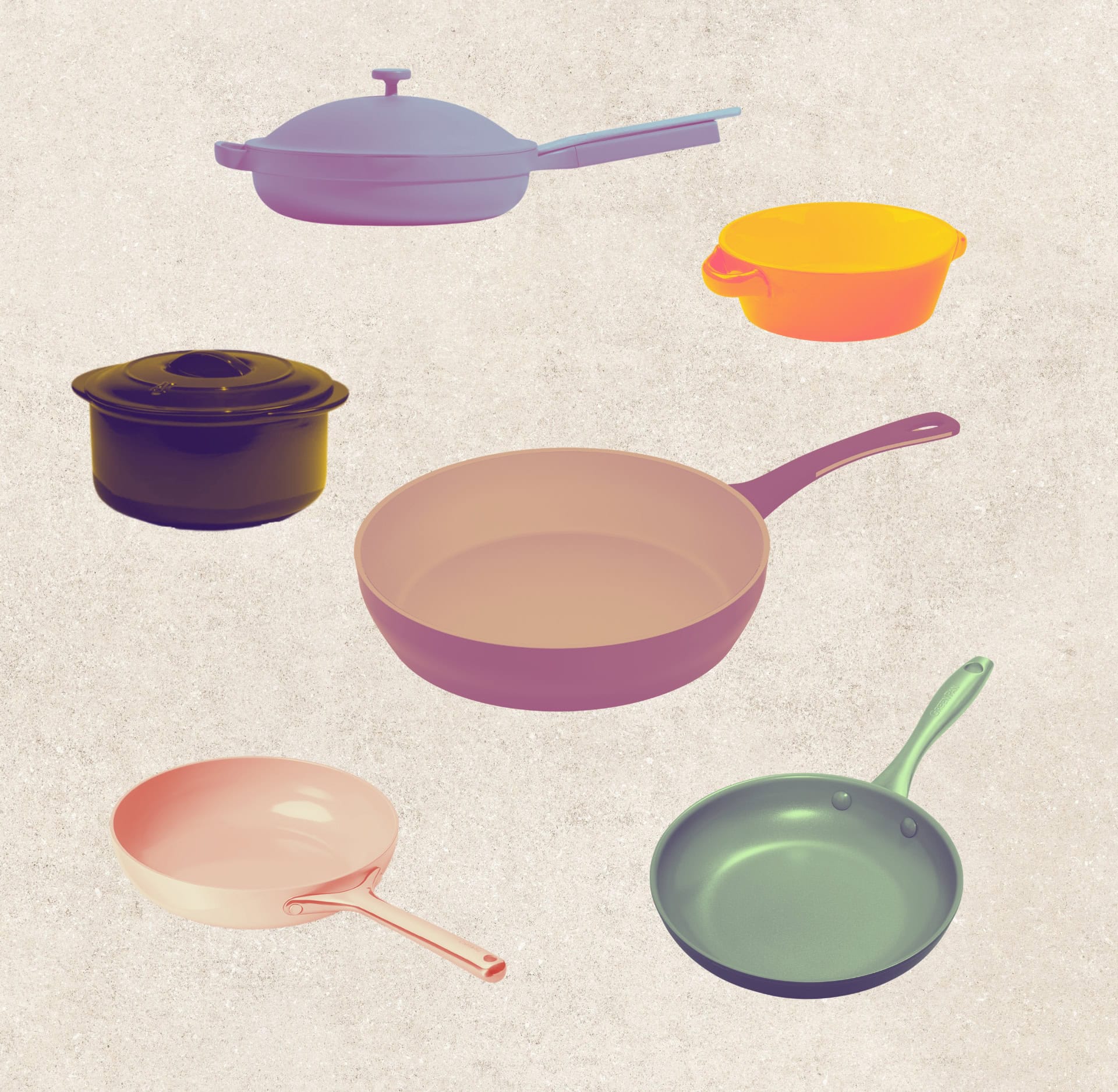
Today’s popular ceramic pans likely never went anywhere near a kiln. That sounds like a technicality, but the framing can be quite misleading.
The pastel, Instagram-friendly cookware all over your feed isn’t fired clay at all. It’s aluminum (usually) with a thin coating derived from silica through a chemical process called sol-gel, and the American Ceramic Society calls these coatings “quasi-ceramic”.
Does that make them unsafe? Not necessarily, but the marketing has run a little ahead of the evidence here. Below, we break down what’s in these coatings, what the research can and can’t tell us, and where the murkiness lies when it comes to safety.
We’ve recommended ceramic-coated cookware at Sustainable Jungle before, and we still recommend Caraway’s stainless steel line in our non-toxic cookware guide. But new research and regulatory scrutiny have built up around ceramic coatings since then, so we’re updating our position to reflect what the science now shows.
Related Guides: How to Avoid Microplastics, Non-Toxic Living, Is Granite Cookware Safe?, Non-Toxic Bakeware, Non-Toxic Food Storage, What Does Non-Toxic Mean?
Ceramic Cookware Safety At a Glance
- Ceramic-coated cookware is safer than PTFE nonstick. It contains no PTFE, PFOA, or other forever chemicals when properly made.
- Most “ceramic” pans are aluminum with a silica-based coating, and “ceramic” and “non-toxic” are unregulated terms.
- Some coatings contain titanium dioxide nanoparticles that can migrate into food, more so once the surface is scratched.
- Ceramic-coated cookware is a reasonable step up from most other non-stick coated cookware, but durable uncoated options (stainless steel, cast iron, carbon steel) don’t have any coatings and last decades longer.
Table of Contents: Ceramic Cookware
- What Is Ceramic Cookware? Jump to section
- Is Ceramic Cookware Safe? Jump to section
- Nanoparticles In Ceramic Cookware Jump to section
- Ceramic Cookware Toxicity: Coating Damage & Aluminum Jump to section
- "Non-Toxic" As A Marketing Term Jump to section
- Ceramic vs. Stainless Steel, Cast Iron, and Carbon Steel Jump to section
- Is Ceramic Cookware Sustainable? Jump to section
- What to Look For When Buying Ceramic Cookware Jump to section
- Frequently Asked Questions About Ceramic Cookware Jump to section
What Is Ceramic Cookware?
There are two types of ceramic cookware:
Ceramic-Coated Cookware
The vast majority of cookware marketed as “ceramic” today is metal pans (almost always aluminum, sometimes stainless steel) coated with a thin layer applied through what’s called a sol-gel process.
The sol-gel process is essentially a mixture of silica, metal oxides, and binders sprayed onto the metal pan and then fired at temperatures between 400°F and 800°F. By contrast, around 2,000°F+ is the firing temperature used for traditional ceramics.
The resulting coating is smooth, nonstick, and free of PTFE (the polymer in Teflon). It looks and feels like a ceramic surface, which is why it’s marketed that way, even though it’s technically a silicone-based polymer matrix rather than a fired clay product. Many coating compositions are proprietary, meaning the full list of ingredients isn’t publicly disclosed.
Caraway, GreenPan, Our Place, and most other brands in this space use this process.
100% Ceramic Cookware (Traditional Clay)
A much smaller category, 100% ceramic cookware is made entirely from clay and minerals, kiln-fired at high temperatures with no metal base. Xtrema is the most well-known brand in this space. These products pass California’s Prop 65 standards and offer full ingredient transparency because there is no proprietary coating to conceal.
But pure ceramic is heavier, more fragile, and more expensive than ceramic-coated options.
When this article refers to “ceramic cookware” from here on, we mean ceramic-coated cookware.
Is Ceramic Cookware Safe?
Ceramic-coated cookware is safer than traditional PTFE-based nonstick cookware when it comes to avoiding PFAS (forever chemicals). However, “safe” and “non-toxic” are unregulated terms with no legal definitions in the cookware industry. And when terms are unregulated, there is room for misuse and misinterpretation.
What Ceramic Coatings Don’t Contain
Ceramic coatings are silica-based, not fluoropolymer-based. That means no PTFE (polytetrafluoroethylene), PFOA, or PFAS when legitimately manufactured. This is the core safety advantage and the main reason these products took off as alternatives to Teflon-coated pans.
Dr. Joe Zagorski, a toxicologist at Michigan State University’s Center for Research on Ingredient Safety, has said the ceramic coating is “generally free of chemicals of concern and is seen as being nontoxic to both humans and the environment.”
The FDA has also stated that ceramic cookware is safe to use when “properly glazed, using materials authorized for food contact use, and the glazing is intact.”
What About Lead and Cadmium?
Lead and cadmium are primarily a concern with vintage, imported, or decorative ceramics where glazes may contain these heavy metals. Modern domestic ceramic nonstick coatings are formulated without them. And reputable brands usually test for their absence.
Washington state restricts lead in cookware under a law that took effect January 2026, limiting lead in aluminum and brass cookware to 90 parts per million (dropping to 10 ppm by 2028).
Nanoparticles In Ceramic Cookware
Some ceramic coatings contain titanium dioxide (TiO₂) nanoparticles. A 2017 study published in Food Additives & Contaminants examined ceramic-coated frying pans and found that the coatings contained TiO₂ nanoparticles embedded in a silicone polymer matrix. The researchers found that both ionic titanium and TiO₂ nanoparticles migrated into food simulants, with mechanical damage (scratches) significantly increasing the release.
A separate study by researchers at NIST (the US National Institute of Standards and Technology) confirmed these findings, detecting TiO₂ and silicon dioxide (SiO₂) nanoparticles in food simulants after simulated consumer use scenarios including washing, scouring, and scratching. Migration was highest under the most aggressive conditions.
Why does this matter, you ask? In 2021, the European Food Safety Authority (EFSA) concluded that titanium dioxide could no longer be considered safe as a food additive (E171), because genotoxicity concerns could not be ruled out. The EU subsequently banned TiO₂ from food products in 2022.
There is more context on this though. EFSA didn’t conclude TiO₂ is definitively harmful. It concluded the existing evidence couldn’t confirm safety, and under EU precautionary standards, that was enough to warrant a ban on it being used in food. Other regulatory bodies, including the UK, Canada, Australia, and New Zealand, reviewed the same evidence and disagreed with EFSA’s conclusion. The US FDA has not restricted TiO₂ in food or cookware.
The nanoparticle issue is probably not a reason to throw out your ceramic pan right away. But labeling ceramic-coated cookware as definitely non-toxic is likely a jump too far.
Ceramic Cookware Toxicity: Coating Damage & Aluminum
A 2025 study in Results in Engineering tested five ceramic coatings against a PTFE coating and found that PTFE maintained nonstick performance at levels up to three times better than the best ceramic coating after 90 cooking cycles. A 2024 study in the Journal of Food Engineering found PTFE outperformed ceramic sol-gel coatings by 7 to 14 times on release force measurements.
In plain terms, this means that ceramic coatings wear out faster than PTFE coatings. Most manufacturers and reviewers estimate a ceramic-coated pan’s nonstick life at roughly 1 to 5 years with proper care, compared to decades for uncoated stainless steel or cast iron.
It also means the aluminum body underneath becomes exposed to food contact. Aluminum has no biological function in the body, and the main health concern tied to it is neurotoxicity, with documented effects on the nervous system, bones, and blood.
A 2023 study published in Toxics found that aluminum leaching from cookware increases significantly with acidic foods like tomato sauce and citrus, and concluded that this migration “poses a potential public health risk.” Most people already get their dietary aluminum from cereals, vegetables, and beverages, and a meaningful share of the population sits at or above the safety threshold from food alone.
Our practical takeaway is that when the coating shows visible scratching, peeling, or loss of nonstick performance, it’s time to replace. In our own experience, our ceramic-coated GreenPan lasted less than a year. So given that 1 to 5 year lifespan, we’d point most people toward more durable options instead (more sustainable, too).
If you already have ceramic-coated cookware, care tips to extend coating life include:
- Using wooden or silicone utensils (metal utensils scratch the coating)
- Cooking on low to medium heat
- Handwashing rather than using the dishwasher
- Avoiding stacking pans without a protective layer between them.
"Non-Toxic" As A Marketing Term
“Non-toxic” is currently a battleground, with cookware brands fighting over the terms they use and the reputational damage those terms can do. Ceramic coatings have drawn a lot of that scrutiny over the last few years, and regulations are starting to catch up.
A June 2025 investigation by The Guardian found that brands like Caraway, Our Place, and GreenPan use “quasi-ceramic” coatings that may contain titanium dioxide, siloxanes, lead, and mercury per independent testing, while marketing their products as “non-toxic” and “ceramic.”
In August 2025, BBB National Programs’ National Advertising Division (NAD) reviewed claims made by Caraway after a challenge from the Cookware Sustainability Alliance. The ruling was nuanced and found that Caraway’s claims about its own products being “free of PFAS” and “non-toxic” were supported.
But NAD concluded that Caraway did not have sufficient evidence to support messaging suggesting traditional nonstick cookware is harmful, can release toxins into food, or can make consumers sick. NAD recommended Caraway discontinue those comparative claims, and Caraway stated it would comply while “respectfully disagreeing” with the findings.
To be clear, this ruling didn’t find that Caraway’s products are unsafe.
On the regulatory front, several US states including Minnesota, Colorado, Connecticut, and Vermont have banned the sale of cookware with intentionally added PFAS, with Minnesota’s ban effective January 2025 and the others taking effect January 2026. California now requires cookware companies to disclose PFAS use on labels and websites, and specifically prohibits products from claiming “PTFE-free” if they contain other PFAS chemicals.
Washington state’s Department of Ecology has adopted a regulation requiring manufacturers to report the intentional use of PFAS in cookware and kitchen supplies under its Safer Products for Washington program, though advocacy groups like Toxic-Free Future have criticized the rule for stopping at reporting rather than restricting PFAS in cookware outright.
These regulations are good news for ceramic cookware brands, whose products should easily comply, but they also point to a broader regulatory trend toward better transparency, which is a good thing albeit not enough to fully protect consumers.
Ceramic vs. Stainless Steel, Cast Iron, and Carbon Steel
Ceramic-Coated vs. Stainless Steel
Stainless steel has no coating to degrade. So there are no nanoparticles to migrate, or proprietary compositions to wonder about. It’s non-reactive with acidic foods and can last generations. The trade-off is that stainless steel isn’t nonstick, so it requires oil or butter and a bit more technique. Read our full breakdown on stainless steel safety.
Ceramic-Coated vs. Cast Iron
Cast iron is one of the oldest cooking materials on Earth. It leaches small amounts of iron into food (which is generally beneficial), handles extreme heat, and develops a natural nonstick seasoning over time. It’s heavy, requires maintenance, and isn’t dishwasher-friendly, but a well-cared-for cast iron skillet will outlast you, and can be passed down for generations.
Ceramic-Coated vs. Carbon Steel
Carbon steel shares cast iron’s durability and seasoning properties in a lighter-weight format. Like cast iron, it develops natural nonstick performance through use, requires no chemical coating, and lasts for decades. We cover the safety profile in detail in our carbon steel safety guide.
When To Buy Ceramic
Ceramic-coated cookware offers a nonstick experience without PFAS, which appeals to people who want easy-release cooking (for things like eggs, fish, and crepes) without learning the seasoning and technique required for cast iron or carbon steel. It’s also a lot lighter than cast iron, less intimidating for new cooks, and works pretty well for low-to-medium-heat everyday cooking.
So, while ceramic coated isn’t our top recommendation, it’s a good next step for anyone who wants to move away from PTFE-coated nonstick, but is intimidated by the uncoated pans.
Is Ceramic Cookware Sustainable?
For those building a lower-waste kitchen, sustainability is an important piece of the decision (we think so anyway). There are a few things to know:
Durability and Replacement Cycles
The biggest sustainability issue with ceramic-coated cookware is how often it needs to be replaced. A ceramic pan that loses its nonstick performance after 2 to 3 years means more manufacturing, more shipping, and more waste than a stainless steel or cast iron pan that lasts 20 to 50+ years.
Remember that every replacement represents extracted raw materials, energy-intensive manufacturing, and an end-of-life product that’s difficult to recycle.
Manufacturing Footprint
The aluminum base of most ceramic-coated cookware is energy-intensive to produce. Aluminum smelting is one of the most energy-intensive industrial processes on the planet.
Brands like GreenPan and Caraway have claimed reduced CO₂ emissions in their manufacturing processes compared to traditional nonstick, but these claims are based on brand-provided data and have not been independently verified through published lifecycle assessments (at least none that we’ve seen).
End of Life
Ceramic-coated aluminum pans are difficult to recycle because the coating needs to be separated from the metal substrate. So, in practice, most end up in landfill.
Stainless steel and cast iron, by contrast, are fully recyclable and commonly accepted by scrap metal facilities.
PFAS Impact
Ceramic-coated cookware is a better environmental choice than PTFE-coated nonstick, because PFAS are persistent environmental contaminants that don’t break down.
What to Look For When Buying Ceramic Cookware
If ceramic-coated cookware is the right fit for you and your kitchen, here’s what we would recommend considering before you buy:
Type Of Ceramic:
“Ceramic” on a product label almost always means ceramic-coated metal. If you want the coating-free experience, look specifically for 100% ceramic and expect a higher price point and different cooking experience.
Independent Lab Testing:
Some brands publish independent test results from accredited labs confirming their products are free of PFAS, lead, cadmium, and BPA. This sends a better trust signal than brand claims alone.
Base Metal:
Pans with a stainless steel core under the ceramic coating mean that if the coating wears through, you’re cooking on food-safe stainless steel rather than bare aluminum.
We’d suggest that this is a meaningful safety advantage over aluminum-body ceramic pans.
Certifications & Compliance:
NSF certification for PFAS-free status is one of the more rigorous available for cookware.
California’s Proposition 65, formally the Safe Drinking Water and Toxic Enforcement Act of 1986, requires businesses to warn consumers before exposing them to any of the 900+ chemicals the state has identified as causing cancer, birth defects, or reproductive harm. The list is maintained by California’s Office of Environmental Health Hazard Assessment (OEHHA) and includes heavy metals like lead and cadmium.
A pan that would expose you to lead above the state’s safe-harbor threshold has to carry a Prop 65 warning, so a product sold in California without one is signaling that its maker believes it stays under those limits. Some pure ceramic brands advertise this directly as a selling point.
But Prop 65 is a warning-and-disclosure law only so it doesn’t certify a product as safe. The absence of a warning depends partly on the manufacturer’s own exposure assessment. So, we would suggest treating it as just one useful data point alongside independent lab testing.
Treat Ceramic Pans As Consumables:
Given ceramic coated pans start to degrade after a few years, we’d suggest budgeting for replacement every 2 to 5 years, when the non-stick coating starts to go. As noted above, this is not great from a sustainability perspective but may be the best answer for some.
Consider Uncoated Alternatives:
If you’re willing to learn a little technique, stainless steel, cast iron, and carbon steel are much better from both a sustainability and safety perspective, and will last decades longer. We personally made the switch and found it really has not been difficult at all (the technique is to essentially cook everything on medium heat).
Frequently Asked Questions About Ceramic Cookware
Does Ceramic Cookware Have PFAS?
No, not typically, though we’d look for clear testing results. Look for “PTFE-free” or “PFAS-free” labels rather than just “PFOA-free, because PFOA is only one chemical within the broader PFAS family.
California law now prohibits cookware from claiming individual chemical-free status if it contains other chemicals in the same class.
Is Ceramic Cookware Safer Than Teflon?
When it comes to PFAS exposure, yes. Ceramic coatings contain no PTFE, PFOA, or other PFAS chemicals, and they don’t release polymer fumes at high temperatures the way PTFE coatings can. Ceramic coatings do have their own open questions around nanoparticles and proprietary compositions (as covered above), but they avoid the well-documented PFAS concerns associated with traditional nonstick.
How Long Does Ceramic Cookware Last?
The nonstick coating on ceramic coated cookware typically lasts 1 to 5 years with proper care, though some users report performance declining sooner. Once the coating degrades, the pan is functionally an aluminum pan.
By comparison, 100% ceramic cookware can last decades with careful handling. Similarly, uncoated metals like stainless steel and cast iron can last generations.
Is Ceramic Cookware Dishwasher Safe?
Most brands say yes, but regular dishwasher use accelerates coating degradation because of abrasive detergents and high-heat drying cycles.
We’d recommend handwashing with mild non-toxic dish soap and a soft sponge.
Is Ceramic Cookware Safe for Birds?
Sounds a bit random, but when PTFE-coated pans are overheated, they release fumes that can be lethal to birds (particularly parrots and other pet birds with sensitive respiratory systems). Ceramic coatings don’t contain PTFE and don’t produce these fumes, so they are a much safer choice for homes with birds.
Is Aluminum Ceramic Cookware Safe?
The aluminum base is not a concern while the ceramic coating is intact. But if the coating is severely scratched or worn, acidic foods could cause small amounts of aluminum to leach into food.
Research has found that aluminum leaching increases significantly with acidic foods like tomato sauce and citrus. Aluminum is worth limiting because its main health concern is neurotoxicity, and many people already sit close to the tolerable intake threshold from food alone.
The amounts may not be trivial from aluminum cookware (with repeated exposure over time), so we’d personally play it safe and replace the pan once it degrades.
Is Ceramic Cookware Safe for the Oven?
Oven-safe limits vary by brand and are set by the manufacturer, usually based on the handle material rather than the coating, so always check the specific product’s stated maximum before putting it in the oven.
Final Thoughts on Ceramic Cookware Safety
Ceramic-coated cookware got popular because it offered a way out of the PFAS problem while still offering the nonstick convenience we’d all come to depend on. For a lot of home cooks, that trade was worth making and that included us when we first started recommending it.
But research into nanoparticle migration, investigations into proprietary coating compositions, and regulatory scrutiny of “non-toxic” marketing claims have made us pause. While none of this definitively concludes that ceramic cookware is dangerous, it does reduce our confidence level, and we personally have made the switch to other materials (when our ceramic-coated pans degraded).
If you use ceramic-coated cookware and take care of it well, it remains a reasonable choice for everyday cooking and a clear improvement over PTFE nonstick. If you want to step off the replacement cycle for good and cook with materials that we think are safer, stainless steel, cast iron, and carbon steel are our suggested alternatives.
The pan that’s best for you is the one you’ll use well and keep for a long time.
We hope this has been helpful and if a friend is about to drop a small fortune on cookware, please be a pal and send them this guide first.

Joy has been a passionate advocate for the environment since she was a small child. She grew up in South Africa and has been lucky enough to be exposed to the wonders of nature not just in Africa but all over the world. She founded Sustainable Jungle (together with her husband Lyall) back in 2017 after becoming enraged by the devastating impact of palm oil. She then founded the Sustainable Jungle Podcast and together with Lyall interviewed remarkable people from all over the world who were finding ways to create positive impact. Outside of Sustainable Jungle, Joy has always worked in the corporate world, starting out as an auditor and later moving into management consulting. More recently she specialized in Climate Investing for the Asia Pacific region. Given her experience, her current passion is Brand Ratings. She is very much enjoying going deeper on what it really means to drive sustainability performance and true impact through business operations.