












Pick up any business magazine and you’ll get one of two stories about sustainable consumers, either everyone cares and the market is booming, or sustainability fatigue has set in and nobody wants to pay more for an eco-friendly anything. Both make pretty good headlines, so what’s the real story? What’s important to sustainable consumers in 2026?
We went looking through the data and have pulled together findings from some of the biggest consumer research programs in the world (including Bain & Company, PwC, NYU Stern, Deloitte, GlobeScan, NielsenIQ, and McKinsey) alongside our own proprietary survey data from the Sustainable Jungle Consumer Report 2026 (SJ Consumer Report).
Combined, these studies represent more than 100,000 survey respondents across dozens of countries, and they show a consumer base that is still very much interested in sustainability and has raised the bar on what’s important.
Related Guides: What Is Greenwashing?, Sustainability Tips, Sustainable Shopping Tips, How To Reduce Your Carbon Footprint, What Is Sustainable Fashion?, What Is Sustainable Living?, Sustainable Jungle Rated Brands
Key Sustainable Consumer Statistics at a Glance
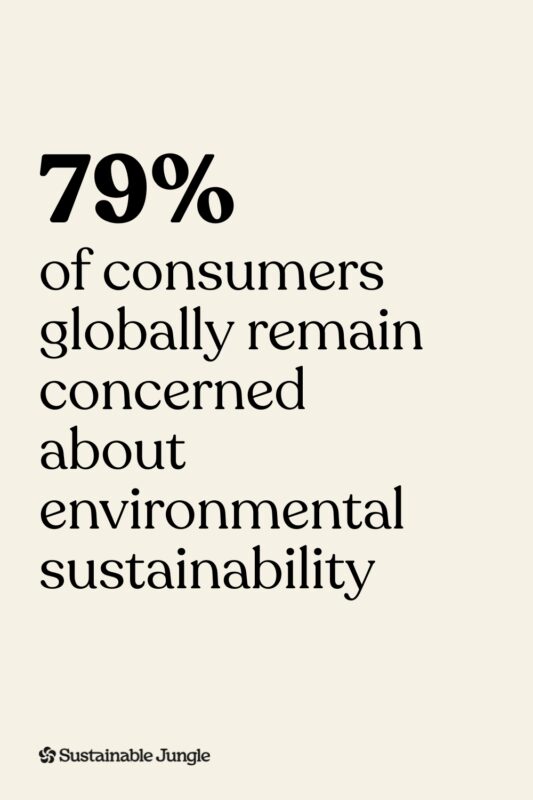
- 79% of consumers globally remain concerned about environmental sustainability (Bain Consumer Lab, 2025).
- Consumers say they are willing to pay an average of 9.7% more for sustainably produced goods (PwC Voice of the Consumer, 2024).
- Sustainability-marketed products now hold a 25.4% market share in the US CPG market (NYU Stern/Circana, 2025 report).
- Greenwashing concern among sustainability-minded consumers has grown fivefold in four years, from 8% to 43% (SJ Consumer Report).
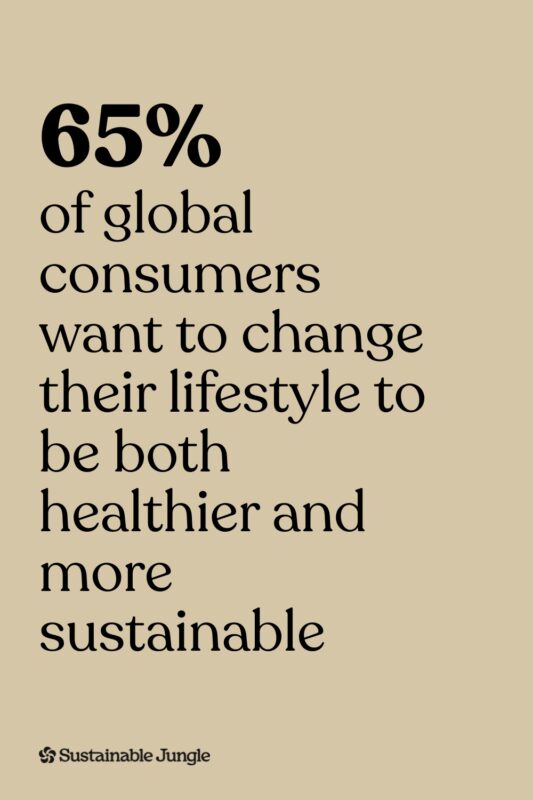
- 65% of global consumers want to change their lifestyle to be both healthier and more sustainable, while only 7% are interested in sustainability alone (GlobeScan, 2025).
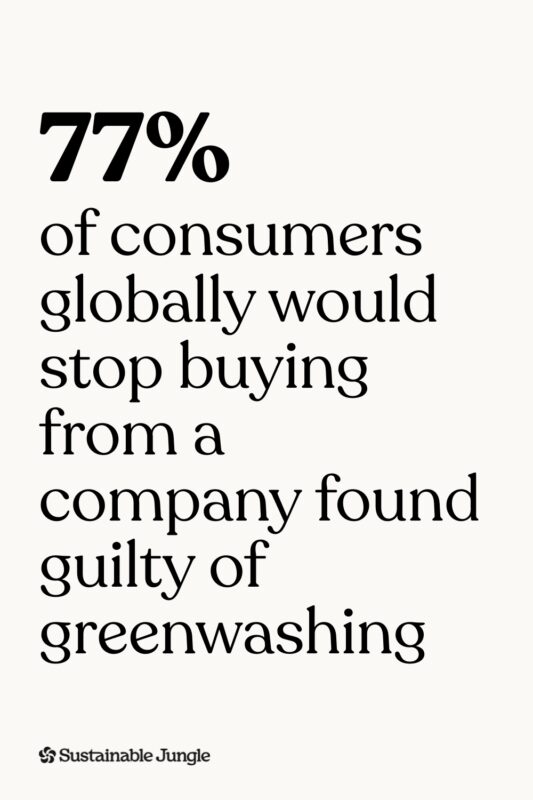
- 77% of consumers globally would stop buying from a company found guilty of greenwashing (NielsenIQ, 2025).
- Sustainability-marketed products grew at a 10.9% five-year CAGR (growth rate), nearly five times faster than conventionally marketed goods at 2.2% (NYU Stern/Circana, 2025 report).
- 85% of companies maintained or expanded their sustainability programs in 2025, but only 16% communicated this publicly (Harvard, 2025).
- Demand for brand transparency jumped 12 percentage points in a single year, with 63% of consumers now saying brands need to be more transparent (SJ Consumer Report).
Table of Contents: Sustainable Consumer Trends
- Do Consumers Care About Sustainability? Jump to section
- Health Is Becoming the Biggest Driver Jump to section
- The Sustainable Products Market Jump to section
- Are Consumers Willing to Pay More For Sustainability? Jump to section
- What Are Consumers Doing Differently & the Intention-Action Gap Jump to section
- The Greenwashing Trust Erosion Jump to section
- Generational Differences Jump to section
- What This Means for You Jump to section
- Frequently Asked Questions On Key Sustainability Consumer Statistics Jump to section
Do Consumers Care About Sustainability?
Key stats:
- 79% of consumers globally remain concerned about environmental sustainability, down from 90% in 2023 (Bain, 14,000+ respondents across 8 countries). The decline in concern for sustainability is attributed to competing priorities (more on this below)
- 80% believe their individual choices make a difference (Bain, 2025)
What this means:
Bain & Company’s 2025 Consumer Lab survey of more than 14,000 people across eight countries found that 79% remain concerned about environmental sustainability, a decline from 90% in 2023 and 86% in 2024 that has fueled plenty of “sustainability is dead” headlines. A drop from 90% to 79% still means four out of five consumers care across a sample spanning the US, UK, Brazil, Italy, China, Indonesia, UAE, and Saudi Arabia, and the same survey found that 80% of respondents believe their individual choices make a difference (a figure that slightly increased from prior years).
The decline is also better explained by competing priorities than by waning interest. Bain’s researchers attributed the softening directly to geopolitical upheaval, economic pressures, and a persistent cost of living crisis that has left consumers worried and overwhelmed, with sustainability competing for headspace against more immediate financial anxieties.
Capgemini’s 2025 A World in Balance report (surveying 6,566 consumers across 13 countries) reached a similar conclusion, finding that consumer adoption of sustainable products is limited by affordability pressures, and that most consumers believe companies are greenwashing (see section below on greenwashing).
When people are stretched financially, the price premium on sustainable goods becomes a harder sell, even when their underlying concern hasn’t changed.
Deloitte’s biannual ConsumerSignals Survey (roughly 20,000 respondents across 20 countries) tells a similar story, with a stable core of consumers identifying climate change as an emergency and modifying their purchasing behavior accordingly.
Health Is Becoming the Biggest Driver
Key Stats:
- 69% of sustainability-minded consumers now cite health and safety as a purchase driver, up from nearly zero two years ago (SJ Consumer Report)
- 65% want to change their lifestyle to be both healthier and more sustainable, while only 7% are interested in sustainability alone (GlobeScan, 32,000 respondents across 31 markets)
- 47% are more likely to choose a brand offering health benefits alongside environmental ones (NielsenIQ, 2025)
- “The right thing to do” as a motivation for consuming sustainable products declined from 82% to 61% (SJ Consumer Report)
What this means:
The most notable shift in recent data is how personal health and safety have moved to the center of sustainable purchasing decisions. Consumers are increasingly connecting what’s good for the planet with what’s good for them personally.
In Sustainable Jungle’s own consumer surveys, health and safety as a purchase driver went from virtually zero to 69% of respondents in just two years, making it the fourth-highest motivation behind climate change, nature and biodiversity, and global inequalities. Meanwhile, “the right thing to do” as a motivation declined from 82% to 61%, suggesting that abstract moral reasoning is giving ground to more personal, tangible concerns.
GlobeScan’s 2025 Healthy & Sustainable Living research (surveying nearly 32,000 consumers across 31 markets) reinforces this finding, with their data showing that 65% of consumers want to change their lifestyle to be both healthier and more sustainable, while only 7% are interested in sustainability alone. NielsenIQ’s 2025 research found that 47% of consumers globally are more likely to choose a brand that offers health benefits alongside environmental ones.
This has practical implications, because brands and products framing sustainability around personal benefit (non-toxic materials, clean ingredients, health-safe production) are connecting with a wider audience than those leading with environmental messaging alone, a pattern reflected in the growth of categories like non-toxic cookware and eco-friendly cleaning products.
The Sustainable Products Market
Key stats:
- 25.4% of US CPG market share is held by sustainability-marketed products, up 10.8 percentage points since 2013 (NYU Stern/Circana, 2025)
- 10.9% five-year CAGR for sustainable products vs. 2.2% for conventional (NYU Stern/Circana, 2025)
- 84% of sustainability-minded consumers seek sustainable cleaning products, 73% food and drinks, 65% clothing and shoes (SJ Consumer Report). More on this below.
- 4 in 10 consumers globally purchase at least one sustainable product every month (Deloitte)
What this means:
The most rigorous tracking of sustainable product sales comes from the NYU Stern Center for Sustainable Business, which partners with Circana (formerly IRI) to analyze national purchasing data across 36 consumer packaged goods categories in the US. Their 2025 report (released April 2026) found that products marketed as sustainable now hold 25.4% of US CPG market share, with a five-year compound annual growth rate of 10.9% compared to 4.0% for the total market and just 2.2% for conventionally marketed goods.
As NYU Stern’s Randi Kronthal-Sacco noted in the report’s release, consumer demand is accelerating even as some corporate sustainability messaging pulls back.
Where Are Consumers Shopping Sustainably?
In Sustainable Jungle’s survey data, the product categories where consumers most seek sustainable alternatives have stayed fairly consistent over four years, with cleaning products (84%), food and drinks (73%), and clothing and shoes (65%) leading the way.
There are interesting shifts underneath though. Sustainable beauty dropped 11 percentage points between 2024 and 2025 (85% to 74%), possibly reflecting growing skepticism around “clean beauty” claims, while food and drinks climbed steadily and overtook both beauty and clothing for the first time in our 2025 data, likely driven by the health-sustainability connection outlined above.
Deloitte’s Consumer Industry Center research found that about 4 in 10 consumers globally purchase at least one sustainable product every month, with green purchases concentrating in food and household goods.
Are Consumers Willing to Pay More For Sustainability?
Key stats:
- 80% say they are willing to pay more for sustainably produced goods (PwC, 2024)
- 9.7% average stated premium consumers will pay (PwC, 2024)
- 13% stated premium among US consumers specifically (Bain, 2025)
- 36% would pay more in the UK (Deloitte UK, 2024)
- 27% average price premium for sustainable products, down from 39% in 2018 and largely stabilized (NYU Stern/Circana, 2025)
What this means:
PwC’s 2024 Voice of the Consumer Survey (more than 20,000 consumers across 31 countries) found that over 80% of consumers say they are willing to pay more for sustainably produced goods, with a stated willingness to pay an average of 9.7% above standard prices, and Bain’s 2025 survey found US consumers reporting willingness to pay up to a 13% premium.
Deloitte’s UK Sustainable Consumer Report found that only 36% would pay more, with the majority either undecided or unwilling. The variation across studies reflects differences in geography, methodology, and question framing, but the consistent finding is that a meaningful share of consumers express willingness to pay a premium for sustainability.
The price premium itself is narrowing, which should help close the gap between intention and action over time. According to NYU Stern’s 2025 data, sustainable products currently carry an average 27% price premium over conventional alternatives, down steadily from 39% in 2018, with the premium largely stabilizing over the past few years of high inflation.
Cost Hits Some Consumers Harder Than Others
Sustainable Jungle’s survey data shows cost as a barrier varies significantly by age and income, with 73% of 26-to-35-year-olds citing cost as a barrier to buying from sustainable brands compared to just 40% of respondents over 66. Globally, willingness to pay varies dramatically by region, and Bain’s 2025 data shows consumers in fast-growing markets (like India, Kenya, and Vietnam) are significantly more willing than those in developed markets.
Younger consumers often face higher housing and living costs relative to their earnings, making a ~10-30% premium on every day purchases a harder ask even when their stated concern about sustainability is high.
What Are Consumers Doing Differently & the Intention-Action Gap
Key stats:
- 85% of people want to make more sustainable choices, but only 29% are actively changing their behavior (Kantar Sustainability Sector Index, 2025)
- 49% reported lower energy use, 46% recycle, 41% use reusable products, 38% reduced disposable purchases (Bain, 2025)
- 82% do not routinely seek out sustainability info about food brands, even though 44% say they’d pay more for sustainably produced food (PwC, 2025)
- 77% of US consumers consider recyclability “extremely” or “very” important when choosing packaged products (McKinsey Sustainability in Packaging Survey, 2025)
- 84% of sustainability-minded consumers seek sustainable cleaning products, 73% food and drinks, 65% clothing and shoes, while sustainable beauty dropped from 85% to 74% in a single year (SJ Consumer Report)
- 76% consider sustainability when choosing energy providers, 37% for banking, 34% for housing (SJ Consumer Report)
- Top consumer frustrations center on packaging, food/grocery, and fast fashion brands like Shein, Temu, and H&M (SJ Consumer Report)
What this means:
This gap between intention and action is one of the most important and confusing dynamics in sustainable consumption. Consumers mean it when they say they care, but convenience, price, and habit still dominate at the point of purchase. Kantar’s 2025 Sustainability Sector Index (surveying more than 20,000 consumers across 22 markets) puts it starkly, with 85% of people saying they want to make more sustainable choices while only 29% are actively changing their behavior.
PwC’s 2025 food-focused survey (21,075 consumers across 28 countries) found that 44% say they are willing to pay more for sustainable food production while 82% do not routinely seek out information on food brands’ sustainability initiatives.
Where the Action Is Happening
Bain’s 2025 survey found that the most common sustainable behaviors are practical, everyday changes rather than dramatic lifestyle overhauls, with 49% of consumers reporting lower energy use, 46% recycling, 41% using reusable products, and 38% buying fewer disposable items. McKinsey’s 2025 Sustainability in Packaging Survey (more than 11,000 consumers across 11 countries) found that 77% of US consumers consider recyclability “extremely” or “very” important when choosing packaged products, followed by recycled content at 62% and compostability and reusability at 60%.
In Sustainable Jungle’s data, the product categories where consumers most actively seek sustainable options are cleaning products (84%), food and drinks (73%), and clothing and shoes (65%). Sustainable beauty dropped 11 percentage points in a single year (85% to 74%).
The frustrations that come up most frequently in our open-text responses center on packaging (a persistent pain point across all four years of our survey), food and grocery systems, fast fashion (with Shein, Temu, and H&M called out repeatedly), and large corporations being named directly more often than in previous years.
Beyond Sustainable Products
Consumers are also increasingly considering sustainability when choosing service providers, not just product brands, with our 2025 data showing 76% consider sustainability when choosing energy providers, 37% when choosing banking services, and 34% when choosing housing, suggesting the conversation is expanding well beyond what people put in their shopping carts.
For practical ideas on shifting your own habits, our guide to Amazon alternatives is a good starting point.
The Greenwashing Trust Erosion
Key stats:
- 43% of sustainability-minded consumers now cite greenwashing as a barrier to sustainable purchasing, up from 8% in 2022 (SJ Consumer Report)
- 62% of consumers believe companies are greenwashing (Capgemini’s 2025 A World in Balance report)
- 77% of consumers globally would stop buying from a company found guilty of greenwashing (NielsenIQ, 2025)
- 85% of companies maintained or expanded sustainability programs, but only 16% said so publicly (Harvard, 2025)
- 36% of consumers saw sustainability messaging from brands in 2025, down from 49% two years earlier (GlobeScan, 2026)
- 63% of consumers say brands need to be more transparent, up 12 percentage points in a single year (SJ Consumer Report)
What this means:
In Sustainable Jungle’s consumer surveys, greenwashing concern grew from 8% in 2022 to 43% in 2025, a more than fivefold increase in four years that now makes it the second-largest barrier to purchasing from sustainable brands, close behind cost (which has hovered between 55% and 65% over the same period).
NielsenIQ reports that 77% of global consumers would stop buying from a company found guilty of greenwashing.
One notable finding from our data is that greenwashing concern is somewhat consistent across all age groups (33% to 47%), suggesting it is a universal issue rather than a generational one, and that everyone is getting more skeptical regardless of age.
The Greenhushing Problem
While consumer distrust grows, many brands are going in the opposite direction by going quiet on their sustainability work altogether, a trend known as greenhushing.
GlobeScan’s 2025 research found that only 36% of consumers saw sustainability messaging from brands in 2025, down from 49% just two years earlier, and trust in those messages dropped from 79% in 2022 to 65% in 2025.
Most of these brands haven’t stopped doing the work. A Harvard-led survey of 75 global companies found that 85% maintained or expanded their sustainability programs, but only 16% said so publicly, driven by fear of greenwashing accusations, tightening regulations (like the EU’s Green Claims Directive), and in some markets, political backlash.
This creates a frustrating cycle for consumers trying to make informed choices, because the brands doing the work aren’t talking about it and the brands talking the loudest may be the ones doing the least.
What Consumers Want
Our data shows that demand for transparency is the fastest-growing consumer expectation, jumping 12 percentage points in a single year to 63% of respondents, and a 2025 study published in the Journal of Advertising Research found that brands navigating the greenhushing dilemma are increasingly relying on third-party sustainability signals rather than making direct claims.
This is part of why independent rating and certification systems (like B Corp certification, GOTS, Fair Trade, and our own Sustainable Jungle brand ratings) are becoming more important in the purchasing decision, because they let brands show their work without relying on marketing language that consumers increasingly dismiss.
Generational Differences
Key stats:
- Nearly a third of consumers practice six or more sustainable habits daily, and 70% want to adopt even more sustainable routines (Bain, 2025)
- Boomers have added more new sustainable habits than Gen Z over the last three years, driven by relative wealth and flexibility (Bain, 2025)
- 65% of Gen Z and 63% of Millennials are willing to pay more for sustainable products. 25% of Gen Z and 26% of Millennials have already researched a company’s environmental impact before buying. (Deloitte, 2025 Gen Z and Millennial Survey)
- 33% of Gen Z are willing to pay 5-10% more for sustainable products (Harris Poll, 2025)
- Greenwashing concern is consistent across all age groups at 33-47% (SJ Consumer Report)
What this means:
Bain’s 2025 data found that nearly a third of consumers practice six or more sustainable habits daily and 70% want to adopt even more sustainable routines, a trend that held consistent across geography and demographics. Perhaps the most surprising generational finding is that Boomers have added more new sustainable habits than Gen Z over the last three years, which Bain attributes to their relative wealth and flexibility to make meaningful changes (like installing solar panels at home).
Gen Z and Millennials remain more willing than older generations to pay a premium for sustainability, with Deloitte’s 2025 Gen Z and Millennial Survey (23,400+ respondents globally) finding that 65% of Gen Z and 63% of Millennials say they would pay more for environmentally sustainable products, and that around 25% of Gen Z have already researched a company’s environmental impact before buying. A Harris Poll study from 2025 put a finer point on the premium, finding that 33% of Gen Z are willing to pay 5-10% more for sustainable products specifically.
What This Means for You
If you’re trying to shop more sustainably (and the fact that you’re reading this suggests you are), here are some ideas to do just that:
To Start, Focus On The Categories Where It Counts:
Cleaning products, food, and clothing have the largest environmental footprint in everyday consumer life and also the widest range of sustainable alternatives.
Starting with one category and building from there is more effective (and less overwhelming) than trying to overhaul everything at once.
Then start looking beyond consumer “products” and consider switching out your energy provider (to renewable), your bank (to a bank that doesn’t support fossil fuels), and other consumer services you spend your hard earned money on.
Related Guides: Fast Fashion Alternatives, Zero Waste Swaps
Look For Third-Party Certifications
With greenwashing concern at an all-time high and brands going quiet on their sustainability work, independent certifications are more reliable signals.
Examples include: Fair Trade, GOTS, B Corp, OEKO-TEX, Climate Label
Don’t Let Perfect Be The Enemy Of Less Bad
One of the consistent findings across all these surveys is that cost remains the biggest barrier, so if the fully sustainable option is out of reach, the less-bad option is still progress.
Using what you have already, choosing secondhand over new, and durable over disposable are simple low-cost ways to reduce your impact.
Connect Sustainability To What You Already Care About
As we’ve found in this article, the research is clear that health and personal wellbeing are now the strongest entry points, so if non-toxic living or reducing microplastics resonates, then lean in on making changes in those areas that are a win-win for you and the planet.
Buy Less, Choose Better
NYU Stern’s data shows sustainable products are growing fast, but the most sustainable purchase is often the one you don’t make, and building a minimalist wardrobe, repairing rather than replacing, and recycling clothes you no longer wear all reduce demand for new production regardless of how sustainably that production is managed.
If you do buy new, support brands and people who are putting in the extra effort to minimize their environmental footprint. At Sustainable Jungle, we see sustainable brands (run by really good people) going out of business everyday, and that’s so sad, especially when we see brands like Shein and Temu doing well.
Frequently Asked Questions On Key Sustainability Consumer Statistics
What Percentage of Consumers Care About Sustainability?
Around 79% of consumers globally express concern about environmental sustainability, according to Bain & Company’s 2025 survey. That figure has declined from 90% in 2023, but the decline is better explained by competing priorities (cost of living, geopolitical uncertainty) than by waning interest, because four out of five consumers still care and 80% believe their individual choices make a difference.
Are Consumers Willing to Pay More for Sustainable Products?
Most surveys find a majority of consumers say they are willing to pay some premium, with PwC’s 2024 survey finding consumers willing to pay an average of 9.7% more and Bain finding US consumers stating willingness to pay up to 13% more.
Stated willingness and purchasing behavior don’t always align though, because cost, convenience, and habit still drive most decisions at the checkout, and the price premium for sustainable products has been narrowing (from 39% in 2018 to 27% in NYU Stern’s latest data) which should help close this gap over time.
What Is the Biggest Barrier to Sustainable Shopping?
Cost is consistently the number one barrier across surveys, with 55-65% of respondents in Sustainable Jungle’s data citing price as the primary barrier across all four years of our survey.
Greenwashing concern is now the second-largest barrier (43%) and growing fast. Younger consumers feel the cost barrier more acutely, with 73% of 26-to-35-year-olds citing cost compared to just 40% of respondents over 66.
Do Gen Z Consumers Care More About Sustainability?
Deloitte’s 2025 Gen Z and Millennial Survey found that 65% of Gen Z and 63% of Millennials are willing to pay more for sustainable products, and about 25% have already researched a company’s environmental impact before buying.
Interestingly though, Bain’s 2025 data found that Boomers have added more new sustainable habits than Gen Z over the last three years, driven by their relative wealth and flexibility. The pattern is less “Gen Z cares more” and more that Gen Z cares differently, with a stronger emphasis on brand authenticity and willingness to pay a premium.
Is the Sustainable Products Market Growing?
Yes! Sustainability-marketed products now hold 25.4% of US CPG market share, up from around 17% a few years ago, and are growing nearly five times faster than conventional products (10.9% vs 2.2% five-year CAGR) according to NYU Stern’s 2025 Sustainable Market Share Index.
How Big Is the Greenwashing Problem?
In Sustainable Jungle’s consumer surveys, greenwashing concern grew fivefold between 2022 and 2025 (from 8% to 43%), making it the second-largest barrier to sustainable purchasing after cost.
NielsenIQ found that 77% of consumers would stop buying from a company caught greenwashing, and Capgemini’s 2025 report found that 62% of consumers believe companies are greenwashing. Meanwhile, 85% of companies maintained or expanded their sustainability programs but only 16% said so publicly, creating a frustrating cycle where the brands doing the work just aren’t talking about it.
Where Can I Find Brands That Are Verified as Sustainable?
Third-party certifications like Fair Trade, GOTS, B Corp, and OEKO-TEX are good starting points, and Sustainable Jungle’s brand assessment rates brands across 22 sustainability criteria in four pillars (Nature & Animals, Communities & Wellbeing, Values & Governance, and Product Performance) to provide independent assessments. You can find rated brands in our sustainable brand directory (filtered for “rated”).
Final Thoughts On Consumer Sustainability Trends
The sustainable consumer hasn’t gone anywhere, and the purchasing data backs that up with 25.4% market share and strong growth rates.
Concern levels have softened from their post-pandemic peak, but consumers are getting smarter about what they buy and who they trust, which is why greenwashing skepticism has grown five times faster than any decline in concern.
The biggest shift we see across all this research (including our own) is that sustainability is becoming less about grand gestures and more about informed, practical choices, with people connecting it to their health, to their household budgets, and to the specific products they reach for every day.
If that sounds like you, you’re in good company, because four out of five consumers worldwide are asking the same questions about the brands they buy from. The trick is knowing where to look for answers.
Editor’s Note: Our proprietary consumer survey data is published in full in the Sustainable Jungle Consumer Report 2026. Survey participants were our own sustainability minded readers.

Joy has been a passionate advocate for the environment since she was a small child. She grew up in South Africa and has been lucky enough to be exposed to the wonders of nature not just in Africa but all over the world. She founded Sustainable Jungle (together with her husband Lyall) back in 2017 after becoming enraged by the devastating impact of palm oil. She then founded the Sustainable Jungle Podcast and together with Lyall interviewed remarkable people from all over the world who were finding ways to create positive impact. Outside of Sustainable Jungle, Joy has always worked in the corporate world, starting out as an auditor and later moving into management consulting. More recently she specialized in Climate Investing for the Asia Pacific region. Given her experience, her current passion is Brand Ratings. She is very much enjoying going deeper on what it really means to drive sustainability performance and true impact through business operations.