













If you’ve spent any time shopping for a non-toxic mattress or organic pillow, you’ve probably noticed that every brand seems to have its own version of the word “natural” plastered across its product pages. Natural latex, 100% natural, and all-natural latex foam. It sounds reassuring, but what does any of it mean?
Natural latex is the milky sap of the rubber tree, and it makes for a remarkably good material for mattresses and pillows. But the gap between “natural” and “organic” latex is wide, and the gap between either of those and “synthetic” latex is wider still.
If you’re going to spend a third of your life lying on this stuff, it helps to know what it is. So we’re going to walk through what natural and organic latex are, how they’re made, whether they’re safe for you and for the planet, and what to look for (and look out for) on product labels.
Related Guides: Non-Toxic Mattresses, Organic & Non-Toxic Pillows, Mattress Toppers, Organic Mattress Protectors, Non-Toxic Bed Frames, Non-Toxic Bedding, Non-Toxic Living, What Does Non-Toxic Mean?
What Is Organic Latex? At a Glance
- Natural latex is the milky sap of the rubber tree, tapped by hand without felling the tree. It’s processed into foam for mattresses, pillows, and toppers using either the Dunlop or Talalay method.
- Organic latex means the natural latex is GOLS-certified. This means at least 95% certified organic rubber, tested VOC limits, restricted chemical inputs, and audited labor conditions.
- Natural (and organic) latex produces minimal VOC emissions compared to polyurethane foam. However, latex proteins can trigger allergic reactions in a small portion of the general population.
- Rubber trees are renewable, carbon-sequestering, and the finished product will biodegrade over time (though vulcanization slows this process). The trade-off is that rubber plantations have driven over 4 million hectares of tropical deforestation in Southeast Asia since 1993. Sourcing geography and certification (GOLS, FSC) make a significant difference.
- If buying latex products, we’d recommend GOLS-certified organic latex from reputable plantations, and check the whole product for organic certification (cover, adhesive, fire barrier) rather than just the latex core.
Table of Contents: Natural & Organic Latex
- What Is Natural Latex? Jump to section
- How Is Natural Latex Processed Into Foam? Jump to section
- Natural vs. Organic vs. Synthetic Latex Jump to section
- Is Natural Latex Safe? Jump to section
- Is Natural Latex Sustainable? Jump to section
- What to Look For When Buying Latex Products Jump to section
- Frequently Asked Questions About Natural & Organic Latex Jump to section
What Is Natural Latex?
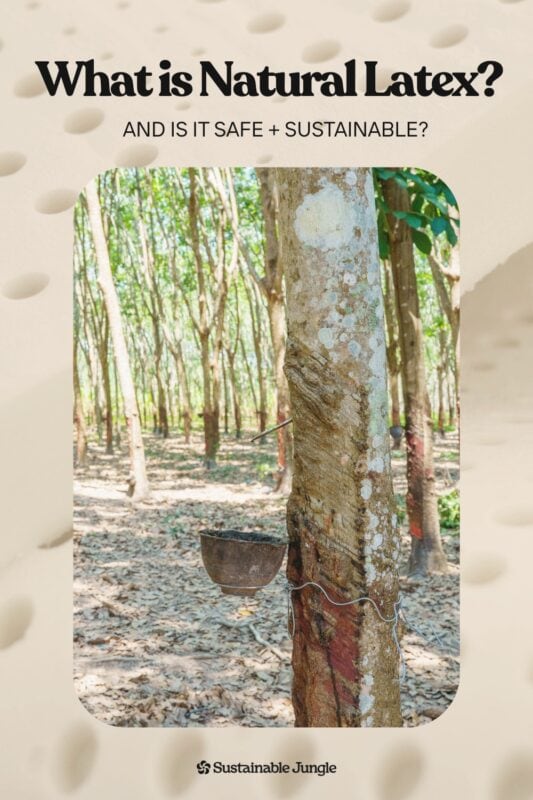
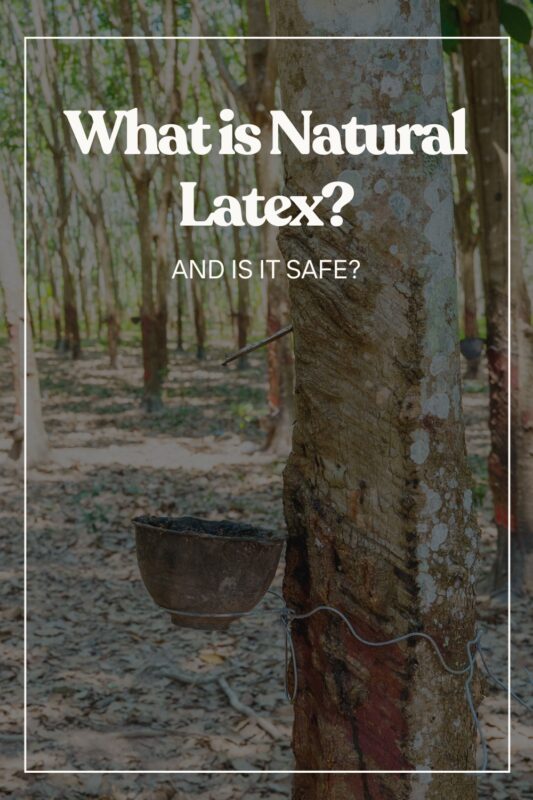
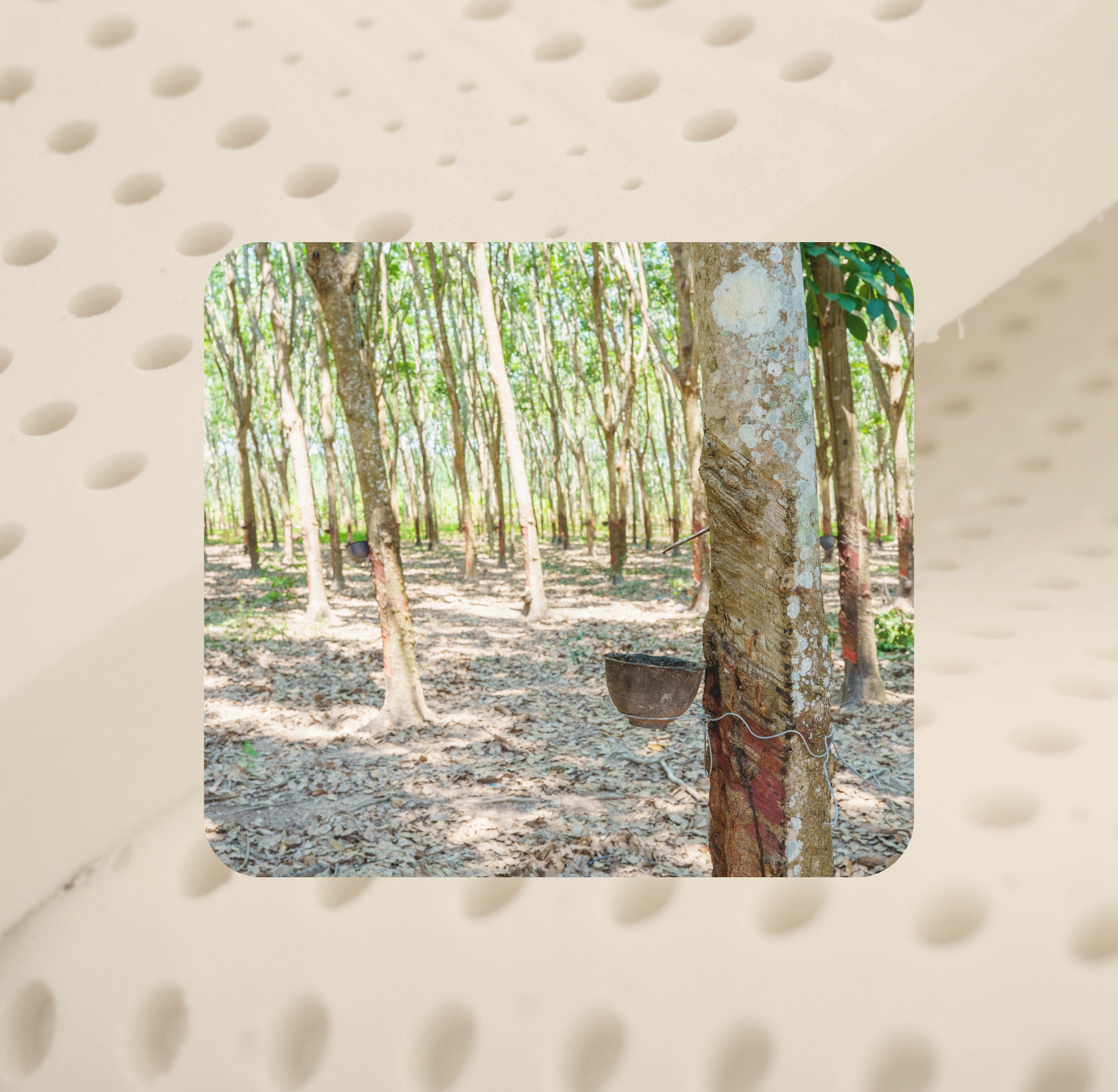
Natural latex is a milky white fluid tapped from the bark of the rubber tree (Hevea brasiliensis). If you’ve ever seen photos of maple syrup harvesting, the process is similar: a thin, angled cut is scored into the bark (typically in a half-spiral pattern), and the sap flows down into a small collection cup.
Each tree yields roughly 50 grams (1.7 ounces) of solid rubber per tapping, with tapping taking place about once every two days. This can continue for decades without harming the tree, because the bark regenerates over time.
Rubber trees are tropical plants, so most of the world’s natural latex comes from Southeast Asia. Thailand is the largest producer (accounting for roughly a third of global output), followed by Indonesia and Vietnam. Together with India, Malaysia, and several other Asian countries, the region dominates production. In total, natural rubber plantations covered approximately 14.2 million hectares across Southeast Asia in 2021.
What makes natural latex useful for sleep products is its molecular structure. The rubber within the latex is a polymer of isoprene (cis-1,4-polyisoprene), a compound that gives it elasticity, resilience, and the ability to bounce back to its original shape after compression. These properties translate well to mattresses and pillows, because the material supports your body weight without permanently deforming the way synthetic foams tend to over time.
How Is Natural Latex Processed Into Foam?
Raw liquid latex needs to be processed before it can become the slab of foam inside your mattress. There are two main methods, and they produce noticeably different results:
Dunlop Process
The original and simpler method, first developed in 1929 by E.A. Murphy at the Dunlop Rubber Company. Liquid latex is whipped into a froth, poured into a mold, and baked (vulcanized). Natural sediment settles to the bottom during baking, which makes Dunlop latex slightly denser on one side. The result is a firm, durable foam.
Dunlop is the more common process for organic and natural latex products.
Talalay Process
A more complex method developed in the 1940s by the Talalay family at B.F. Goodrich. After the latex is whipped and poured into a mold (only partially filling it), the mold is sealed and a vacuum is applied, causing the latex to expand and fill the remaining space.
The mold is then flash-frozen to stabilize the cell structure, carbon dioxide is introduced to gel the latex, and the mold is heated to vulcanize it. The result is a softer, more consistent foam with a slightly bouncier feel. Talalay tends to be more expensive because the process is energy-intensive.
Both processes require small amounts of curing agents (sulfur, zinc oxide, and other compounds) to stabilize the foam, which is why even “100% natural” latex contains approximately 5% non-latex additives. We’ll come back to this below.
Natural vs. Organic vs. Synthetic Latex
Let’s walk through what each of these labels means:
What Is Organic Latex?
“Organic” is tied to a specific certification: GOLS (Global Organic Latex Standard). To carry a GOLS label, latex must meet a strict set of requirements:
It must contain a minimum of 95% certified organic raw material by total weight.
The rubber trees must be grown on plantations certified organic under the USDA National Organic Program or EU organic regulations, meaning no synthetic pesticides, herbicides, or chemical fertilizers are used.
GOLS also sets limits on VOC emissions, prohibited substances, and filler content, and it includes social criteria covering worker safety and fair labor.
The remaining ~5% in GOLS-certified latex consists of the curing agents (sulfur, zinc oxide, fatty acid soaps) required to turn liquid sap into stable foam. These are unavoidable in the vulcanization process, which is why no latex foam can be labeled “100% organic.”
Any brand claiming otherwise is either uninformed or misleading you.
vs. Natural Latex
“Natural” means the latex was harvested from rubber trees rather than produced from petrochemicals. But the term “natural” has no standardized legal definition in mattress labeling.
The FTC has taken enforcement action against mattress companies for unsubstantiated “natural” and “organic” claims, finding cases where products marketed as “natural” were made wholly or primarily from synthetic materials.
A product marketed as “100% natural latex” still contains approximately 5% curing agents, because that’s how vulcanization works. And without certification, there’s no independent verification of how much natural versus synthetic latex is in the product.
vs. Synthetic Latex
Synthetic latex is produced from petrochemicals, most commonly styrene-butadiene rubber (SBR). It mimics some properties of natural latex but is derived from fossil fuels and is not biodegradable. Synthetic latex tends to be cheaper and is often blended with natural latex to reduce costs.
vs. Blended Latex
This is a mix of natural and synthetic latex, with the natural content varying widely between products. Blended latex is common in mid-range mattresses and is often marketed with language like “latex foam” or “latex comfort layer” without specifying the natural/synthetic ratio.
If the label isn’t clear but has natural claims, and is not “GOLS certified,” there’s a reasonable chance you’re looking at a blend.
Is Natural Latex Safe?
The safety profile of natural latex is one of its strongest selling points, particularly compared to the polyurethane foam found in most conventional mattresses. But the picture isn’t completely uncomplicated.
VOC Emissions and Off-Gassing
One of the most common concerns about any synthetic mattress material is whether it releases volatile organic compounds (VOCs) into your bedroom air.
A 2022 study published in Chemosphere evaluated VOC emissions from memory foam mattresses and found that compounds including 2-propanol, acetone, chloromethane, and toluene peaked during the first 24 hours after installation and continued at declining levels for over a month.
A separate study in Environmental Science & Technology found that VOC emissions from polyurethane mattresses increased significantly under simulated sleeping conditions, with elevated body heat identified as the primary driver. That means the chemicals you breathe in during sleep may be higher than lab tests at room temperature would suggest.
Natural latex, by contrast, produces minimal VOC emissions because it’s plant-derived rather than petroleum-based. A new natural latex mattress may have a mild rubber scent for a few days, but this is the smell of the material itself, not chemical off-gassing.
Certified organic latex (GOLS, OEKO-TEX, GREENGUARD Gold) is tested specifically for harmful emissions.
Natural Latex & Allergy
Natural rubber latex contains proteins that can trigger IgE-mediated (Type I) allergic reactions.
A 2016 review in the Journal of Occupational Health found that the prevalence of latex allergy remains approximately 4.3% among the general population worldwide, rising to 9.7% among healthcare workers who have prolonged occupational exposure.
A 2021 review in the World Allergy Organization Journal confirmed that sensitization rates in the general population range from less than 1% to 7.6%, depending on how and where the study was conducted.
For mattress and pillow use, the risk is relatively low for most people, because processed latex foam is encased in fabric layers and direct skin contact with the latex itself is minimal. But if you have a known latex allergy, or if you’re in a higher-risk group (healthcare workers, people with multiple surgical histories, individuals with spina bifida), this is a consideration worth taking seriously. Talk to an allergist before investing in a latex sleep product.
A Note on “Hypoallergenic” Claims
Many mattress brands market natural latex as “hypoallergenic” and “antimicrobial.” These claims deserve scrutiny. While rubber tree sap does contain proteins with demonstrated antimicrobial activity in laboratory settings, there are no peer-reviewed studies comparing dust mite colonization or microbial growth in natural latex mattresses versus polyurethane foam mattresses in real-world use. The theoretical argument (that latex’s denser structure retains less moisture, making it less hospitable to dust mites) is plausible but unproven.
More importantly, calling latex “hypoallergenic” is arguable when the material itself contains proteins that trigger allergic reactions in a small portion of the general population. Latex may offer some practical advantages for people with dust mite allergies, but it introduces its own allergy risk. If you’re choosing a mattress primarily for allergy reasons, an allergen-proof encasement over any mattress type is better supported by evidence than the mattress material itself.
Chemical Additives in Processing
As noted above, even organic latex requires curing agents to become stable foam. GOLS certification limits these additives and prohibits the use of synthetic fillers, heavy metals, formaldehyde, and certain other substances.
Non-certified “natural” latex may contain higher levels of processing chemicals because there is no independent standard governing what “natural” means.
Is Natural Latex Sustainable?
Natural latex comes from trees, it’s renewable, and it biodegrades. So it must be the perfect sustainable material, right? The reality is more layered.
What Makes Natural & Organic Latex More Sustainable
Rubber trees are a renewable resource. A single tree can be tapped for latex for 25 to 30 years without being felled, and the trees sequester carbon throughout their lifespan. This is a meaningful advantage over petroleum-derived foams, which rely on fossil fuel extraction and don’t biodegrade.
Natural rubber is biodegradable, though vulcanization (the sulfur cross-linking process that makes latex foam durable) slows decomposition significantly. Raw natural rubber breaks down relatively quickly in soil, but vulcanized latex foam takes considerably longer because microorganisms must first break the sulfur bonds before they can digest the polymer chains. It will still break down over time under the right conditions, which is more than can be said for synthetic polyurethane foam, but “biodegradable” deserves an asterisk when applied to a finished latex product.
The processing of natural latex into foam is also relatively clean compared to polyurethane foam manufacturing. The Dunlop process uses mechanical foaming (whipping air into liquid latex) rather than the chemical blowing agents and petrochemical reactions required for polyurethane, and it consumes roughly one-fifth the energy of the more complex Talalay process.
What Makes Natural Latex Less Sustainable
Rubber plantations have been a significant driver of tropical deforestation in Southeast Asia. The same Nature study we mentioned above that mapped 14.2 million hectares of rubber plantations found that rubber-related forest loss has been at least two to three times higher than previous policy estimates suggested. More than 4 million hectares of forest have been lost to rubber plantations since 1993, and over 1 million hectares of rubber plantations are located in Key Biodiversity Areas.
The countries most affected include Indonesia, Thailand, Cambodia, and Malaysia. Cambodia had the highest conversion intensity, with 35.3% of its rubber plantations displacing primary forest.
A 2024 life cycle assessment review in Industrial Crops and Products found that in the early stages of natural rubber production, inorganic fertilizer use generates the highest environmental impacts. The review also found that forest-to-plantation conversion is particularly damaging, with emissions reaching up to 6.4 tonnes of CO₂-eq per tonne of fresh latex in newly converted areas.
This doesn’t mean you should avoid natural latex, but rather it means the source matters enormously. Latex from well-managed, long-established plantations (particularly those with FSC or organic certification) has a very different environmental footprint from latex sourced from recently deforested land in Cambodia or Laos.
What Organic Certification For Latex Adds
GOLS certification addresses some of these concerns by requiring that rubber plantations are certified organic (no synthetic pesticides or fertilizers) and by including social and environmental criteria. But GOLS focuses primarily on chemical inputs and labor conditions rather than on deforestation history. Forestry certifications (like FSC certification) for the plantation itself are a stronger indicator that the land was managed responsibly, but it remains uncommon in the rubber sector.
Natural Latex End of Life
Natural latex will biodegrade over time, which gives it an advantage over polyurethane and memory foam at end of life (though vulcanization slows the process, as noted above). However, most finished mattress products contain non-latex components (fabric covers, adhesives, metal springs, fire barriers) that complicate disposal further.
A latex mattress won’t biodegrade as a unit if it’s wrapped in polyester or glued together with synthetic adhesives. The most sustainable option is to choose products where all components are natural (organic cotton cover, wool fire barrier, GOLS latex core) so the entire product has the best possible end-of-life outcome.
Related Guide: How To Dispose Of An Old Mattress
What to Look For When Buying Latex Products
If you’re shopping for mattress toppers, pillows, or mattresses made with latex, here’s how to separate the good from the greenwashed.
Choose certified:
GOLS (Global Organic Latex Standard) is the gold standard for organic latex. It means at least 95% certified organic content, tested VOC limits, and supply chain traceability.
If a brand says “organic” without mentioning GOLS, ask why.
OEKO-TEX Standard 100 on the finished product confirms it has been tested for harmful substances, and GREENGUARD Gold certification tests for VOC emissions in indoor environments.
Understand what “100% natural” does and doesn’t mean:
A “100% natural latex” mattress still contains approximately 5% curing agents by weight, because that’s how vulcanization works.
What you want to avoid is a product labeled “natural” that is in fact a blend of natural and synthetic (SBR) latex. It’s a red flag if the brand won’t specify the percentage of natural content.
Look at the whole product:
The latex core might be GOLS certified, but what about the cover? The adhesive? The fire barrier? The most transparent brands use additional non-toxic components like GOTS-certified organic cotton covers, natural wool as a fire barrier (wool is naturally flame-retardant), and either no adhesives or plant-based alternatives.
Check whether the finished product holds a GOTS certification for the textile components (cover, fire barrier) in addition to GOLS for the latex core. A GOTS-certified finished mattress means the entire manufacturing process and supply chain have been independently audited, not just one component.
Beware vague sustainability language:
Terms like “eco-friendly latex,” “green sleep,” and “pure comfort” have no certifiable meaning. Look for specific claims backed by third-party verification.
Ask about sourcing geography:
Latex from countries with established organic rubber industries (India, Sri Lanka, Guatemala) is more likely to come from well-managed plantations than latex from countries where recent deforestation for rubber has been severe (Cambodia, Laos, parts of Indonesia). The best brands name their source farms or processing facilities.
Frequently Asked Questions About Natural & Organic Latex
Is Natural Latex the Same as Rubber?
Natural latex and natural rubber come from the same source: the sap of the Hevea brasiliensis tree. Latex is the liquid sap, and rubber is the solid material produced when that sap is processed (dried, coagulated, or vulcanized). In consumer products like mattresses and pillows, “natural latex foam” refers to rubber tree sap that has been whipped, poured into a mold, and baked into a resilient foam.
Is Organic Latex Hypoallergenic?
Natural latex’s dense structure may offer some practical advantages for people with dust mite allergies, because it retains less moisture than some other mattress materials. However, there are no peer-reviewed studies proving latex mattresses resist dust mites better than alternatives, and the latex itself contains proteins that can cause allergic reactions in a small portion of the general population.
Can You Be Allergic to a Natural Latex Mattress?
Yes, though the risk is low for most people because processed latex foam is enclosed in fabric layers and direct skin contact is minimal. People with known latex sensitivities, healthcare workers with prolonged latex glove exposure, and individuals with a history of multiple surgeries are at higher risk. If you’re unsure, consult an allergist before purchasing.
Is Natural Latex Biodegradable?
Yes, though with a caveat. Natural rubber’s polymer structure can be broken down by microorganisms, but the vulcanization process (sulfur cross-linking) that makes latex foam durable also slows decomposition considerably. A vulcanized natural latex product will biodegrade over time under soil conditions, but not as quickly as raw natural rubber. Synthetic latex (SBR), by contrast, is petroleum-based and does not biodegrade in any meaningful timeframe.
What Is the Difference Between Dunlop and Talalay Latex?
Dunlop is the simpler, more energy-efficient process: latex is whipped, poured, and baked. It produces a slightly denser foam. Talalay adds vacuum-distribution, flash-freezing, and CO₂ gelling steps before vulcanization, resulting in a softer, more uniform foam. Both produce high-quality latex, and the choice comes down to firmness preference and budget (Talalay tends to cost more).
Is Organic Latex Worth the Extra Cost?
If your priorities include verified organic sourcing, restricted chemical inputs, tested VOC levels, and supply chain traceability, then yes. GOLS certification independently verifies that the marketing matches the material. Non-certified “natural” latex may be perfectly good, but you’re relying on the brand’s word rather than third-party verification.
How Long Do Natural Latex Mattresses Last?
Natural latex mattresses typically last 15 to 20 years with proper care, and high-quality models can exceed that. This is significantly longer than the 7 to 10 year average lifespan of a conventional polyurethane foam or spring mattress. This durability is itself a sustainability feature, because a mattress that lasts twice as long generates half the waste.
Is Latex Natural or Synthetic?
It can be either. Natural latex is harvested from rubber trees. Synthetic latex is manufactured from petroleum-derived chemicals (typically styrene-butadiene rubber). Many consumer products, particularly budget mattresses, use a blend of both. The label should specify, and if it doesn’t, assume it’s blended.
Final Thoughts On Natural & Organic Latex
Natural latex is one of the better materials available for sleep products. It’s plant-based, durable, produces minimal VOC emissions, and biodegrades at end of life. If you’re trying to reduce your chemical exposure during the eight hours a night you spend with your face pressed against a mattress, natural or organic latex is a sound choice.
But the labeling around latex is messy, and the sustainability story has more wrinkles than an unslept-in bed. “Natural” is an unregulated term that brands stretch to fit whatever they’re selling. The rubber industry has driven significant deforestation in Southeast Asia. And the allergy question, while low-risk for most people, could be a significant issue for some.
Choose GOLS-certified organic latex when your budget allows, look for brands that pair it with other sustainably certified materials, and don’t be afraid to ask a brand exactly where their latex comes from and what certifications they hold.
Sleep well, and sleep informed. And please share with any loved ones who are exploring new mattress or pillow options.

Joy has been a passionate advocate for the environment since she was a small child. She grew up in South Africa and has been lucky enough to be exposed to the wonders of nature not just in Africa but all over the world. She founded Sustainable Jungle (together with her husband Lyall) back in 2017 after becoming enraged by the devastating impact of palm oil. She then founded the Sustainable Jungle Podcast and together with Lyall interviewed remarkable people from all over the world who were finding ways to create positive impact. Outside of Sustainable Jungle, Joy has always worked in the corporate world, starting out as an auditor and later moving into management consulting. More recently she specialized in Climate Investing for the Asia Pacific region. Given her experience, her current passion is Brand Ratings. She is very much enjoying going deeper on what it really means to drive sustainability performance and true impact through business operations.