














If you’ve recently fallen down a rabbit hole about forever chemicals in cookware, you’re probably looking at your kitchen with new suspicion. Nonstick pans? Potentially laced with PFAS. Aluminum? Questions about leaching. That shiny ceramic set you bought last year? The coating’s already flaking.
Carbon steel has become one of the most talked-about alternatives. It’s a centuries-old cookware material that’s getting attention from people who just want to cook dinner without worrying about what’s leaching into it. Professional chefs have used carbon steel for generations, and now home cooks are catching on, too.
But most of the information about carbon steel safety comes from companies selling carbon steel pans. So we went to the peer-reviewed research, government data, and independent sources instead. The short answer is that carbon steel is one of the safest cookware materials available. The longer answer involves some nuance about iron, seasoning chemistry, and who should pay a little extra attention.
Related Guides: Non-Toxic & Sustainable Cookware, Is Granite Cookware Safe?, Non-Toxic Food Storage, Non-Toxic Living Guide, Non-Toxic Cutting Boards, Non-toxic Bakeware, Non-Toxic Cooking Utensils, How To Avoid Microplastics, Is Stainless Steel Non-Toxic?
Table of contents: Carbon Steel
- What Is Carbon Steel Cookware? Jump to section
- Is Carbon Steel Cookware Non-Toxic? Jump to section
- Does Carbon Steel Leach Into Food? Jump to section
- What About the Seasoning Layer? Jump to section
- Carbon Steel vs. Other Cookware Materials Jump to section
- Carbon Steel Cookware Pros and Cons Jump to section
- Is Carbon Steel Cookware Sustainable? Jump to section
- What to Look For When Buying Carbon Steel Cookware Jump to section
- FAQs on Carbon Steel Cookware Jump to section
What Is Carbon Steel Cookware?
Carbon steel is an alloy made of approximately 99% iron and 1% carbon. There’s no chromium or nickel in the mix, no synthetic coatings, and no proprietary chemical blends. It’s one of the simplest cookware compositions on the market.
If that sounds a lot like cast iron, you’re right. The two are close relatives. Cast iron typically contains 2–3% carbon, which makes it harder and more brittle. Carbon steel’s lower carbon content makes it lighter, smoother, and more responsive to temperature changes. A 12-inch carbon steel pan weighs roughly 5 pounds compared to 7+ pounds for a comparable cast iron skillet.
You’ll find carbon steel used primarily in skillets, woks, crepe pans, and roasting pans. It’s the standard pan in French professional kitchens (De Buyer and Matfer Bourgeat are both French manufacturers) and across Asian cooking, where carbon steel woks have been used for centuries.
A note on nitrided carbon steel
A newer category of carbon steel pans uses a nitrogen treatment process (nitriding) to harden the surface, making it more resistant to rust and corrosion.
Nitriding doesn’t add any coatings or chemicals. It’s a heat treatment that alters the surface chemistry of the steel itself by infusing nitrogen atoms into the iron. The resulting surface is harder and more corrosion-resistant, but the pan is still fundamentally iron and carbon.
Brands like Misen and Anolon have introduced nitrided carbon steel lines. The safety profile is effectively the same as traditional carbon steel.
Is Carbon Steel Cookware Non-Toxic?
The short answer is yes, for the vast majority of people. Carbon steel is one of the safest cookware materials you can use. Though read on to understand the nuance (and lack of science) around seasoning.
Here’s what makes carbon steel non-toxic:
What’s in Carbon Steel
Iron and carbon. Both are naturally occurring elements. Iron is an essential mineral the human body needs for oxygen transport, energy production, and immune function. Carbon is a basic building block of life. Neither is toxic in the trace amounts relevant to cooking.
What’s NOT in carbon steel
Carbon steel contains no PFAS (per- and polyfluoroalkyl substances) and no PTFE (polytetrafluoroethylene, the chemical behind Teflon). It’s also free from PFOA, lead, cadmium, and synthetic nonstick coatings.
This matters because PFAS contamination in cookware has become a significant regulatory concern, with multiple U.S. states (including Minnesota, Vermont, and Maine) now banning PFAS in cookware entirely as of 2026.
What “non-toxic” means in this context
It’s worth flagging that “non-toxic” is not a regulated term for cookware and there’s no FDA certification or government seal that declares a pan “non-toxic.” The FDA does not approve cookware or classify specific materials as “food-grade” in the way many manufacturer blogs claim.
What the FDA does require is that food contact materials not adulterate food (i.e., they must not leach harmful substances into food at levels that could cause harm). Under the FDA Food Code (Section 4-101.11), cookware materials must be “safe under conditions of intended use.” Carbon steel comfortably meets this standard, having been used for food preparation for centuries without associated health concerns.
So when we say carbon steel is “non-toxic,” what we mean is that it contains no known harmful substances. It doesn’t release synthetic chemicals into food. And the only thing it can transfer to your food (iron) is an essential nutrient for most people.
Does Carbon Steel Leach Into Food?
Yes, carbon steel can leach small amounts of iron into food. This is the same phenomenon that occurs with cast iron, and the science on it is well-established.
What the research shows:
The foundational study on iron leaching from cookware was published in the Journal of the American Dietetic Association in 1986 by researchers Kuligowski and Halperin. They tested 20 different foods cooked in iron cookware and found that cooking significantly increased the iron content of most foods. The effect was most pronounced with acidic, wet foods cooked for longer periods. Applesauce cooked in a new iron skillet increased from 0.35 mg of iron per serving to 7.3 mg. Scrambled eggs went from 1.49 mg to 4.76 mg.
A follow-up study by Cheng and Brittin (1991) in the Journal of Food Science confirmed these findings and found that spaghetti sauce cooked in cast iron picked up roughly 2-6 mg of iron per serving, even after the pans had been used 50 times. Importantly, they found that well-seasoned cookware leached less iron than newer or poorly seasoned pans because the seasoning layer acts as a physical barrier between the food and the metal.
A 2021 systematic review published in PMC examined 13 studies on iron cookware and concluded that cooking in iron pots can meaningfully increase both the iron content of food and blood hemoglobin levels. It’s bee reported in the past that the WHO identified iron cookware as a potential strategy for addressing iron deficiency anemia in developing countries though this is considered a myth.
But these studies examined cast iron specifically, not carbon steel. However, because carbon steel is 99% iron (compared to cast iron’s 97-98%), the leaching mechanism is fundamentally the same. If anything, the slightly lower carbon content of carbon steel means its leaching profile is comparable to or marginally higher than cast iron’s, though we’re not aware of a dedicated leaching study on carbon steel cookware specifically.
What affects how much iron leaches:
Three factors determine how much iron transfers to your food.
- The first is the acidity of what you’re cooking (more acidic means more leaching).
- The second is how long the food is in contact with the pan (longer contact means more leaching).
- The third is how well-seasoned the pan is (better seasoning means less leaching).
For example: A quick stir-fry in a well-seasoned pan contributes negligible iron. A tomato sauce simmered for 30 minutes in a freshly seasoned pan contributes more.
Is this a problem?
For most people, no. Iron deficiency is the most common nutritional deficiency in the world, affecting an estimated 40% of the population in developing countries and 10% in developed nations. The recommended daily intake is 8 mg for adult men and 18 mg for pre-menopausal women. A few extra milligrams from your cookware is, for most people, either neutral or mildly beneficial.
When it IS a concern
People with hemochromatosis (hereditary iron overload) should be mindful. If you have hemochromatosis or another iron storage disorder, you may want to limit how often you cook acidic foods in carbon steel or cast iron, or opt for stainless steel or ceramic instead. This isn’t a reason for the general population to avoid carbon steel, but it’s a real caveat that most manufacturer blogs skip entirely.
Note: We are not healthcare professionals so if this article is prompting you to make any changes, please check with your doctor first.
What About the Seasoning Layer?
This is the question people are really asking when they search “is carbon steel safe.” So let’s be specific about what seasoning is, what’s happening chemically, and what we do and don’t know about its safety.
Seasoning is the dark, slick coating that develops on carbon steel (and cast iron) when cooking oil is heated to high temperatures on the pan’s surface. It’s what gives the pan its nonstick properties and protects the metal from rust.
The chemistry of carbon steel seasoning:
When a thin layer of cooking oil is heated past its smoke point, several chemical reactions occur simultaneously. The triglycerides in the oil break down into glycerol (which burns off as smoke) and free fatty acids. These fatty acids then undergo radical polymerization, where the molecules bond together into long cross-linked chains and form a hard, solid film. This process is chemically analogous to how drying oils (like linseed oil used in painting and wood finishing) harden into a protective coating. The resulting layer bonds directly to the iron surface at a molecular level.
In simpler terms, you’re turning liquid oil into a thin layer of a natural polymer. It’s not a synthetic coating applied at a factory but rather created in your kitchen from cooking oil you choose yourself.
Is the seasoning layer safe?
The polymerized seasoning layer is a cross-linked solid. It doesn’t behave like liquid oil anymore. It doesn’t break down at normal cooking temperatures, and it doesn’t leach into food in meaningful amounts. The Cheng and Brittin (1991) study demonstrated this indirectly by showing that well-seasoned cast iron pans leached significantly less iron into food than new or poorly seasoned pans. The seasoning acts as a physical barrier between food and metal, which tells us it’s a stable, intact layer that isn’t dissolving into your dinner.
However, there is a legitimate question about whether the seasoning layer could contain trace amounts of harmful compounds, specifically polycyclic aromatic hydrocarbons (PAHs). PAHs are a class of compounds formed when organic matter (including cooking oil) is heated to high temperatures. A 2001 study by Chen and Chen published in the Journal of the American Oil Chemists’ Society confirmed that heating cooking oils to their smoke point produces PAHs in the resulting smoke, with higher levels from polyunsaturated oils like soybean oil. A 2021 review in Frontiers in Nutrition documented the broader chemistry of oil degradation at high temperatures, including the formation of aldehydes, free radicals, and polymeric compounds.
So we know the process of seasoning produces smoke containing compounds (including PAHs and free radicals) that you don’t want to breathe. That’s well-established but what we don’t have is a peer-reviewed study that has directly tested whether these compounds persist in the finished polymerized layer at levels that matter for food safety.
Nobody has put a piece of cast iron or carbon steel seasoning through the kind of toxicological analysis you’d do for a new food contact material.
What we can say is this. When seasoning is done properly (thin layers, heated in an oven at 450–500°F for a full hour), the volatile compounds produced during the process dissipate as smoke. What remains is a hard, cross-linked polymer bonded to the iron. This is the same fundamental chemistry behind linseed oil wood finishes, which have centuries of documented use as food-safe coatings on wooden bowls, cutting boards, and utensils. And the Cheng and Brittin study confirms the resulting layer is stable enough to meaningfully reduce iron migration into food even after 50 cooking cycles.
The risk profile also needs context. A 2017 review in Critical Reviews in Food Science and Nutrition linked cancer risks to the inhalation of cooking oil fumes over prolonged occupational exposure (think: restaurant workers standing over woks for decades). The concern there is the smoke, not the solid polymer left behind on the pan. And PAHs are produced any time you cook at high heat, whether you’re grilling meat, charring vegetables, or searing a steak. So they’re not unique to the seasoning process.
Our take: the finished seasoning layer on a properly seasoned pan is very likely safe based on the available evidence and centuries of use. But it is not 100% proven safe. If you want to minimize any theoretical risk, season your pan in a well-ventilated space (or outdoors), use thin layers heated for a full hour at high temperature so volatile compounds fully dissipate, and avoid using your pan if the seasoning is visibly flaking (strip it and start over instead). Or use other types of cookware (see our guide linked at the top of the article and more on other materials below).
If seasoning flakes, is that a problem?
If seasoning is applied too thickly or at the wrong temperature, it can flake off in visible pieces. Ingesting small bits of polymerized oil is not considered toxic, but it’s a sign your technique needs adjustment. Proper seasoning involves applying an extremely thin layer of oil (wipe it on, then wipe most of it off) and heating until the pan stops smoking. Multiple thin layers build a better surface than one thick one.
Acidic foods (tomatoes, vinegar, citrus, wine) can strip seasoning, especially on newer pans that haven’t built up many layers yet. This isn’t a safety issue but rather a maintenance one. You’ll need to re-season more frequently if you regularly cook acidic dishes.
Which oils work best for seasoning?
Oils high in polyunsaturated fatty acids polymerize more readily. In practice, grapeseed oil, canola oil, and flaxseed oil are popular choices. Flaxseed oil produces an exceptionally hard seasoning layer (it’s the food-grade version of linseed oil, which artists and woodworkers use as a protective coating), but it can be brittle and flake if applied too thickly.
The 2017 review mentioned above also noted that more polyunsaturated oils produce higher levels of degradation compounds during heating, so there’s a tradeoff between polymerization quality and the compounds generated during the process. For most home cooks, canola or grapeseed oil provides reliable results at a fraction of the cost.
Carbon Steel vs. Other Cookware Materials
Understanding how carbon steel compares to other options helps put its safety profile in context.
Carbon Steel vs. Nonstick (PTFE/Teflon)
Traditional nonstick pans use PTFE (polytetrafluoroethylene) coatings. PTFE itself is considered stable at normal cooking temperatures, but when overheated above approximately 500°F (260°C), it can release toxic fumes (including particulate matter that is lethal to pet birds and can cause flu-like symptoms in humans, sometimes called “polymer fume fever“).
The bigger concern is that many PTFE coatings historically contained PFOA and other PFAS chemicals in their manufacturing process. While PFOA has been phased out, replacement chemicals from the same PFAS family are still used by some manufacturers, and the long-term safety data on these replacements is limited. Carbon steel contains none of these chemicals.
Carbon Steel vs. Stainless Steel
Stainless steel is an alloy of iron, chromium (at least 10.5%), and typically nickel (often 8–10% in the common 18/10 grade). It doesn’t require seasoning and is more resistant to corrosion.
However, stainless steel can leach small amounts of nickel and chromium into food, particularly when cooking acidic dishes. For people with nickel sensitivity or allergy (which affects an estimated 10–20% of the population), this is relevant. A 2023 study in Foods found that steel cookware leached significantly less metal overall than aluminum cookware, and that the amounts were generally within safe limits.
Carbon steel’s advantage is that it leaches only iron and doesn’t introduce nickel or chromium, making it the simpler composition from a toxicity standpoint.
Carbon Steel vs. Cast Iron
These two are close cousins with near-identical safety profiles. Both are iron-based, both require seasoning, both leach iron into acidic foods, and both are free of synthetic coatings.
The practical differences are weight (carbon steel is lighter), responsiveness (carbon steel heats and cools faster), and surface texture (carbon steel is smoother). From a safety perspective, there’s no meaningful difference.
Carbon Steel vs. Ceramic
Ceramic-coated cookware uses a sol-gel coating (typically derived from silicon dioxide) over a metal base (usually aluminum). Pure ceramic coatings are PFAS-free and considered safe.
However, the Consumer Reports investigation into “non-toxic” cookware found that some products marketed as “ceramic” contained undisclosed chemicals, and ceramic coatings degrade over time (typically lasting 1-3 years of regular use before the nonstick properties fade).
Once the ceramic coating wears through, you’re cooking on the aluminum base underneath. Carbon steel, by contrast, has no coating to degrade, and there’s no hidden base material to worry about.
Carbon Steel Cookware Pros and Cons
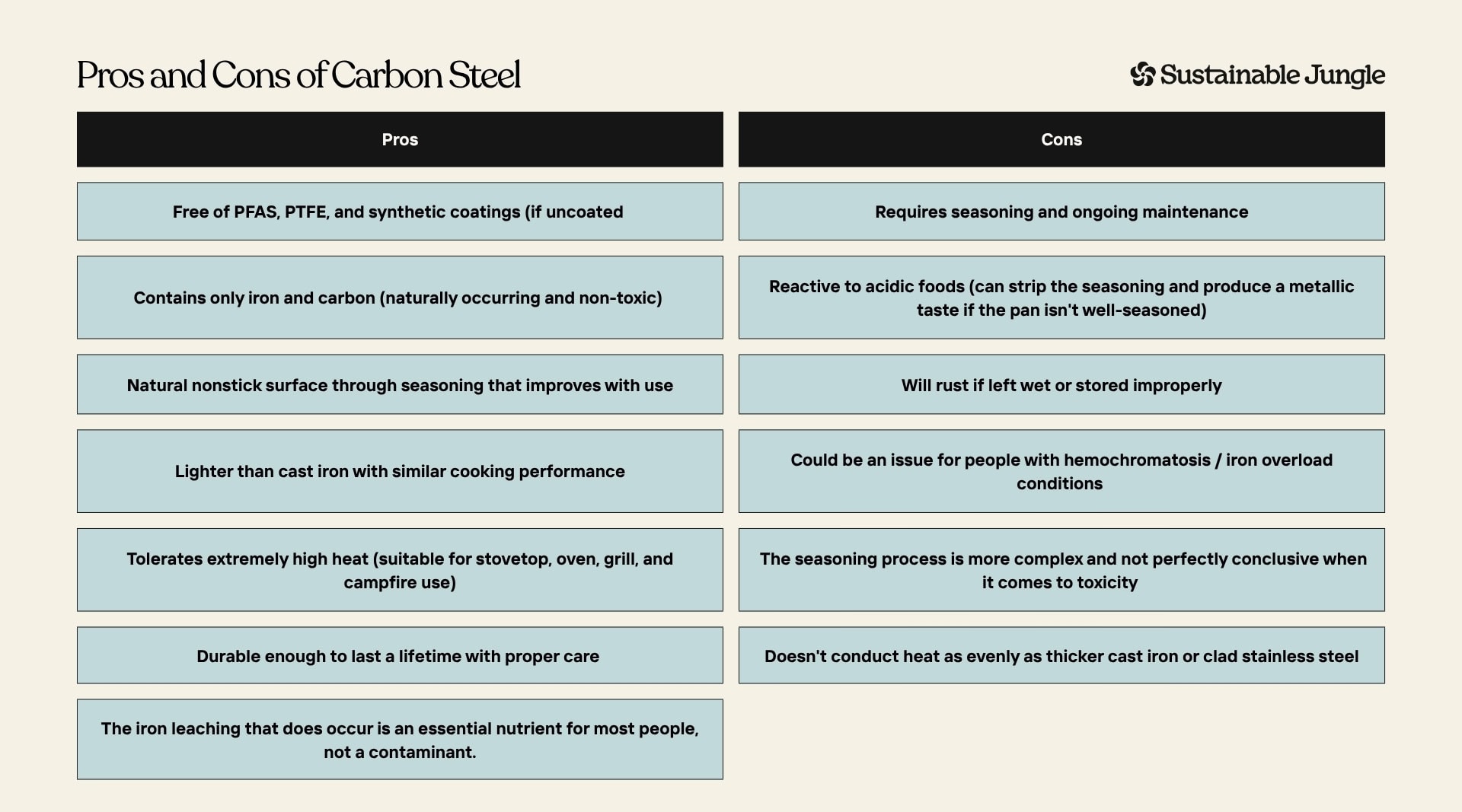
Pros:
- Carbon steel is free of PFAS, PTFE, and synthetic coatings.
- It contains only iron and carbon, both naturally occurring and non-toxic.
- The material develops a natural nonstick surface through seasoning that improves with use.
- It’s lighter than cast iron (by roughly 30%) while offering similar cooking performance.
- Carbon steel tolerates extremely high heat (up to 1,200°F), making it suitable for stovetop, oven, grill, and campfire use.
- It’s durable enough to last a lifetime with proper care. A well-maintained carbon steel pan is essentially a buy-it-for-life kitchen tool.
- The iron leaching that does occur is an essential nutrient for most people, not a contaminant.
Cons:
- Carbon steel requires seasoning and ongoing maintenance (you can’t just throw it in the dishwasher).
- It’s reactive to acidic foods, which can strip the seasoning and impart a metallic taste if the pan isn’t well-seasoned.
- It will rust if left wet or stored improperly.
- People with hemochromatosis or iron overload conditions should use it cautiously with acidic foods.
- It doesn’t conduct heat as evenly as thicker cast iron or clad stainless steel (though this can be an advantage for techniques like stir-frying).
- And the seasoning process, while straightforward, does involve a learning curve for new users and is not perfectly conclusive when it comes to toxicity.
Is Carbon Steel Cookware Sustainable?
Since sustainability is at the core of what we do at Sustainable Jungle, it’s worth examining carbon steel through an environmental lens as well.
Longevity is the biggest sustainability win
A quality carbon steel pan, properly maintained, will last decades and in some cases generations. This stands in stark contrast to nonstick pans, which typically need replacing every 2–5 years as their coatings degrade, sending old pans to landfill.
The EPA estimates that durable goods (including cookware) are a meaningful contributor to municipal solid waste. A pan you buy once and keep forever is a pan that never becomes waste.
Steel is infinitely recyclable
At end of life, carbon steel is 100% recyclable. Steel is the most recycled material on Earth. According to the World Steel Association, over 85% of steel products are recycled at end of life so this is potentially a fully circular economy material.
No synthetic coatings to shed
Carbon steel pans don’t contribute to microplastic pollution or chemical contamination the way degrading nonstick coatings can. The seasoning layer is food-derived oil, and if a pan reaches end of life, there are no problematic materials to separate or dispose of.
Manufacturing is energy-intensive but simple
Steel production does require significant energy and generates CO₂ emissions. This is true of all metal cookware. However, carbon steel cookware is typically uncoated and simply stamped or forged from sheet steel, which is a relatively low-complexity manufacturing process compared to multi-layer clad cookware or coated nonstick pans.
The extended lifespan amortizes the manufacturing footprint over many years of use and the emissions profiles improves if renewable energy is used in production.
Labour standards
Most premium carbon steel cookware comes from France (De Buyer, Matfer Bourgeat, Mauviel), the USA (Lodge, Made In, Blanc Creatives), or established Asian manufacturers.
European and US manufacturing generally involves stronger environmental regulations and labor standards than some lower-cost alternatives. If sustainability is a priority, choosing a pan from a manufacturer with transparent sourcing and production practices is worthwhile.
What to Look For When Buying Carbon Steel Cookware
If you’re sold on carbon steel as a safer cookware alternative, here’s what to pay attention to when shopping.
- Make sure it’s pure carbon steel: Some products marketed as “carbon steel” are actually carbon steel with a nonstick coating applied on top, which defeats the purpose. Look for pans described as “uncoated” or “bare” carbon steel. If a product claims to be carbon steel and nonstick out of the box without seasoning, it likely has a coating you should investigate.
- Thickness matters: Very thin carbon steel pans (under 2mm) can warp on high heat and distribute heat unevenly. Most quality pans are 2-3mm thick. De Buyer’s Mineral B line is approximately 2.5mm; Matfer Bourgeat’s black carbon steel pans are around 3mm. Thicker pans cost more and weigh more, but they’ll perform better and last longer.
- Handle construction: Riveted handles are standard and durable. Some brands (like Blanc Creatives and Solidteknics) offer rivetless, single-piece construction, which eliminates potential food trap points around rivets. This is a nice-to-have.
- Where it’s manufactured: France, the USA, and Japan have the longest traditions of carbon steel cookware production and the strongest manufacturing standards. Look for brands that specify where their steel is sourced and where the pan is made.
A few brands worth knowing:
- De Buyer (France, est. 1830): The benchmark for carbon steel cookware. Their Mineral B line uses beeswax coating for shipping protection (not a synthetic coating). Made in France with FSC-certified wooden handles on some lines. Widely considered the gold standard by both home cooks and professionals.
- Matfer Bourgeat (France, est. 1814): Another French heritage brand used in professional kitchens worldwide. Their black carbon steel pans are slightly thicker than De Buyer’s, which some cooks prefer.
- Lodge (USA, est. 1896): Best known for cast iron, Lodge also makes carbon steel skillets manufactured in the USA. Their pans come pre-seasoned, which is convenient for beginners. Lodge has strong transparency about their Tennessee-based manufacturing.
For a full rundown of our top-rated options, see our guide to non-toxic cookware linked above.
FAQs on Carbon Steel Cookware
Is Carbon Steel Non-Toxic?
Yes, with one nuance worth understanding. The metal itself is composed of iron (~99%) and carbon (~1%), both naturally occurring, non-toxic elements. It contains no PFAS, PTFE, lead, cadmium, or synthetic coatings. The only substance the metal can transfer to food is iron, which is an essential nutrient for most people. The seasoning layer (polymerized cooking oil) is a cross-linked solid that research suggests is stable at cooking temperatures, though no peer-reviewed study has directly tested its safety as a food contact surface. Based on the available evidence and centuries of use, carbon steel is considered one of the safest cookware materials available. “Non-toxic” isn’t a regulated term for cookware, but carbon steel has one of the simplest compositions on the market.
Does Carbon Steel Leach Iron Into Food?
Yes, in small amounts. Research has found that cooking acidic foods like tomato sauce in iron cookware can add small amounts of iron per serving. The amount depends on food acidity, cooking time, and how well-seasoned the pan is. For most people, this trace iron is harmless and can help address iron deficiency. But people with hemochromatosis should exercise caution.
Is Carbon Steel Seasoning Carcinogenic?
There is no evidence that a properly built seasoning layer is carcinogenic. The concern stems from the fact that heating oil past its smoke point produces polycyclic aromatic hydrocarbons (PAHs) and other compounds in the smoke, some of which are known carcinogens. However, the health risks documented in the research literature relate to inhaling cooking oil fumes over prolonged periods, not to the finished solid polymer left on the pan. No peer-reviewed study has directly tested the finished seasoning layer for residual harmful compounds. To minimize any theoretical risk, season in a well-ventilated space using thin oil layers heated for a full hour, and strip and re-season if the coating starts to flake.
Is Carbon Steel Safer Than Stainless Steel?
Both are considered safe. The key difference is composition. Carbon steel leaches only iron, while stainless steel can leach small amounts of nickel and chromium. For people with nickel sensitivity, carbon steel may be the better choice. For people with iron overload conditions, stainless steel may be preferable. For everyone else, both are good options.
Is Carbon Steel Safe for Cooking Acidic Foods?
Yes, with a caveat. Acidic foods (tomatoes, citrus, vinegar, wine) will strip the seasoning on a carbon steel pan, especially if the pan is relatively new. This isn’t a safety issue, but it can affect flavor (metallic taste) and means you’ll need to re-season afterward. Once a pan has built up a robust seasoning over many months of use, it handles acidic foods much better. For long-simmered tomato sauces, a stainless steel or enameled pot is still a better tool for the job.
Is Nitrided Carbon Steel Safe?
Yes. Nitriding is a heat treatment that infuses nitrogen atoms into the iron surface to increase hardness and corrosion resistance. It doesn’t add coatings, chemicals, or foreign materials. The pan is still fundamentally iron and carbon. Nitrided carbon steel is more resistant to rust and may require less maintenance than traditional carbon steel, which can be an advantage for busy kitchens.
Can Carbon Steel Cookware Contain PFAS?
No. Pure, uncoated carbon steel contains no PFAS by definition. PFAS are synthetic fluorinated compounds used in nonstick coatings like PTFE. Since carbon steel relies on oil-based seasoning rather than synthetic coatings for its nonstick properties, PFAS are not part of the equation. If a “carbon steel” product has a factory-applied nonstick coating, that coating could potentially contain PFAS, which is why buying uncoated carbon steel from reputable brands is important.
Is Carbon Steel or Cast Iron Safer?
They have essentially identical safety profiles. Both are iron-based, both leach small amounts of iron into acidic foods, and both develop a natural seasoning layer through the same polymerization process. That means the same open questions about seasoning chemistry apply equally to both materials. Neither has synthetic coatings, and neither has been linked to adverse health outcomes in the research literature. Choose between them based on cooking preferences (weight, heat responsiveness, surface texture) rather than safety concerns.
What Is the Safest Cookware Material?
There’s no single “safest” material because safety depends on your individual health circumstances. For most people, carbon steel, cast iron, and high-quality stainless steel are all excellent choices. Carbon steel and cast iron have the simplest compositions (iron + carbon, no alloy metals). Stainless steel avoids the iron leaching concern but introduces nickel and chromium in trace amounts.
Final Thoughts on Carbon Steel Cookware Safety
In a kitchen landscape cluttered with confusing coatings, vague “non-toxic” marketing, and a legitimate reckoning over PFAS in our cookware, carbon steel is refreshingly straightforward. It’s iron and carbon and has been used for cooking for centuries.
The iron-y is that one of the safest cookware options available is also one of the oldest and simplest. While the nonstick industry spends millions developing the next coating that might not give you cancer, carbon steel just sits there being two elements and a bit of cooking oil.
That said, carbon steel isn’t perfect for everyone. If you have an iron storage disorder, be thoughtful about how often you cook acidic foods in it. If you hate maintenance, it’s going to frustrate you. And if you want something for slow-simmered tomato sauce, grab a stainless steel or titanium pot instead.
But for searing, sautéing, stir-frying, and general everyday cooking? Carbon steel earns its place in any kitchen that prioritizes safety, longevity, and simplicity. It’s a pan you buy once, season with care, and pass down. About as sustainable as cookware gets.
If one of your friends or family members is looking into carbon steel, hit pedal to the metal and share this with them.

Joy has been a passionate advocate for the environment since she was a small child. She grew up in South Africa and has been lucky enough to be exposed to the wonders of nature not just in Africa but all over the world. She founded Sustainable Jungle (together with her husband Lyall) back in 2017 after becoming enraged by the devastating impact of palm oil. She then founded the Sustainable Jungle Podcast and together with Lyall interviewed remarkable people from all over the world who were finding ways to create positive impact. Outside of Sustainable Jungle, Joy has always worked in the corporate world, starting out as an auditor and later moving into management consulting. More recently she specialized in Climate Investing for the Asia Pacific region. Given her experience, her current passion is Brand Ratings. She is very much enjoying going deeper on what it really means to drive sustainability performance and true impact through business operations.