











If you’ve been paying close attention to the labels on your favorite sustainable clothes, you’ve probably seen the name lyocell (or TENCEL™ lyocell) come up. So in this explainer, we’re going to cover what lyocell fabric is, how it’s made, whether it’s safe to wear, and how its sustainability credentials hold up under scrutiny.
Lyocell is a more sustainable form of rayon fabric that provides exceptional comfort and softness, while also being relatively soft on the planet.
Finding sustainable fabrics in our increasingly unsustainable fast fashion culture can feel like finding a needle in a haystack. And with all the unusual names and difficult-to-understand production processes, you’d be forgiven for putting it on the back-burner.
But if you’ve been wondering how that favorite pair of lyocell underwear was produced, whether it’s actually non-toxic, and how to care for it, we’ll help you get to the bottom of those lyocell bottoms.
Related reading: TENCEL™ Clothing Brands (for sustainable brands using lyocell), What Is Modal Fabric?, Vegan Fabrics
Watch our video explainer below on lyocell fabric and its sustainability credentials:
Contents: Lyocell Fabric
- What Is Lyocell Fabric? Jump to section
- How Is Lyocell Made? (And What Is The Closed-Loop Process?) Jump to section
- Is Lyocell Toxic? Is It Safe To Wear? Jump to section
- Is Lyocell Fabric Sustainable? Jump to section
- Lyocell Advantages & Disadvantages (At A Glance) Jump to section
- What Is Lyocell Used For? Jump to section
- How To Wash Lyocell Jump to section
- Lyocell Vs. Cotton, Viscose, Modal & Polyester Jump to section
- Key Players: Who Makes Lyocell? Jump to section
- How To Identify Sustainable Lyocell Jump to section
- Lyocell Fabric FAQs Jump to section
What Is Lyocell Fabric?
Lyocell is a regenerated cellulose fiber made by dissolving wood pulp in a non-toxic organic solvent and spinning it into fibers. It belongs to the broader family of man-made cellulosic fibers (MMCFs), alongside viscose and modal, but it’s produced through a fundamentally different and far less polluting process.
The lyocell process was first developed in the 1970s by American Enka and later commercialized at scale in 1992 by Courtaulds at a plant in Mobile, Alabama. Today, the largest producer is Austrian company Lenzing AG, which markets its lyocell fibers under the TENCEL™ brand.
Because lyocell starts with plant cellulose but is processed using synthetic chemicals, it’s considered a semi-synthetic fiber (or processed cellulosic fiber). It’s breathable, moisture-wicking, and soft, which is why it shows up in everything from underwear and dresses to dress shirts and bedding.
For its ability to replace less sustainable fibers, some companies have dubbed it a “miracle fabric”. While we’d push back on the marketing hyperbole, there’s a legitimate technical case for why lyocell really does outperform most of its peers.
What Is Lyocell Made Of?
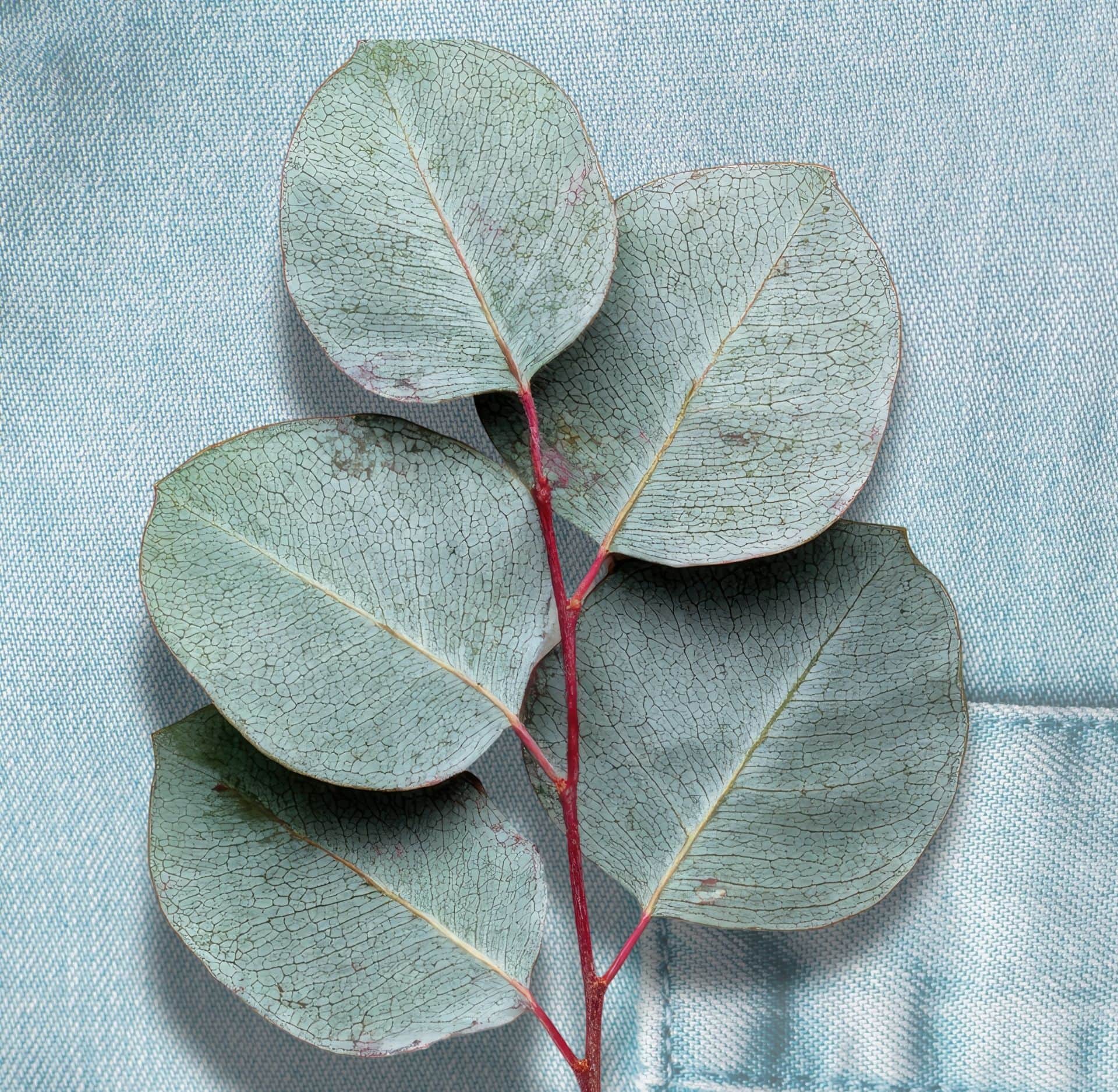
Lyocell is made from plant cellulose, most commonly from eucalyptus trees, though oak, birch, beech, spruce, and pine are also used. Some lyocell is made from bamboo, and a growing share now incorporates recycled cotton waste (more on that below).
Because lyocell fibers are essentially regenerated wood, they’re naturally biodegradable. This is true of all cellulose-based fibers, but lyocell stands out because the chemicals it’s processed with are far less environmentally damaging than those used for viscose or rayon.
How Is Lyocell Made? (And What Is The Closed-Loop Process?)
The lyocell production process is where the fabric earns most of its sustainability credentials, and where the toxicity story begins.
Step 1: Wood pulp preparation
Wood is debarked, chipped, and cooked to separate cellulose from lignin and other compounds. It’s then bleached (in the case of Lenzing, using a totally chlorine-free process) and pressed into dissolving pulp sheets.
Step 2: Dissolving the cellulose in NMMO
The dissolving pulp is mixed with a solvent called N-methylmorpholine N-oxide (NMMO, sometimes written as NMO), a cyclic amine oxide that has the unusual ability to dissolve cellulose directly without chemically altering it.
In the older viscose process, cellulose is dissolved using sodium hydroxide and carbon disulfide (CS₂), a highly toxic gas linked to neurological and reproductive harm in factory workers. According to peer-reviewed research published in the journal Fibers, the viscose process produces 200-300 tonnes of wastewater per tonne of fiber, and 25-35% of the carbon disulfide used is never recovered.
Lyocell skips that chemistry entirely because NMMO breaks the hydrogen bonds in cellulose through purely physical dissolution.
Step 3: Extrusion and fiber formation
The dissolved cellulose (“dope”) is filtered to remove impurities, then forced through tiny holes called spinnerets. The filaments drop into a water bath, where the cellulose precipitates out as long, thin fibers. These are then washed, dried, crimped, and cut into staple fibers.
Step 4: Solvent recovery (the closed loop)
Instead of dumping the spent NMMO and water into the environment, the system captures and recovers them. According to Lenzing’s official technical documentation, more than 99.8% of NMMO is recovered and fed back into the production loop in their TENCEL™ Lyocell process.
A 2024 pilot recovery study published in Fibers confirmed that NMMO can be successfully recovered from process wastewater using evaporation, with no degradation of the solvent.
So what happens to the other 0.2%?
The small fraction of NMMO that isn’t recovered ends up in the process wastewater in very dilute form. According to a ScienceDirect engineering reference on the lyocell process, these very small quantities are “readily degraded in biological wastewater treatment plants.”
It’s worth adding a bit of nuance here, though. NMMO actually does not meet the threshold for “readily biodegradable”, which sounds worse than it is. What a 1998 study in the journal Biodegradation showed is that activated sludge can be adapted to break down NMMO and its metabolites to below detection limits, and that the adaptation takes about 15–20 days. In practice, this means wastewater treatment plants at lyocell production sites develop the right microbial populations to handle the residual NMMO, and the substance is ultimately biodegradable with no persistent breakdown products formed.
There’s a second, smaller loss pathway worth knowing about. A fraction of NMMO can thermally degrade during the recovery step itself, breaking down into byproducts that include N-methylmorpholine (NMM) and morpholine, as documented in peer-reviewed reviews of the lyocell process. To prevent this, producers add stabilizers (commonly propyl gallate, a phenolic antioxidant also widely used as a food preservative) which trap reactive intermediates before they can cause problems, and they then regenerate degraded NMM back into usable NMMO using hydrogen peroxide. So most of what would otherwise be “lost” is chemically reconstituted and put back into the loop. None of these process intermediates end up in Lenzing’s finished fiber, which is repeatedly washed and tested against OEKO-TEX® STANDARD 100 limits for harmful substances before it leaves the factory.
That’s what “closed-loop” means in practice. It isn’t zero chemicals but rater near-total recovery and reuse, with the small unrecovered fraction either chemically regenerated inside the plant or biologically broken down at standard wastewater treatment plants before it can reach the wider environment.
Is Lyocell Toxic? Is It Safe To Wear?
This is one of the most-asked questions about lyocell, and the short answer is no. Lyocell is not toxic to wear, and it’s one of the safer fabrics for skin contact when sourced from a reputable producer like Lenzing.
But “safe to wear” and “made with totally harmless chemicals” aren’t quite the same thing, so it’s worth pulling this apart:
Is the NMMO solvent used in Lyocell production toxic?
NMMO is widely classified as a low-toxicity solvent, particularly when compared to the carbon disulfide used in viscose production. According to the safety data sheet for NMMO in 50% aqueous solution, it carries a “Warning” signal word and is classified as a skin and eye irritant (Category 2) with potential for respiratory irritation (Category 3 STOT-single exposure). Its dermal LD50 is above 8,000 mg/kg in rabbits, which indicates very low acute toxicity. It is not listed as a carcinogen by IARC, NTP, ACGIH, or OSHA, and the SDS notes no known endocrine disrupting properties.
In other words, NMMO is an irritant that requires protective equipment in industrial settings, but it’s in a completely different risk category from the carbon disulfide used in viscose production, which is a known neurotoxin.
That said, NMMO isn’t without industrial handling challenges. A peer-reviewed paper in the journal Cellulose from researchers at the University of Natural Resources and Life Sciences in Vienna notes that NMMO can undergo exothermic decomposition reactions if contaminated with transition metals or strong reductants, which is why production facilities use stabilizers and careful process controls. Again, these are workplace considerations, not consumer safety concerns.
Does any NMMO end up in the finished fabric?
Effectively no. The fibers are repeatedly washed during production, and finished TENCEL™ Lyocell from Lenzing carries OEKO-TEX® STANDARD 100 certification, which independently tests for harmful substances against criteria more stringent than most national regulations. The same fibers also hold the EU Ecolabel for textile products.
Does lyocell shed microplastics?
No, and this is one of its biggest advantages. Lyocell is plastic-free. A 2021 study published in Science of the Total Environment by researchers at the Scripps Institution of Oceanography found that wood-based cellulose fabrics (including lyocell) fully degraded in seawater within about 30 days, while polyester fabrics remained essentially intact after more than 200 days. A follow-up study published in PLOS ONE in 2023 confirmed the same result on the seafloor and in closed bioreactors, with lyocell fully biodegrading within 28 days.
That means lyocell doesn’t shed microplastics into waterways during washing, and it doesn’t leave persistent fragments behind at end of life.
So is lyocell non-toxic overall?
For the wearer, yes. Pure lyocell from a certified producer is one of the cleanest fabrics you can put on your skin. There are a few caveats worth knowing about.
- Blends: A “lyocell” garment blended with elastane, polyester, or nylon will shed microplastics from those synthetic components, even if the lyocell portion doesn’t.
- Dyes and finishes: The base fiber being clean doesn’t mean the final garment is, if it’s been dyed with heavy metals or treated with formaldehyde-based wrinkle-release finishes. OEKO-TEX 100 certification on the finished garment (not just the fiber) is what to look for.
Generic lyocell varies: Not all lyocell is made by Lenzing, and some producers in regions with weaker environmental regulation have less robust solvent recovery and wastewater management.
Is Lyocell Fabric Sustainable?
Lyocell is generally considered one of the most sustainable mainstream fabrics available, but how sustainable depends heavily on who made it.
The forest sourcing question
Lyocell starts with trees, so the first question is whether those trees are logged responsibly. According to Canopy’s 2024 Hot Button Report, which is the textile industry’s leading independent assessment of forest sourcing risk in man-made cellulosic fiber producers, three companies tied for the top “dark green shirt” rating in 2024: Lenzing (Austria), Aditya Birla (India), and Tangshan Sanyou (China).
Lenzing in particular sources its wood from FSC® or PEFC™ certified forests under its Wood and Pulp Policy, which excludes ancient and endangered forests. Eucalyptus is the dominant raw material because it grows quickly, requires no irrigation or pesticides, and can be cultivated on land unsuitable for food crops.
Generic lyocell from non-rated producers is a different story, and historically some MMCF supply chains have been linked to deforestation in Indonesia, Brazil, and Canada. This is why brand and certification matter so much.
Water and chemical use
The closed-loop NMMO process uses dramatically less water and produces far less chemical effluent than viscose or conventional cotton. According to Lenzing’s published Higg Materials Sustainability Index data (referenced on the TENCEL™ Lyocell product page), TENCEL™ Lyocell has up to 69% lower water consumption and up to 53% lower global warming impact than generic lyocell.
For comparison, conventional cotton typically requires several thousand litres of water per kilogram of fiber, while lyocell uses a small fraction of that. (We dig into the cotton numbers in our organic cotton guide.)
Energy and carbon
Lyocell production is energy-intensive (the dissolving and recovery steps require significant heat), and this is one of its real weaknesses. Lenzing has addressed this in part by powering its newer Thailand facility with biomass and pursuing an SBTi-validated net-zero target, with a stated goal to cut production emissions 42% by 2030 against a 2021 baseline.
Generic lyocell produced in regions with coal-heavy grids will have a meaningfully higher carbon footprint.
Biodegradability and end of life
This is where lyocell shines. LENZING™ Lyocell standard fibers are certified by TÜV Austria as biodegradable in soil, freshwater, and marine environments, and compostable under both home and industrial conditions, per Lenzing’s certifications page. This is backed by independent peer-reviewed science from Scripps Institution of Oceanography (cited above).
There is one catch worth flagging. This biodegradability only applies to 100% lyocell garments. Blends with polyester, elastane or other synthetic fabrics are not biodegradeable.
Circular innovations
Lenzing’s REFIBRA™ technology blends post-industrial and post-consumer cotton waste with virgin wood pulp to make new lyocell fibers, currently at up to 30% recycled content (with a stated goal of reaching 50% post-consumer content). This is one of the few commercially scaled examples of textile-to-textile chemical recycling in the cellulosic fiber space.
Lyocell Advantages & Disadvantages (At A Glance)
Here are some lyocell pros & cons to consider:
Advantages of lyocell fabric:
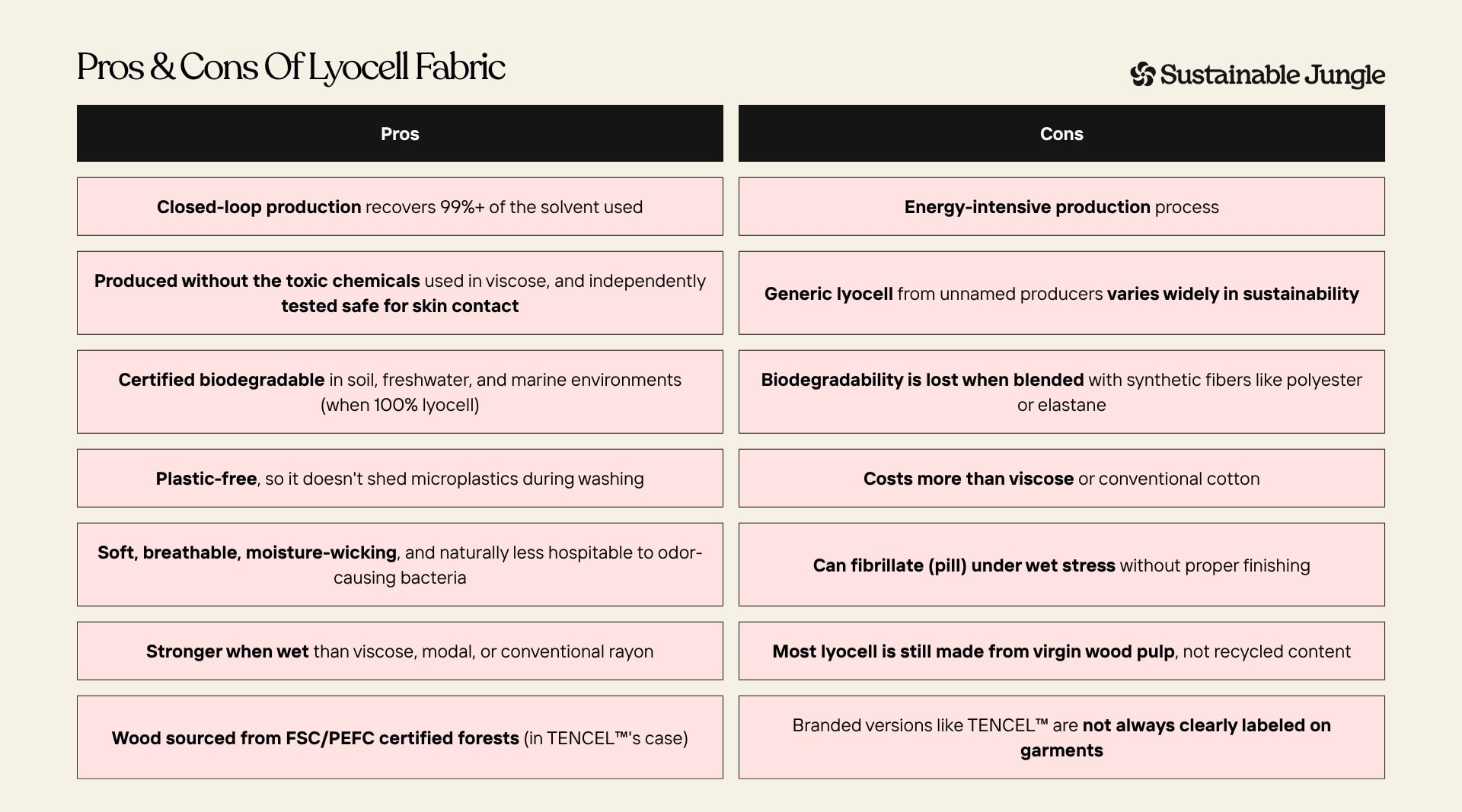
- Closed-loop production recovers 99%+ of the solvent used
- Produced without the toxic chemicals used in viscose, and independently tested safe for skin contact
- Certified biodegradable in soil, freshwater, and marine environments (when 100% lyocell)
- Plastic-free, so it doesn’t shed microplastics during washing
- Soft, breathable, moisture-wicking, and naturally less hospitable to odor-causing bacteria
- Stronger when wet than viscose, modal, or conventional rayon
- OEKO-TEX certified safe for skin contact (TENCEL™ Lyocell)
- Wood sourced from FSC/PEFC certified forests (in TENCEL™’s case)
Disadvantages of lyocell fabric:
- Energy-intensive production process
- Generic lyocell from unnamed producers varies widely in sustainability
- Biodegradability is lost when blended with synthetic fibers like polyester or elastane
- Costs more than viscose or conventional cotton
- Can fibrillate (pill) under wet stress without proper finishing
- Most lyocell is still made from virgin wood pulp, not recycled content
- Branded versions like TENCEL™ are not always clearly labeled on garments
What Is Lyocell Used For?
Lyocell is very versatile. Commercially, it shows up in conveyor belts, medical dressings, filtration cloths, specialty paper, and lining materials. But for everyday consumers, it mostly turns up in:
- Clothing: t-shirts, dresses, dress shirts, sustainable jeans, activewear, yoga clothes, socks
- Underwear: a popular choice for ethical underwear and sustainable lingerie thanks to its softness and moisture management
- Bedding: sheet sets and duvets, where it’s prized for thermoregulating properties
- Sleepwear: sustainable pajamas, often blended with organic cotton
What Does Lyocell Feel Like?
Silky, buttery, and smooth. It has a subtle sheen, drapes beautifully, and feels cool against the skin. People often describe it as feeling like a hybrid of high-thread-count cotton, rayon, and silk.
Is Lyocell Stretchy?
Lyocell has some natural give and excellent recovery, which is why it’s often used in activewear and socks. But it’s not stretchy in the elastane sense so for high-stretch applications it’s usually blended with a small percentage of spandex.
Is Lyocell Breathable?
Yes, very. According to Lenzing’s published fiber data, lyocell efficiently absorbs and releases moisture, supporting a drier microclimate against the skin. This moisture management also makes it naturally less hospitable to odor-causing bacteria, which is why lyocell garments often need fewer washes.
It’s NOT waterproof, though, so it’s not suitable for garments meant to repel water.
How To Wash Lyocell
Lyocell is more delicate than cotton, so a bit more care goes a long way.
- Wash cold on a gentle cycle, or hand-wash. Cold water uses less energy and protects the fibers.
- Skip the dryer where possible and hang dry instead. This is gentler on the fibers and saves energy.
- Use a mild eco-friendly detergent and avoid bleach and harsh enzymatic cleaners.
Does Lyocell Shrink?
Minimally. Lyocell is thermally stable and shrinks far less than cotton, especially when washed cold. Hot water and tumble drying are still best avoided.
Does Lyocell Wrinkle?
Lyocell drapes well and resists wrinkles better than linen or cotton, but it’s not wrinkle-proof. Balling it up in a packed drawer will still produce creases.
How To Iron Lyocell
Avoid ironing if you can. If you must, use a warm (not hot) iron and don’t dwell. Better yet, hang the garment in a steamy bathroom or use a handheld steamer.
Lyocell Vs. Cotton, Viscose, Modal & Polyester
Lyocell Vs. Cotton
Both are plant-based, but cotton is purely natural while lyocell is regenerated through chemical processing. Sustainability-wise, lyocell uses dramatically less water and pesticides than conventional cotton. It’s even competitive with organic cotton on water and land use, though organic cotton has the edge for processing simplicity.
Lyocell Vs. Viscose
Both start with wood pulp, but viscose uses sodium hydroxide and toxic carbon disulfide, while lyocell uses non-toxic NMMO in a closed loop. Lyocell is also stronger (especially when wet), more absorbent, and more durable. Viscose is cheaper but also generally produced less sustainably.
Lyocell Vs. Modal
Modal is also made by Lenzing but uses a modified viscose process rather than the lyocell process. It has higher chemical recovery rates than generic viscose but lower than lyocell. Modal is softer and more elastic than lyocell, while lyocell is stronger and has lower environmental impact.
Lyocell Vs. Polyester
Polyester is fully synthetic, petroleum-derived, and sheds microplastics with every wash. Lyocell is plant-based, biodegradable, and microplastic-free. Polyester is cheaper and more durable in some applications, but environmentally there’s no contest.
Lyocell Vs. TENCEL™
There is no difference! TENCEL™ is just Lenzing’s branded version of lyocell. All TENCEL™ Lyocell is lyocell, but not all lyocell is TENCEL™. Lyocell is also marketed by other producers under names like Newcell and Excel.
Key Players: Who Makes Lyocell?
Where your lyocell comes from determines whether it lives up to its sustainability story.
Lenzing AG (Austria)
The dominant global producer and the inventor of the modern commercial lyocell process. It operates plants in Lenzing and Heiligenkreuz, Austria; Mobile, Alabama; Grimsby, England; and Prachinburi, Thailand. The Thailand facility, opened in 2022, is the world’s largest lyocell plant and runs on biomass. Lenzing markets its lyocell as TENCEL™ (textile applications) and VEOCEL™ (nonwoven applications, including hygiene products).
Aditya Birla Group / Birla Cellulose (India)
Produces lyocell under the Excel and Birla Excel brand. Birla Cellulose has held Canopy’s #1 ranking in the Hot Button Report for five consecutive years and operates closed-loop facilities with significantly reduced resource consumption.
Tangshan Sanyou (China)
The third producer to earn Canopy’s dark green shirt rating in 2024, alongside Lenzing and Birla.
Smaller and emerging producers
This includes various Chinese manufacturers (some with less robust sustainability credentials), as well as suppliers like Simplifi Fabric. Boody is a fashion brand that markets a bamboo lyocell that’s not made by Lenzing but is also produced through a closed-loop process.
Certifications to look for in Lyocell products
- EU Ecolabel: The European Union’s official environmental label, awarded to TENCEL™ Lyocell.
- OEKO-TEX® STANDARD 100: Tests for harmful substances in finished textiles.
- FSC® and PEFC™: Certify that wood comes from responsibly managed forests.
- TÜV Austria biodegradability and compostability certifications
Recycled Claim Standard (RCS) / Global Recycled Standard (GRS): For REFIBRA™ and other recycled-content lyocell.
How To Identify Sustainable Lyocell
Brand labels and clothing tags do a lot of work here, so it pays to read them properly.
- Look for “TENCEL™ Lyocell” or a named branded fiber: Generic “lyocell” tells you nothing about who made it.
- Check the blend: “100% lyocell” is biodegradable; “60% lyocell, 40% polyester” is not.
- Check certifications on the finished garment: OEKO-TEX 100 on the fiber is good, but on the finished garment is better.
- Read brand sustainability reports: Brands sourcing from Lenzing usually shout about it. Vagueness is a red flag.
- Be cautious with “bamboo lyocell”: The closed-loop processing is what makes it sustainable, not the bamboo input. “Bamboo viscose” is a different (and much less sustainable) material despite often being marketed identically. Our bamboo fabric guide explains the difference.
For more on decoding labels generally, see our guide to reading clothing tags, and our greenwashing guide for spotting marketing fluff.
Lyocell Fabric FAQs
Is lyocell a natural fiber?
Lyocell is semi-synthetic and not a natural fiber. It starts from a natural raw material (wood cellulose) but is processed using synthetic chemicals to regenerate it into fiber form. It’s neither fully natural like cotton nor fully synthetic like polyester.
Is lyocell plastic?
No. Lyocell is plastic-free. It’s made from cellulose (wood) and contains no petroleum-derived polymers, which is why it biodegrades and doesn’t shed microplastics.
Is lyocell biodegradable?
Yes, when it’s 100% lyocell. LENZING™ Lyocell standard fibers are certified by TÜV Austria as biodegradable in soil, freshwater, and marine environments, and compostable in both home and industrial conditions. Blended fabrics are NOT biodegradable (e.g. lyocell blended with polyester).
Is TENCEL lyocell toxic?
No. TENCEL™ Lyocell is OEKO-TEX® STANDARD 100 certified, holds the EU Ecolabel, and is produced using a low-toxicity solvent (NMMO) in a closed-loop system that recovers more than 99.8% of the solvent. It’s considered one of the safer fabrics for skin contact.
Is lyocell good for sensitive skin?
Yes. Its smooth fiber surface, breathability, and moisture-wicking properties make it less irritating than rougher fabrics, and the lack of harsh chemical residues (when OEKO-TEX certified) makes it suitable for sensitive skin. It’s also naturally less hospitable to odor-causing bacteria.
What is the difference between lyocell and TENCEL?
TENCEL™ is the brand name for lyocell fibers produced specifically by Lenzing AG. All TENCEL™ Lyocell is lyocell, but not all lyocell is TENCEL™. Other producers make lyocell under names like Excel, Birla Excel, and Newcell.
Does lyocell shrink in the wash?
Minimally. Lyocell is more thermally stable than cotton, especially when washed cold on a gentle cycle. Hot water and tumble drying may cause some shrinkage.
Is lyocell better than cotton?
For environmental impact, generally yes and particularly when compared to conventional cotton, which uses far more water and pesticides. Compared to organic cotton, the two are competitive. Lyocell is also softer, more absorbent, and more drapey.
Final Thoughts On Lyocell
Lyocell is a fabric that has earned its reputation in the sustainable fashion world, and not just because brands love telling you about it. The closed-loop NMMO process is a technical achievement, the biodegradability is backed by peer-reviewed marine science, and the wearer-safety credentials hold up under scrutiny.
But lyocell isn’t a free pass. Generic lyocell from unnamed producers can still be linked to forest destruction and weaker chemical management, and the moment you blend it with polyester or elastane, it’s no longer biodegradable.
Our take is straightforward. When you see “TENCEL™ Lyocell” or another named, certified fiber on a clothing label, it’s one of the better choices you can make. When you see plain “lyocell” with no brand or certification attached, treat it the same way you’d treat any other unverified sustainability claim, which is to stay politely skeptical until proven otherwise.
And if you found this useful, please share it with someone who’s been wondering whether their favorite t-shirt is actually as eco-friendly as the label suggests. Helping more people understand what they’re wearing is what we’re here for.
Editor’s Note: Originally published in August 2020. It has been updated a few times since including in April 2026 with a new section on lyocell toxicity and wearer safety; expanded explanation of the closed-loop NMMO process with citations to peer-reviewed research, and more.

Joy has been a passionate advocate for the environment since she was a small child. She grew up in South Africa and has been lucky enough to be exposed to the wonders of nature not just in Africa but all over the world. She founded Sustainable Jungle (together with her husband Lyall) back in 2017 after becoming enraged by the devastating impact of palm oil. She then founded the Sustainable Jungle Podcast and together with Lyall interviewed remarkable people from all over the world who were finding ways to create positive impact. Outside of Sustainable Jungle, Joy has always worked in the corporate world, starting out as an auditor and later moving into management consulting. More recently she specialized in Climate Investing for the Asia Pacific region. Given her experience, her current passion is Brand Ratings. She is very much enjoying going deeper on what it really means to drive sustainability performance and true impact through business operations.









Thank you for your information, makes the topic very detailed. However, I would like to know more about how wrinkle, wrinkle-free the frabric would be. Please including this research and provide more in this area.Nowadays, spending time and effort to get the clothings well-press is such a huge challenge in our daily lives. Next time you write about the material, I really appriciate your effort.
What about the rain forests being decimated to create youre sustainable fibers?
Good day. I’m living in South africa on a farm. I want to make my own Lyocell fabric at home
Do you think that it will be possible?
Hi Amanda, sounds like an interesting project. We’re certainly not the experts in the practical production of lyocell but my understanding is you would need a fairly sophisticated setup to create lyocell in an environmentally friendly way (i.e. a closed loop set up) which I imagine would be expensive for the machinery. Certainly worth investigating further though! Good luck with the project!
Can this material be dyed with like a “ritz” dye ?
Hi Marie, I’m not sure. Hopefully some other readers can help out with this question!