












First things first (aid): are bandages non-toxic?
Given that most drugstore varieties are made of polyester and chemical adhesives, probably not.
But you don’t have to go with the conventional off-the-shelf options, there are more non-toxic bandaids entering the space for cleaner, healthier wound care.
Not only does this mean better healing for minor burns, scrapes, and cuts but also a lower impact on the Earth.
Because the options we’ve curated are also biodegradable so they can be returned to the earth responsibly after use.
So with that in mind, let’s (add)dress the topic with our favorite bandages and bandaids.
We independently research all featured brands, and we ask them to confirm their claims. In many cases we personally review recommended products. This post contains affiliate links which means we may earn a commission if you buy something. We explain this further in our Terms of Use.
The Best Biodegradable Bandaids For Your Ouchies
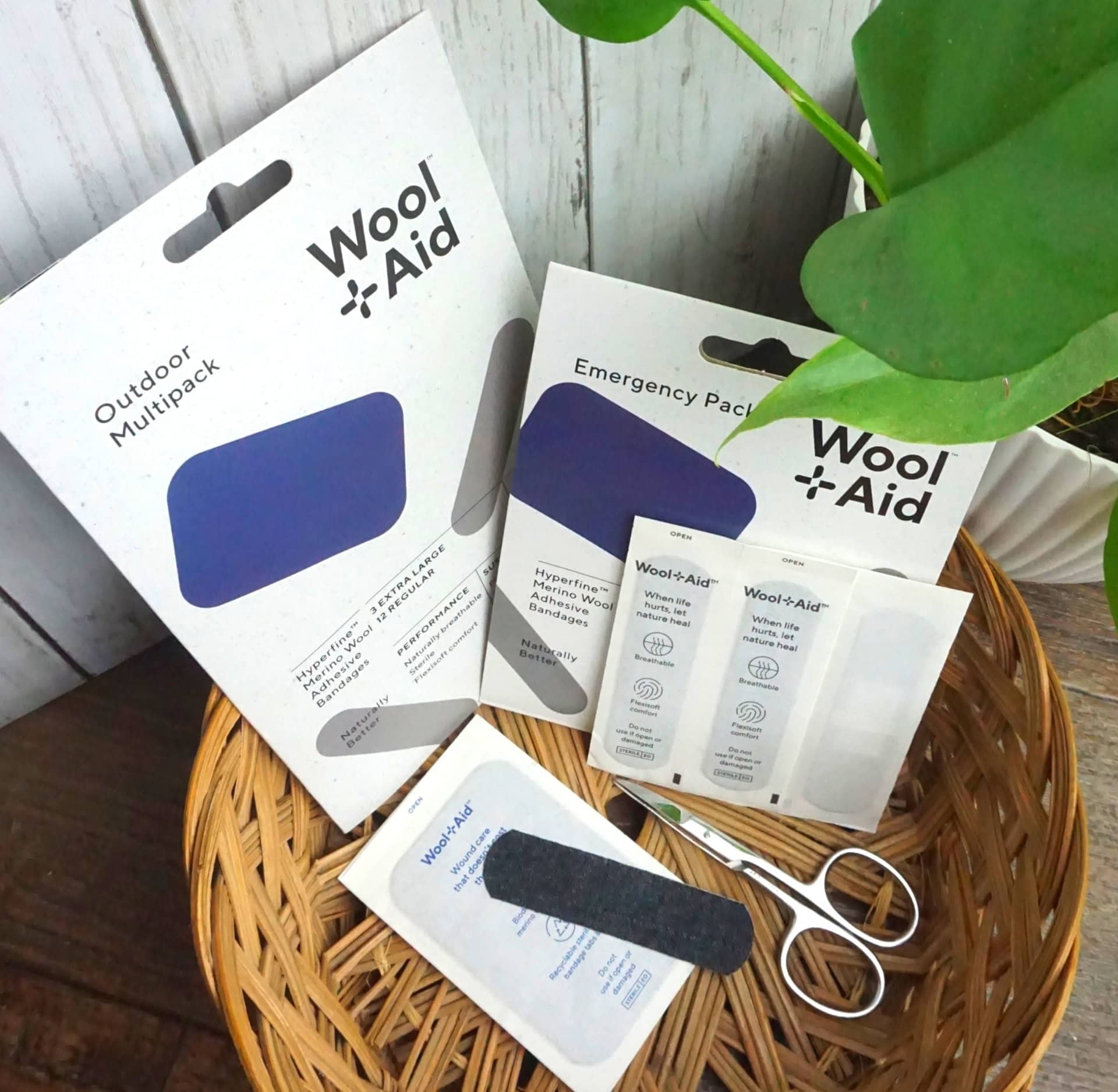
WoolAid makes hyperfine Merino wool bandages that are better for the Earth and your injuries, taking just four months to fully decompose in soil.
Patch up your boo-boos the natural way with PATCH biodegradable bamboo bandages, which infuse the organic bamboo lyocell fiber with nature’s own super-healers, like activated charcoal, coconut oil, and aloe vera.
Index: Eco-Friendly Bandages
- WoolAid Jump to section
- PATCH Jump to section
- Nepia Jump to section
WoolAid


WoolAid’s First Aid Bandages
Price Range: $6–$10
Merino wool more recently was taken to new heights with sustainable running shoes and more being made from the renewable material. Next up is wool bandages that really work.
WoolAid will come to your aid with their Merino wool, award-winning flexible fabric strips for cuts and scrapes, in both extra large and regular sizes.
You can be sure there is no plastic here, and these non-toxic bandaids are hypoallergenic for sensitive skin.
They also have a medical grade absorbent wound pad and pressure sensitive adhesive, with the pad being made of 60% plant-based fibers.
Not only is the bandage itself fully biodegradable within four months in soil, but packaging is likewise biodegradable and recyclable.
We recently tested out these latex-free bandaids and love how soft and breathable they are, which actually creates a better environment for wound healing.
We usually have an allergic reaction to adhesive bandages, but we were able to wear these all day with no redness or itching.
They’re currently sitting on our compost bin, so we’ll update on whether they decompose as quickly as they say they do.
About WoolAid
WoolAid’s bandages sans plastic were founded by someone who knows a thing about heights, wool, and pain, its founder Lucas Smith was a tour guide in New Zealand’s Aotearoa.
He’d also spent some previous time working on sheep farms and wanted to do something that would be environmental and helpful for people.
They source New Zealand Merino ethical wool (P.S.: New Zealand doesn’t allow mulesing) which is spun at the sustainable certified Reda wool mill in Italy.
PATCH


PATCH’s Bamboo Bandages
Price Range: $8
PATCH make use of mineral-based, pressure sensitive adhesive (PSA) bandages as an effective alternative to conventional bandages that only patch us with toxins and irritating chemicals.
Free of plastic, silicone, latex, or parabens, they’re safe for sensitive skin, as well as cruelty-free and vegan-friendly.
The bamboo bandaids are made from entirely natural ingredients such as 100% certified organic bamboo fiber and gauze, activated charcoal, coconut oil, and aloe vera to soothe minor abrasions.
Plus, they’re biodegradable and compostable, so pop them in your indoor compost bin when it’s time to take them off.
To top it all off, PATCH bamboo bandages are packaged in compostable rice paper and shipped in recycled materials to further lessen their environmental footprint.
About PATCH
It was when a bandage caused an allergic reaction to his son’s injury, making it worse, that Certified B Corp PATCH (under the Nutricare umbrella) founder James began his mission for a better way to treat wounds.
He learned that chemicals in conventional adhesive bandages are known harmful substances to human skin and began his experiments with natural ingredients and nourishing additives.
Enter PATCH organic bamboo adhesive strip bandages: wound dressing that not only covers cuts and scrapes a natural way, but also actually treats them.
PATCH bandages are manufactured in a BSCI-certified factory in China, and they plant a tree for every order or new retailer through Trees For the Future.
Nepia


Nepia’s Organic Bamboo Bandages
Price Range: $6–$16
Nepia believes they are “nature’s guardian” and create bamboo bandages that are hypoallergenic and free from known irritants, to act as guardians to our healing minor cuts and scrapes, too.
They’re latex-free and suitable for sensitive skin, with only organic bamboo viscose and a waterproof, supportive, comfortable absorbent pad.
These adhesive bamboo bandages will help mend your boo-boos and when you’re done, they’re 100% biodegradable and will break down in your garden in weeks.
They come in ample multipacks or in smaller boxes of especially shapes, like for the knuckles and fingertips. Both in a handy zero waste reusable tin or via compostable refill boxes.
They also offer blister prevention pads, but these are made purely from rayon fabric, so they’re not as sustainable.
About Nepia
This China-based brand uses one of the country’s most valuable renewable resources, bamboo, to create compostable bandages.
Everything they make is tested for sensitivity in the US by the UL lab.
However, we’re not sure if their natural bamboo fiber is made in a closed-loop way and will be reaching out to inquire.
DIY Biodegradable Bandages


Looking for other options?
As with just about everything—from non-toxic cleaning to sustainable skincare—the best bandages are often those you make yourself.
If you’re ready to make the effort, a popular DIY bandage remedy for minor burns, cuts, and scrapes is using dried SCOBY.
If you’re not a professional kombucha brewer, SCOBY stands for Symbiotic Culture Of Bacteria and Yeast. It’s what ferments and adds probiotic benefits to everything from ‘booch to vinegar.
To use on wounds, remove the SCOBY, dry it out, cut to size, wrap with gauze, and gently press it on the wound.
Scoby works its wonders because the natural pH reduces the growth of bacteria, in turn speeding up the healing time.
While this is backed by scientific studies, we’re not medical professionals, and we advise you to check with your doctor before approaching this natural bandage method, especially for more severe wounds.
Why Choose Non-Toxic Bandages And Bandaids?
Boo-boos are bad enough; we don’t need known irritants or toxins in the various parts of a band aid being absorbed into already sensitive spots.
What Are Bandages Made Of?
What many people don’t realize about most of the common adhesive bandages on the market is that they’re made from polyethylene (PE), polyvinyl chloride (PVC), or polyurethane (PUR) with polyester gauze pads and harsh acrylic adhesives.
Keep in mind that PVC is the most dangerous and toxic type of plastic there is, so when PVC bandages down, they release many dangerous chemicals like phthalates, dioxins, lead, and more.
Who wants that sticking around on their flesh, let alone a tender sore that’s trying to heal?
Do Band Aids Contain Latex?
Many bandages also contain latex, which is derived from natural rubber.
Even so, many folks are allergic. Contact dermatitis is known to form from bandage irritation, which usually comes from chemical adhesives and latex.
What’s more is that at end-of-life, plastic bandaids won’t break down becoming yet another single-use plastic item landing in the landfill.
Okay, so are there biodegradable bandages?
We wouldn’t be here if not! Bandaids such as bamboo strip bandages, not only aid the Earth, but also aid our healing.

Molly Willows is a Thailand-based writer for sustainability and purpose-driven publications and brands. She has a BA in Philosophy from the University of King’s College and an MA in Anthropology from Freie Universität Berlin. With a strong background in TV and advertising, she’s held top-tier roles such as Director and Executive Producer. Really, Molly loves being a semi-nomadic writer most of all. Today, she happily spends her days writing, researching, teaching yoga, meditating, and attempting to surf. Molly’s words are published by Huffington Post and The Guardian, and some of her previous film projects can be seen on Hulu, Apple TV, or at the iconic Onassis Stegi in Athens.