












Your floor is the literal foundation of your home, and keeping it streak-free and spotless doesn’t have to cost you a pretty penny—or the environment.
Making your own homemade floor cleaner is an effective solution (so long as you choose a good recipe) that’s way more affordable and eco-friendly. It also reduces your family’s exposure to harsh chemicals, and saves the planet from more single-use plastic packaging.
You can tell we’re big fans of DIY cleaning products, but when it’s such a no-brainer why wouldn’t we be?
With savings of up to $14 per batch of your own DIY floor cleaner solution (compared to the cost of your average store-bought cleaner, scroll to the bottom to see how much you can save), we’ll show you how to make your own floor cleaners that smell amazing, clean beautifully, and are kind to your wallet—though we can’t promise they’ll make mopping any more fun!
Whether you’re caring for natural stone tile, laminate, or hardwood, we have four tailored recipes that we’ve tried and tested and used on many surfaces and we’re positive these will give your floors the TLC they deserve.
Index: DIY Floor Cleaner Recipes
- Floor Cleaning Hacks For Different Floor Surfaces Jump to section
- DIY Floor Cleaner With Vinegar Jump to section
- DIY Floor Cleaner Without Vinegar Jump to section
- DIY Wood Floor Cleaner With Black Tea Jump to section
- DIY Floor Cleaner Spray & Polish Jump to section
- Cost Savings of DIY Floor Cleaners Jump to section
Floor Cleaning Hacks For Different Floor Surfaces
By opting to go the DIY route (er, grout in this instance?), you can tailor your cleaner to suit your flooring type and personal scent preferences. Here are our suggestions for making the best DIY floor cleaner recipes for laminate (also vinyl), hardwood and stone depending on what flooring type you have:
Coated Tile & Laminate: Both with vinegar- and vinegar-free recipes are suitable as DIY laminate floor cleaner. Avoid excess water to prevent warping or mold growth under laminate. See recipes 1, 2, 3, and 4.
Sealed Hardwood: Use a slightly damp mop with either recipe. Excessive water or vinegar can damage the finish over time. See recipes 3 and 4 for DIY hardwood floor cleaner.
Natural Stone: Stick to the vinegar-free recipe. Acidic cleaners like vinegar can erode stone surfaces like marble, granite, or travertine. See recipe 2.
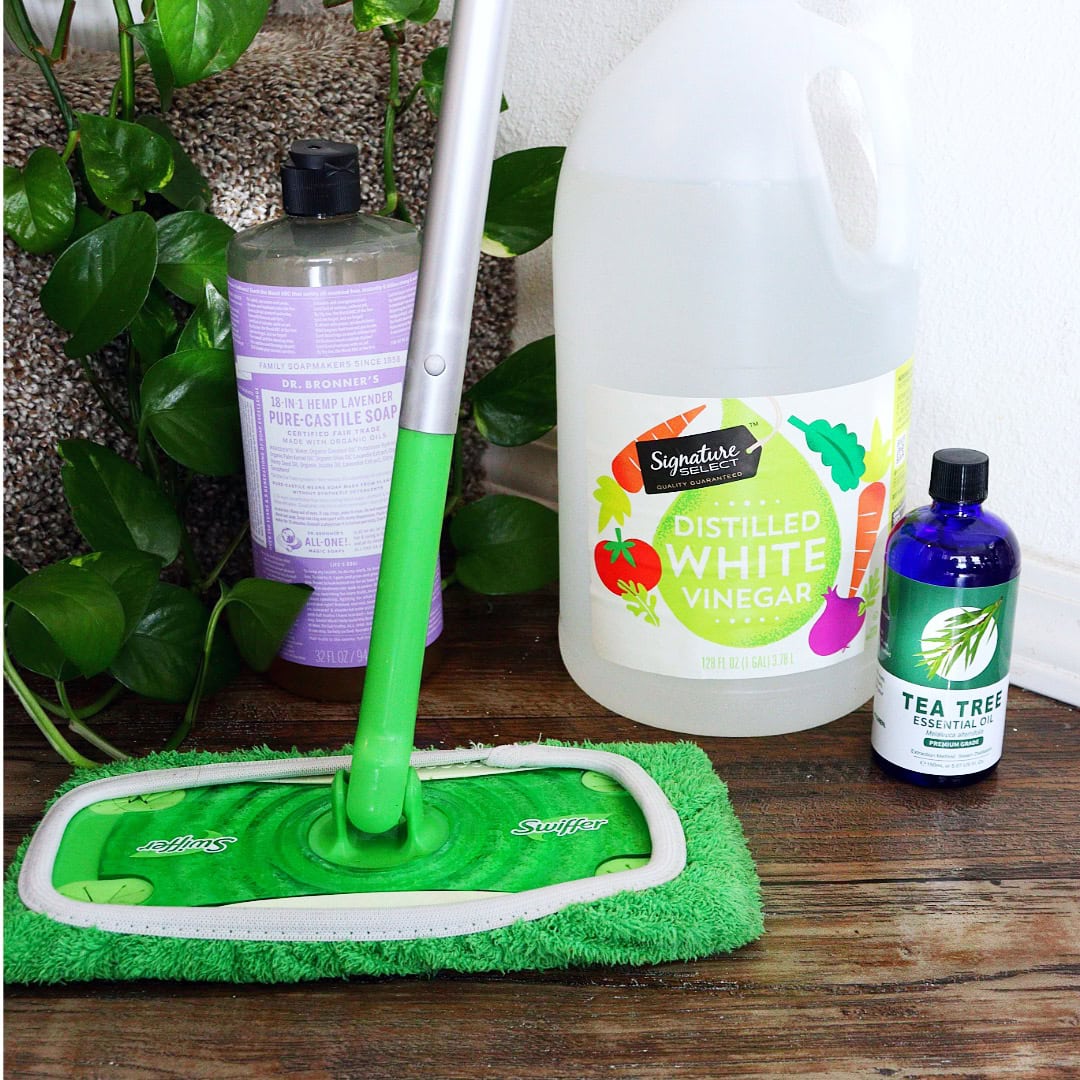
Our recipes below say that you should put the solutions in a bucket so that you can submerge your mophead. However, if you use a Swiffer mop with a spray function, you can just fill the reservoir with the same solution, and can even halve them if it’s too much.
If you use a Swiffer mop with a reusable mop pad as we do, you can either dunk it in the bucket as you would a normal mop, or place the solution in a sprayer bottle and simply dampen the pad while mopping as needed. We recommend the latter in this instance as you’ll need to use less of the solution and it’ll last for a whole lot longer.
The first three recipes make large buckets, but the recipes can easily be halved or quartered to best suit your floor space and how much mopping you actually need to do.
DIY Floor Cleaner With Vinegar

Vinegar is our favorite ingredient when it comes to green cleaning, and this is a tried-and-true recipe we’ve been using for as long as I can remember. And it’s perfect as a DIY floor cleaner for tile, laminate, and sealed hardwood floors. The only type you’ll want to avoid using this on is natural stone. Here’s what you need.
Ingredients:
- 1/2 cup white vinegar: Cuts through grime, eliminates odors, and is naturally antibacterial. It also helps in creating a streak-free floor cleaner.
- 1 tablespoon castile soap (such as Dr. Bronner’s): Gentle on floors but tough on dirt, this adds cleaning power.
- 10 drops essential oil (optional): Adds a pleasant scent and additional antimicrobial benefits but isn’t necessary. You can tailor your oil choices to your taste. Citrus oils provide a fresh and energizing feel, lavender or peppermint create a soothing home environment, and pine makes the home smell and feel earthy.
- 1 gallon warm water: Acts as the base for diluting cleaning agents.
Instructions:
- In a large bucket, combine all the ingredients and stir to agitate the soap.
- Dip your eco-friendly mop into the solution and wring it out until damp, not dripping. For sealed hardwood floors, use even less moisture on the mop to prevent excess.
- Mop the floor, ensuring even coverage, then let the floor air dry or dry with a reusable paper towel to make it extra-streak-free.
DIY Floor Cleaner Without Vinegar

If you have stone or raw tile flooring, you’ll need a different floor cleaning recipe, since vinegar can have a corrosive chemical reaction with natural stone. This recipe replaces vinegar with baking soda to avoid corrosion while still delivering a deep clean.
Because grout is typically stone-based, this formula is also ideal as a homemade floor grout cleaner.
To make it, gather the following ingredients.
Ingredients:
- 1/4 cup liquid castile soap: Safely lifts dirt and grime without damaging sensitive surfaces.
- 1 tablespoon baking soda: Gentle abrasive action for stubborn spots; neutralizes odors.
- 10 drops essential oil (optional): If you want something slightly acidic but not as much as vinegar, citrus oils can provide a little grease-cutting power without harming the stone.
- 1 gallon warm water: Provides the base for your cleaner.
Instructions:
- Combine all ingredients in a bucket and stir to dissolve.
- Mop the floor as usual, taking care to rinse your mop frequently.
- Wipe down any excess moisture with a soft towel for a clean, residue-free finish.
DIY Wood Floor Cleaner With Black Tea
Sustainable tea isn’t just for sipping—it’s a natural cleaning powerhouse too! The tannins in black tea specifically help restore shine while gently lifting dirt and grime. This DIY hardwood floor cleaning recipe is ideal for sealed hardwood but not recommended for tile or stone.
Ingredients:
- 4 black tea bags: Provides tannins that enhance the natural color and shine of hardwood.
- 10 drops essential oil (optional): Scents such as cedarwood add a pleasant scent and can provide antibacterial properties.
- 1 gallon warm water: Serves as the base for dilution.
Instructions:
- Boil 4 cups of water and steep the tea bags for 10–15 minutes.
- Remove the tea bags and pour the tea into a bucket.
- Add the remaining warm water and essential oil, if desired.
- Dip a mop into the solution, wring out the excess, and mop the floor.
Pro Tip: Before jumping into this recipe, we recommend making a small amount and testing the tea solution on a small area first, especially if your floors are light-colored, as tea can slightly darken wood over time.
DIY Floor Cleaner Spray & Polish

A basic homemade wood floor polish can be made by mixing equal parts white vinegar and olive oil, diluted with a larger amount of warm water. This solution not only works as a DIY floor cleaner in a spray bottle which is super easy to use but also adds a safe and subtle shine to your hardwood floors.
Ingredients:
- 2 tablespoons white vinegar: Acts as a natural cleaner, breaking down dirt and grime.
- 2 tablespoons olive oil: Provides a light sheen and helps nourish the wood.
- 2 cups warm water: Dilutes the mixture to a safe cleaning consistency.
Instructions:
- In a spray bottle, combine all three ingredients and shake well.
- Spray the solution onto your wood floor and mop in the direction of the wood grain.
Cost Savings of DIY Floor Cleaners

One of the main reasons many of us make the effort to create our own home cleaning solutions, including DIY floor cleaner solutions, is the noticeable cost savings compared to buying commercial products. And in this case the money you’ll save by doing so is really impressive.
Let’s break down the cost of each DIY recipe and see how they stack up against the average price of store-bought options for various floor types.
1. DIY Floor Cleaner with Vinegar (costs):
- 1 gallon warm water: ~$0.00 (from tap)
- 1/2 cup white vinegar: ~$0.10 (based on $2.50 per gallon)
- 1 tablespoon castile soap: ~$0.10 (based on $18 for 32 oz of Dr. Bronner’s)
- 10 drops essential oil: ~$0.15 (based on $15 for 15 mL, 300 drops per bottle)
Total Cost per Batch: ~$0.35
Store-Bought Equivalent: ~$8 for 32 oz bottle (e.g., Bona, Method, or similar streak-free cleaners).
Savings per Batch: $7.65
2. Homemade Floor Cleaner Without Vinegar (costs):
- 1 gallon warm water: ~$0.00
- 1/4 cup liquid castile soap: ~$0.40 (based on $18 for 32 oz of Dr. Bronner’s)
- 1 tablespoon baking soda: ~$0.05 (based on $1 for a 16 oz box)
- 10 drops essential oil: ~$0.15
Total Cost per Batch: ~$0.60
Store-Bought Equivalent: ~$10 for 32 oz of stone-safe cleaners (e.g., Black Diamond or Rejuvenate).
Savings per Batch: $9.40
3. DIY Wood Floor Cleaner with Black Tea (costs):
- 1 gallon warm water: ~$0.00
- 4 black tea bags: ~$0.20 (based on $2.50 for 100 tea bags)
- 10 drops essential oil: ~$0.15
Total Cost per Batch: ~$0.35
Store-Bought Equivalent: ~$12 for 32 oz of wood floor cleaners (e.g., Murphy’s Oil Soap or Bona Hardwood Floor Cleaner).
Savings per Batch: $11.65
4. Homemade Wood Floor Cleaner & Polish (costs):
- 2 tablespoons white vinegar: ~$0.02
- 2 tablespoons olive oil: ~$0.25 (based on $10 for 51 oz)
- 2 cups warm water: ~$0.00
Total Cost per Batch: ~$0.27
Store-Bought Equivalent: ~$15 for 32 oz of wood floor polish (e.g., Howard or Weiman’s).
Savings per Batch: $14.73
As you can see the savings are substantial for all of these homemade floor cleaner recipes. With the least cost effective option still saving you $7.64 per batch (floor cleaner with vinegar), while the most cost effective option will keep a hefty $14.73 in your pocket (wood floor cleaner and polish). And if we assume you use 1 batch per month, then you’re looking at savings of at least $91.80 and up to $176.76 per year!
Why Choose An All-Natural Homemade Floor Cleaner?
Switching to homemade floor cleaners ensures that your home stays safe, especially for kids, pets, and those with sensitivities. This is because store-bought cleaners (of any sort) often contain a cocktail of harmful chemicals, including:
- Ammonia: Found in many commercial cleaners, it can irritate eyes, skin, and respiratory systems, especially in poorly ventilated spaces.
- Phthalates: Present in synthetic fragrances, these are endocrine disruptors linked to hormonal imbalances and reproductive issues.
- Sodium Hypochlorite: A common bleach ingredient that releases toxic fumes when mixed with acids or ammonia.
- Quaternary Ammonium Compounds (Quats): Often marketed as antibacterial, some evidence suggests quats can trigger asthma and may be linked to antimicrobial resistance.
Conventional cleaners also contribute to water pollution, especially when residues are washed down the drain. Ingredients like phosphates lead to eutrophication and harm aquatic life by disrupting ecosystems.
Plus, with pantry staples like vinegar, baking soda, and essential oils, you’re likely already stocked with what you need so you can save money making your own, too.

Amber obtained Bachelor of Arts degrees in English, Creative Writing, and Psychology from The University of Oxford and Arcadia University. She is an avid crafter, gardener, quail farmer, wannabe novelist, and self-proclaimed eco adventurer. From living in a camper van to living in a tiny house, she is enamored by the small and self-sufficient; and aspires to one day become an off-grid micro-farmer, bridging sustainability with non-toxic living and eating. With a passion for outdoor sports like rock climbing, skiing, and travel, having already backpacked across 30 countries, she is always up for the next big adventure while seeking ways to minimize her impact along the way.