













Many consumer brands invest enormous effort into reducing their negative environmental and social impact. They source better materials, improve factory conditions, reduce waste, and track their carbon footprint. Yet this work often goes unnoticed by the customers who would most value it.
A sustainability assessment helps bridge that gap. Third-party evaluation gives brands a credible way to communicate their progress without sounding like marketing hype. It provides a benchmark for improvement, showing where you stand relative to peers in your category. And it helps conscious consumers find and support the brands doing the work.
Whether you’re a fashion startup using organic cotton, a furniture maker exploring FSC certification, or a beauty brand reformulating to remove harmful chemicals, understanding your assessment options matters. The right sustainability evaluation can validate years of effort and help you tell your impact story with confidence.
Related Guides: Sustainability Certifications, Manufacturing Certifications, What is Eco-cert, MADE SAFE® Certification, GOTS Certification
Table of contents: Sustainability Assessment For Consumer Brands
- What Is a Sustainability Assessment for Brands? Jump to section
- Why Consumer Brands Need Sustainability Assessment Jump to section
- Sustainability Assessment Providers For Consumer Brands Jump to section
- Comparing Sustainability Assessments: What's Right for Your Brand? Jump to section
- How to Choose the Right Sustainability Assessment Jump to section
- Getting Started With A Sustainability Assessment Jump to section
What Is a Sustainability Assessment for Brands?
A sustainability assessment evaluates how well a company performs on environmental and social criteria. These assessments examine everything from materials sourcing and carbon emissions to labor practices and transparency.
Unlike self-declared claims (which invite scrutiny), independent sustainability assessments and certifications provide external validation. They vary widely in scope, rigor, and cost. Some focus narrowly on a single issue like carbon neutrality. Others take a broader view across multiple criteria. Some are formal certifications requiring legal commitments. Others are ratings based only on publicly available information.
For consumer brands specifically, these assessments serve three purposes. First, they build trust with conscious consumers who want to avoid greenwashing and support responsible businesses. Second, they provide competitive differentiation in crowded markets. Third, they offer a benchmark for improvement over time.
Why Consumer Brands Need Sustainability Assessment
Consumers, investors, and regulators all want to see real change and progress towards a thriving future for all.
The consumer trust problem is straightforward. Greenwashing is ubiquitous and consumers often struggle to tell the difference between genuine sustainability and misleading claims. But when Princess Polly received B Corp certification despite fast fashion criticism, or when Nestlé’s sustainability messaging clashed with its bottled water controversies, consumers noticed. They’re tired of vague commitments and prefer brands that can point to external verification.
Competitive advantage matters too. Small DTC brands can’t outspend giants on marketing, but they can out-sustain them. Third-party assessments level the playing field. A sustainable bedding brand with legitimate credentials stands out against conventional competitors making unsubstantiated claims. For fashion brands, furniture makers, beauty companies, and just about any other consumer category, these credentials can directly influence purchase decisions.
Regulatory compliance is coming faster than many brands realize. The EU’s Empowering Consumers Directive takes effect in September 2026, banning generic environmental claims like “eco-friendly” or “sustainable” unless properly substantiated. California’s SB 253 requires companies with over $1 billion in revenue doing business in the state to disclose greenhouse gas emissions starting in 2026. Even smaller businesses should prepare for increased scrutiny. A credible sustainability assessment can help prepare for a more rigorous regulatory environment.
Sustainability Assessment Providers For Consumer Brands
B Corp Certification
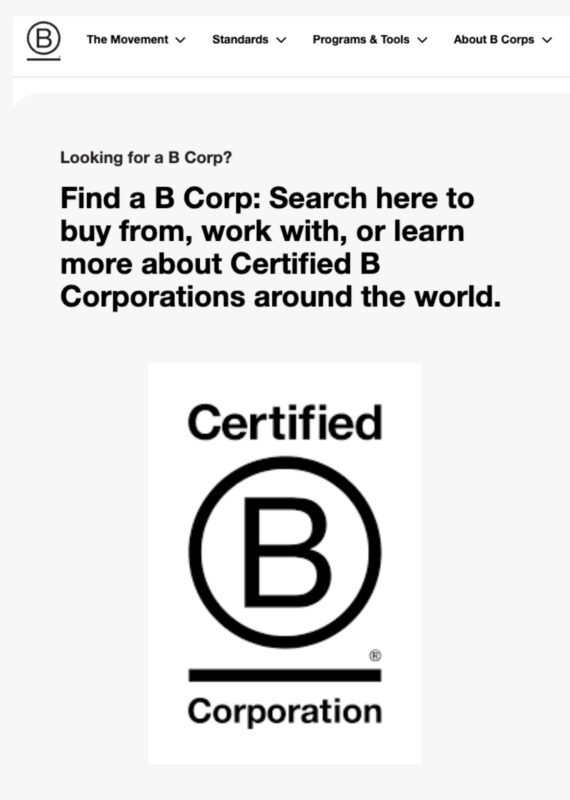
B Corp certification remains the most recognized sustainability credential in business. It requires companies to meet rigorous standards across governance, workers, community, environment, and customers. The certification involves a legal commitment to stakeholder governance and comprehensive impact assessment. Any type of company or business (including companies in all types of industries) can go through the certification process and to be certified, a minimum score of 80 out of 200 points must be achieved across all certification categories.
- Timeline: 6 to 12+ months from application to certification
- Cost: Varies from $1,000 to $50,000 annually based on revenue
- Best for: Established companies ready to make deep structural commitments
The upside: B Corp carries significant credibility with informed consumers and provides a comprehensive framework for improvement. The network effect helps companies connect with like-minded businesses and customers.
The downside: The process is lengthy, costly and resource-intensive. Companies must meet minimum scores across all categories, which can be challenging for brands strong in some areas but developing in others. Recent controversies around certification of fast fashion brands have raised questions about whether B Corp inadvertently can aid in greenwashing. The certification requires legal changes to corporate structure, which isn’t feasible for all businesses. Additionally, some brands have told us that the certification is too broad for consumer brands and doesn’t adequately cover issues most important or relevant to consumers specifically. For example, reading the B Corp certification summary, consumers cannot identify which specific materials are used in products, or what safety standards are in place.
Related Guide: Is B Corp Greenwashing?
Good On You Brand Ratings (Fashion & Beauty)
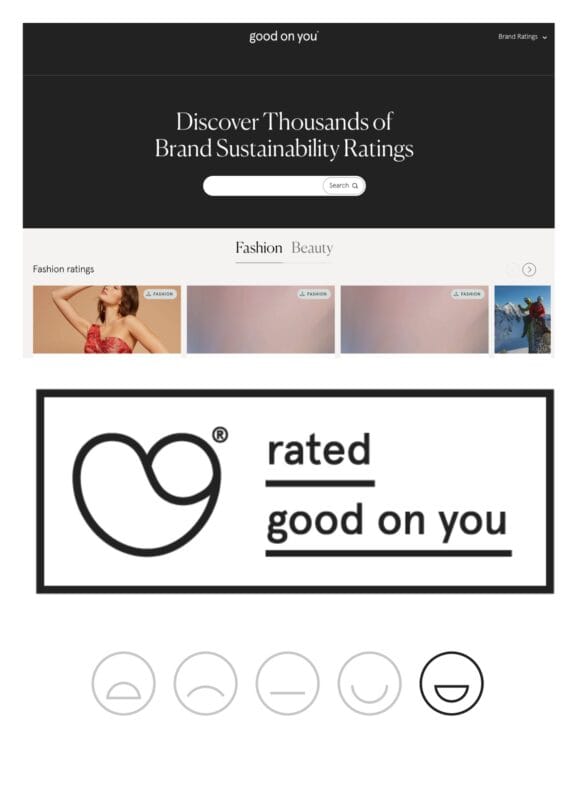
Good On You rates fashion and beauty brands specifically, assessing impact on people, planet, and animals. The platform uses publicly available information to evaluate thousands of brands, making their ratings accessible to millions of consumers through their app.
- Timeline: Good On You has a long pipeline of brands so it may take quite some time to get rated. Once rated, they are updated regularly.
- Cost: Free public ratings based on public information
- Best for: Fashion and beauty brands of any size
The upside: Good On You’s fashion-specific expertise means they evaluate issues that matter most in apparel and cosmetics: textile waste, microplastics, garment worker conditions, and supply chain transparency. Their mobile app puts ratings directly in consumers’ hands at the point of purchase. The five-tier rating system (from ‘We Avoid’ to ‘Great’) is easy for shoppers to understand.
The downside: Limited to fashion and beauty. Brands in other categories need different solutions. The ratings rely heavily on disclosed information, so companies with less effective communication may score lower than their actual practices warrant. Given their long pipeline of brands waiting to be rated, it may take some time.
Commons Brand Ratings
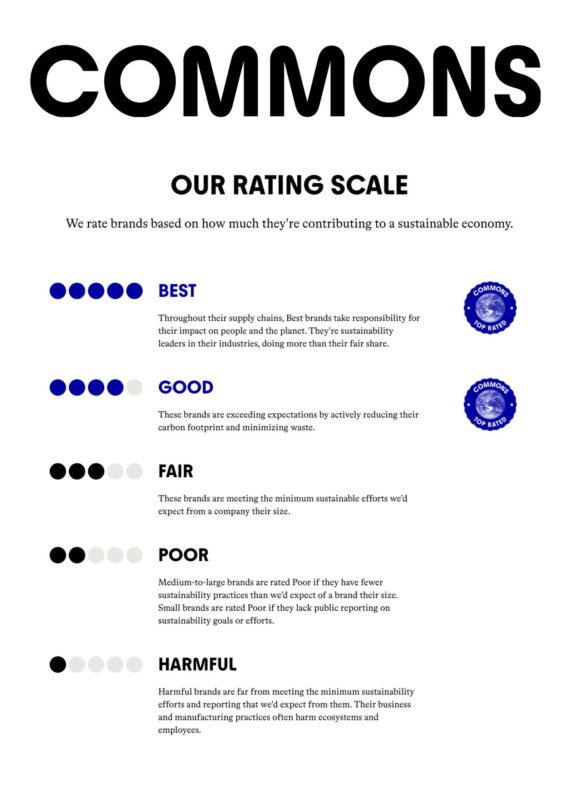
Commons takes a carbon-first approach, rating brands on how much they contribute to a sustainable economy. Their assessments consider resources, slow consumption, and accountability, with a particular focus on climate action.
- Timeline: Regular updates as new information becomes available
- Cost: Free public ratings based on public information.
- Best for: Brands with strong climate stories across categories
The upside: Carbon tracking is Commons’ core expertise. They scale accountability by company size, recognizing that large corporations have more resources and greater responsibility. Their app rewards consumers for sustainable purchases, creating a direct incentive loop. Auto-generated ratings supplement expert analysis to cover more brands.
The downside: The carbon-centric focus may not capture brands excelling in other areas like labor rights or animal welfare. Smaller brands with limited public climate reporting may struggle to achieve high ratings even if they have strong practices. The mixed use of AI and expert ratings creates some inconsistency in depth. We couldn’t easily find a way for a brand to submit a request to be rated so we’re not sure if this is possible but if the brand is already listed on their site, you can click the “request” button to try bump the rating up in the queue.
Eco-Stylist Sustainability Ratings (Fashion)
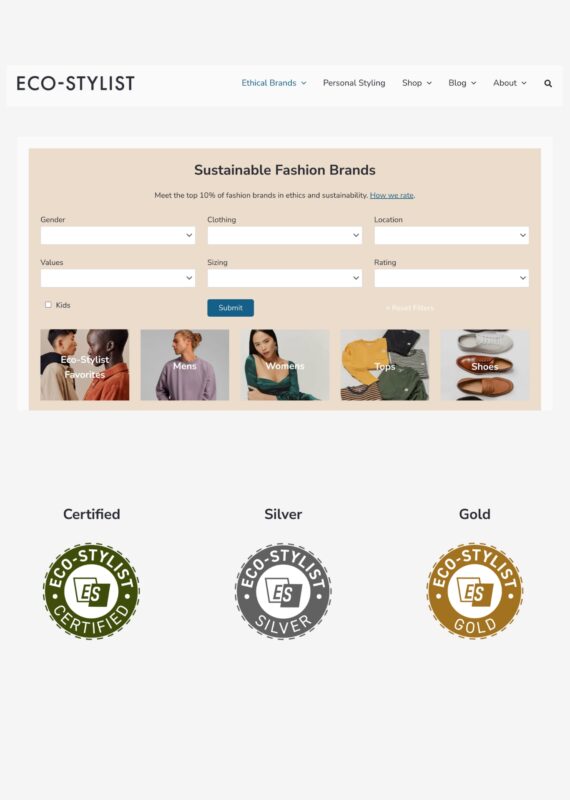
Eco-Stylist exclusively evaluates fashion brands on transparency, fair labor, and sustainable materials. Only the top 10% of researched brands earn certification, creating a curated directory of genuinely ethical options.
- Timeline: 2 weeks to get rated
- Cost: $499 – $999 one off fee
- Best for: Fashion brands with established sustainability initiatives in place
The upside: The selective approach (only top 10% pass) makes certification meaningful. Eco-Stylist goes deep on living wages, with 60% of their certified brands paying garment workers fairly. Their three-pillar framework (transparency, fair labor, sustainable materials) aligns with what conscious fashion consumers care about most. The certification process helps brands identify specific areas for improvement.
The downside: Fashion-only. The high bar means many brands working toward sustainability won’t qualify.
Green Hive
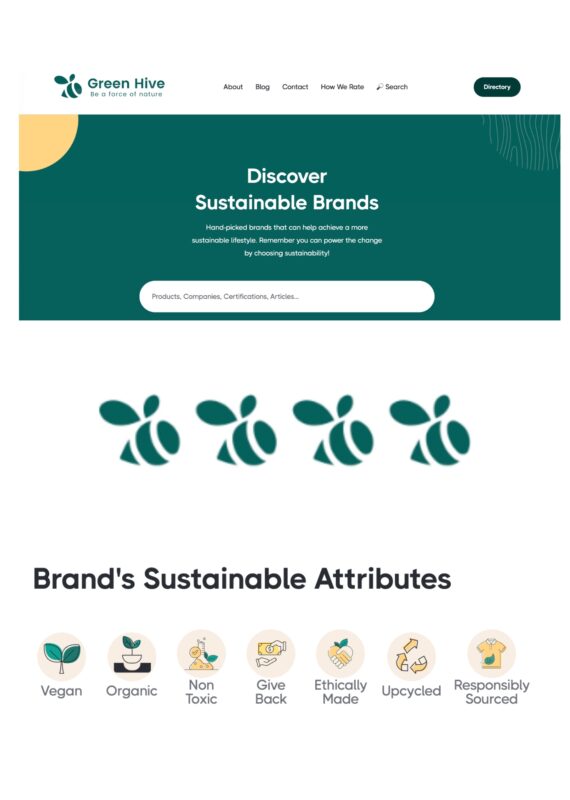
Green Hive assesses brands across multiple categories using third-party certifications as the foundation. They assign point values to different certifications and sustainable attributes, then adjust scores based on company size and transparency.
- Timeline: Brands can apply directly, unclear how long a rating takes
- Cost: $59 – $249 one time rating, plus additional fees for extras
- Best for: Brands with existing certifications across home, beauty, and lifestyle categories
The upside: Green Hive’s certification-based approach is relatively objective. Brands already investing in credentials like Leaping Bunny, Climate Neutral, or USDA Biobased get recognized. The size adjustment acknowledges that larger companies face different challenges. Their point system is transparent and explained in detail.
The downside: Heavy focus on certifications means brands without formal credentials may underperform even with strong practices. Newer categories and smaller product types may have fewer recognized certifications available.
The Good Shopping Guide
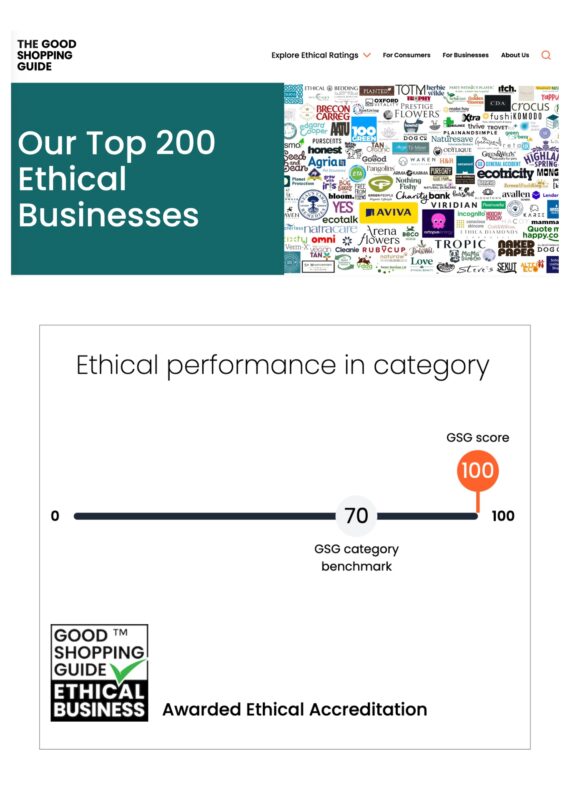
The Good Shopping Guide provides comprehensive ethical ratings across dozens of product categories from energy to chocolate. They’ve been rating brands since 2001, offering paid ethical accreditation.
- Timeline: Accreditation process takes 6-8 weeks.
- Cost: Paid accreditation with annual fees, based on Revenue
- Best for: Ethical consumer brands across food, home, beauty, and lifestyle\
The upside: The breadth is impressive, covering categories other platforms miss. Their methodology examines parent companies, so consumers understand the full corporate picture behind each brand. The green/red table visualization makes comparisons easy. Ethical accreditation comes with a logo brands can use in marketing. They also offer a free initial assessment.
The downside: The parent company analysis can penalize smaller sustainable brands owned by larger corporations, even when the brand operates independently. Some brands find the multi-category approach less specialized than single-focus assessments.
Ethical Consumer
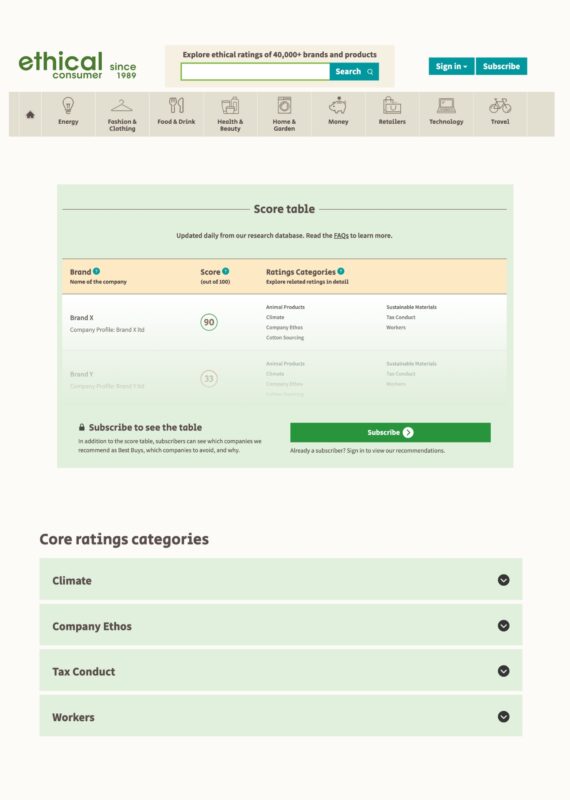
Ethical Consumer offers the most detailed corporate ethics research available to the public, rating companies on animals, environment, people, politics, and sustainability. They’ve tracked company behavior for over 30 years.
- Timeline: Continuous research updates.
- Cost: Subscription for consumers; brands can request assessment. To get a brand report, the cost is £200-350 (+ VAT)
- Best for: Established brands ready for thorough scrutiny
The upside: The depth is unmatched. Ethical Consumer examines subsidiaries, political donations, tax conduct, and arms industry connections. They look at issues most platforms ignore: armaments, controversial technologies, anti-social finance. Their five-year rolling window means companies must maintain standards consistently. The research is transparently available with full sourcing.
The downside: The political/ethical scope goes beyond what many brands consider “sustainability.” Strong environmental performers may score poorly due to parent company political activities. The comprehensive approach can feel overwhelming. Some brands find certain criteria (like mutual status or political donations) less relevant to their sustainability story. Access for consumers is not free.
Sustainable Jungle Brand Ratings
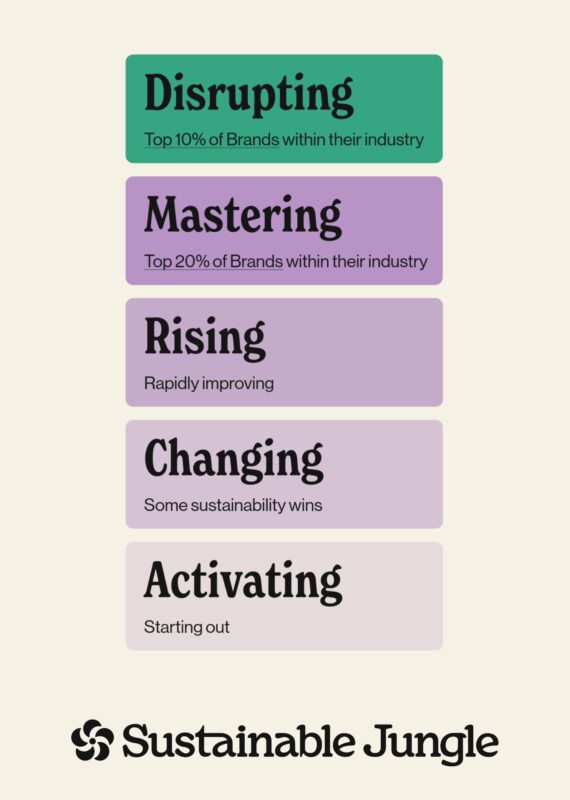
Sustainable Jungle provides fast-turnaround sustainability brand ratings for consumer brands across multiple categories. The assessment covers 22 criteria across nature and animals, communities and wellbeing, business governance, and product performance, then benchmarks brands against industry peers.
- Timeline: 2-3 weeks once documentation is submitted
- Cost: $899-$2,499 annually depending on revenue, with lower renewal fees. Includes a detailed brand profile and exposure opportunities
- Best for: DTC sustainable brands across fashion, beauty, home, food, and lifestyle. Small brands find Sustainable Jungle’s offering particularly helpful
The upside: Sustainable Jungle works directly with brands to understand and spotlight their initiatives beyond certifications and public disclosures. The benchmarking approach (rating brands relative to category leaders) recognizes that furniture sustainability performance looks different from fashion sustainability performance. Sustainable Jungle will only rate brands who are on the sustainability journey already. The 22-criteria framework is comprehensive but not overwhelming. Pricing scales with company size, making it accessible for early-stage brands. The rating comes with a badge, directory listing, and ongoing editorial features. Ratings can be completed in a matter of weeks.
The downside: Ratings are based on disclosed information and documentation rather than detailed auditing or direct supply chain inspections. Newer in the market compared to established rating players. The broad category coverage means less specialized expertise than single-industry raters.
Comparing Sustainability Assessments: What's Right for Your Brand?
The right sustainability assessment depends on your timeline, budget, and business goals.
If you need speed: B Corp takes 6-12+ months from application to certification. For faster validation, Sustainable Jungle (2-3 weeks) and Eco-Stylist (2 weeks for fashion brands) provide quick turnaround. Good On You has a long pipeline of brands waiting to be rated, so timing is uncertain.
If budget is tight: Several platforms offer free public assessment based on available information (Good On You, Commons). Paid options range from Eco-Stylist’s one-off $499-$999 fee to Sustainable Jungle’s revenue-based pricing starting at $599 (initial rating fee covering 1 year) for brands under $500K in revenue. B Corp fees range from $1,000 to $50,000 annually.
If you’re fashion or beauty: Good On You and Eco-Stylist offer specialized expertise in your industry, though Good On You’s long pipeline means uncertain timing while Eco-Stylist provides 2-week turnaround. Their criteria reflect fashion-specific concerns like textile waste and garment worker conditions. Sustainable Jungle, Green Hive, and The Good Shopping Guide also rate fashion but across broader frameworks.
If you’re in other consumer categories: Sustainable Jungle covers all consumer product categories from furniture to food. Green Hive and The Good Shopping Guide also span multiple categories. Fashion-specific raters won’t be relevant.
If you want detailed assessment vs basic screening: Free platforms typically rely on publicly available information. Paid assessments like Sustainable Jungle, B Corp, or The Good Shopping Guide involve deeper review of documentation, certifications, and brand-specific practices.
If ongoing visibility matters: Some assessments are one-time credentials. Others, like Sustainable Jungle’s editorial integration or Commons’ app-based rewards, provide continued consumer touchpoints beyond the initial rating.
If you want to influence policy: B Corp’s legal structure change demonstrates the deepest commitment. Ethical Consumer’s political scope includes advocacy. Most other assessments focus on operational practices.
How to Choose the Right Sustainability Assessment
Start by asking three questions:
- What’s your timeline? If you need credibility now to launch a product line, compete for retail partnerships, or respond to customer questions, fast-turnaround options like Sustainable Jungle or EcoStylist make sense. If you’re planning a multi-year transformation and want the strongest possible credential, B Corp justifies the investment.
- What’s your current sustainability maturity? Brands just beginning the journey may find comprehensive frameworks overwhelming. Start with focused assessments that give you a baseline and clear next steps. More advanced brands ready for deep scrutiny can pursue rigorous certifications. The key is matching assessment depth to your genuine progress.
- What matters most to your customers? Fashion customers care about living wages and textile sourcing. Furniture customers prioritize materials and durability. Beauty customers focus on ingredients and animal testing. Choose assessments that evaluate what your specific audience values most.
Getting Started With A Sustainability Assessment
Most brands benefit from taking a tiered approach.
- Immediate (next 30 days): Check if you already have free public ratings from platforms like Good On You, Commons, or Ethical Consumer to understand your current baseline. Read what’s already being said about your brand and parent company. Identify obvious gaps.
- Short-term (1-6 months): Consider paid assessments that provide third-party credentials with reasonable turnaround times. Use the assessment process to document your practices and policies. Display your rating to customers.
- Medium-term (6-12 months): If you scored well in initial assessments and want deeper recognition, explore specialized certifications relevant to your category. Many brands layer multiple credentials over time rather than pursuing everything at once.
- Long-term (1-3 years): For established brands with resources, B Corp or similar comprehensive certifications provide the strongest signal. Use earlier assessments to prepare by addressing weak areas first.
The brands that benefit most from sustainability assessment are those that are committed to improvement. Assessments work best as tools for progress. Choose evaluators who will push you toward better practices while recognizing the work you’ve already done.
Customers who care about sustainability aren’t looking for perfection. They want brands that are honest about where they are and working to improve. Overstated claims turn them off more than admitting you’re still figuring things out and demonstrating progress.
Ready to get your brand assessed? Explore Sustainable Jungle’s rating process here.

Joy has been a passionate advocate for the environment since she was a small child. She grew up in South Africa and has been lucky enough to be exposed to the wonders of nature not just in Africa but all over the world. She founded Sustainable Jungle (together with her husband Lyall) back in 2017 after becoming enraged by the devastating impact of palm oil. She then founded the Sustainable Jungle Podcast and together with Lyall interviewed remarkable people from all over the world who were finding ways to create positive impact. Outside of Sustainable Jungle, Joy has always worked in the corporate world, starting out as an auditor and later moving into management consulting. More recently she specialized in Climate Investing for the Asia Pacific region. Given her experience, her current passion is Brand Ratings. She is very much enjoying going deeper on what it really means to drive sustainability performance and true impact through business operations.