











As with most conventional beauty care products, hair conditioners and masks aren’t cheap. But when you can whip up your own nourishing DIY hair mask right at home with ingredients straight from your kitchen cupboard?
Where do we sign up!?
But what’s more is that our homemade recipe is far gentler on your scalp and strands, sticking to really simple, all natural ingredients (instead of synthetic fillers and wasteful packaging)—making them a win for both your hair and the planet!
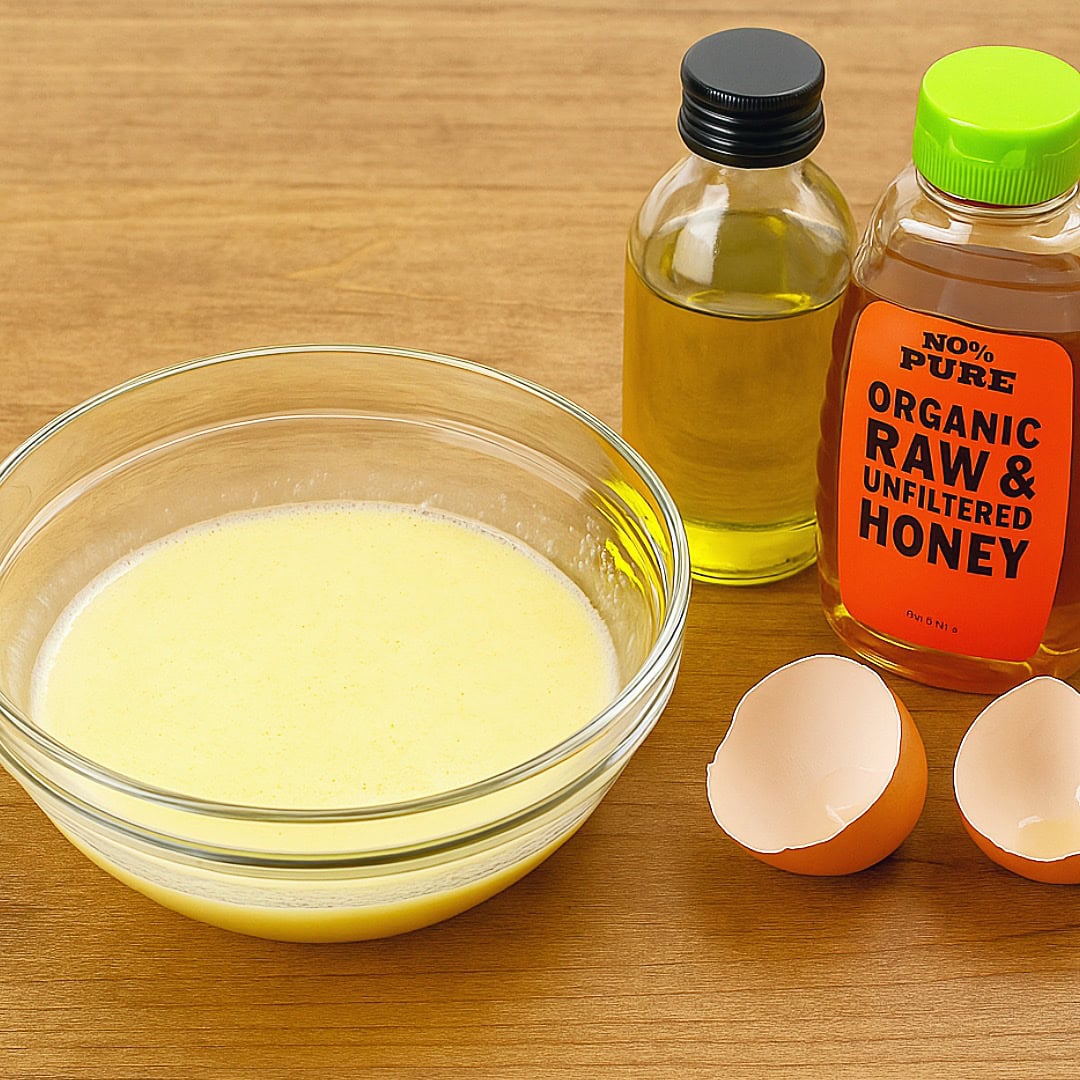
In this easy, tried-and-tested recipe, we’ll show you how to make your own protein-rich hair mask using egg, olive oil, honey, and yogurt to hydrate dry hair, repair damage, and bring back that healthy shine.
Index: Homemade Hair Mask
- DIY Hair Mask Recipe Jump to section
- Cost Savings of Making Your Own Hair Mask with Egg and Honey Jump to section
- Why Make Your Own Hair Mask With Egg and Olive Oil Jump to section
DIY Hair Mask Recipe

Your hair deserves a little TLC every now and then. Forget the pricey salon treatments—this easy, deep conditioning hair mask uses something as simple as kitchen staples to nourish and strengthen strands, helping to reduce breakage and promote shine. It’s perfect for dry or damaged hair, as it repairs while improving hair elasticity.
Ingredients:
- Egg (1, or 2 for longer hair): Packed with protein and essential nutrients that strengthen hair, reduce breakage, and promote healthy growth.
- Olive Oil Or Castor Oil (2 tbsp): Provides deep moisture and helps smooth frizz, leaving hair soft and shiny. Castor oil has additional benefits of promoting hair growth.
- Honey (1 tbsp): A natural humectant that locks in hydration and adds shine.
- Yogurt (1 tbsp, optional): Contains probiotics and lactic acid to nourish the scalp and improve hair texture.

Instructions:
- In a small bowl, whisk the egg(s) until smooth.
- Add your oil of choice, honey, and yogurt (if using), and mix until well combined.
- Apply the mixture evenly to damp hair, focusing on the mid-lengths and ends.
- Leave it on for 15–20 minutes, covering with a shower cap for better absorption.
- Rinse thoroughly with cool or lukewarm water (hot water can cook the egg!), and follow with your regular shampoo and conditioner to remove any residue.
Cost Savings of Making Your Own Hair Mask with Egg and Honey

Salon-quality results don’t have to come with a salon-style price tag.
This simple DIY hair mask costs just $1.41 per use—made with pantry staples like egg, castor oil, honey, and yogurt—you can whip it up whenever suits. This compared to $3 or more for a single-use store-bought packet.
That’s nearly half the price for a nourishing treatment that’s better for your hair and free from synthetic fillers. Let’s break down all the costs.
Cost Savings:
- Egg: $6 for a dozen (~$0.50 for one egg)
- Castor Oil: $10 for a 16 oz bottle (~$0.62 for 2 tbsp)
- Honey: $11 for a 32 oz bottle (if not organic) (~$0.18 for 1 tbsp)
- Yogurt: $7 for a 32 oz tub (~$0.11 for 1 tbsp)
Cost per batch: ~$1.41 per single use
Store-Bought Equivalent: ~$3 for a single use packet (e.g., A TRESemme, Clairol, and similar haircare brands)
Savings per Batch: $1.59
Why Make Your Own Hair Mask With Egg and Olive Oil
While store-bought hair masks may seem like a convenient fix for dry or damaged hair, many come with questionable ingredients that can impact both your health and the environment.
Conventional hair masks often rely on synthetic chemicals, petroleum-based ingredients, and artificial fragrances to deliver short-term results—many of which have been flagged in scientific studies for their potential side effects. Here’s a closer look at what’s typically inside those single-use packets:
- Silicones (e.g., Dimethicone, Cyclopentasiloxane): Used to create a smooth, glossy finish, silicones coat the hair rather than nourish it. Over time, they can build up, weigh down strands, and block moisture from penetrating the hair shaft.
- Synthetic Fragrances: Often listed simply as “fragrance” or “parfum,” these can contain dozens of undisclosed chemicals. Some are known allergens, hormone disruptors (like phthalates), or linked to skin irritation and respiratory issues.
- Preservatives (e.g., DMDM Hydantoin, Parabens): These extend shelf life but have raised concerns. DMDM hydantoin releases formaldehyde, a known carcinogen, while parabens have been linked to hormone disruption.
- Petroleum-Based Ingredients (e.g., Mineral Oil, Petrolatum): These are used to lock in moisture but can clog pores on the scalp, trap dirt, and carry a risk of contamination with PAHs (polycyclic aromatic hydrocarbons), which are linked to cancer.
- Quaternary Ammonium Compounds (e.g., Behentrimonium Chloride): Common in hair conditioning products, some “quats” are known irritants and have been associated with allergic reactions and respiratory issues with prolonged exposure.
By making your own DIY face mask, homemade hair mask, or just DIY beauty products in general, you skip these unnecessary additives and avoid any risks that come with them.

Amber obtained Bachelor of Arts degrees in English, Creative Writing, and Psychology from The University of Oxford and Arcadia University. She is an avid crafter, gardener, quail farmer, wannabe novelist, and self-proclaimed eco adventurer. From living in a camper van to living in a tiny house, she is enamored by the small and self-sufficient; and aspires to one day become an off-grid micro-farmer, bridging sustainability with non-toxic living and eating. With a passion for outdoor sports like rock climbing, skiing, and travel, having already backpacked across 30 countries, she is always up for the next big adventure while seeking ways to minimize her impact along the way.