













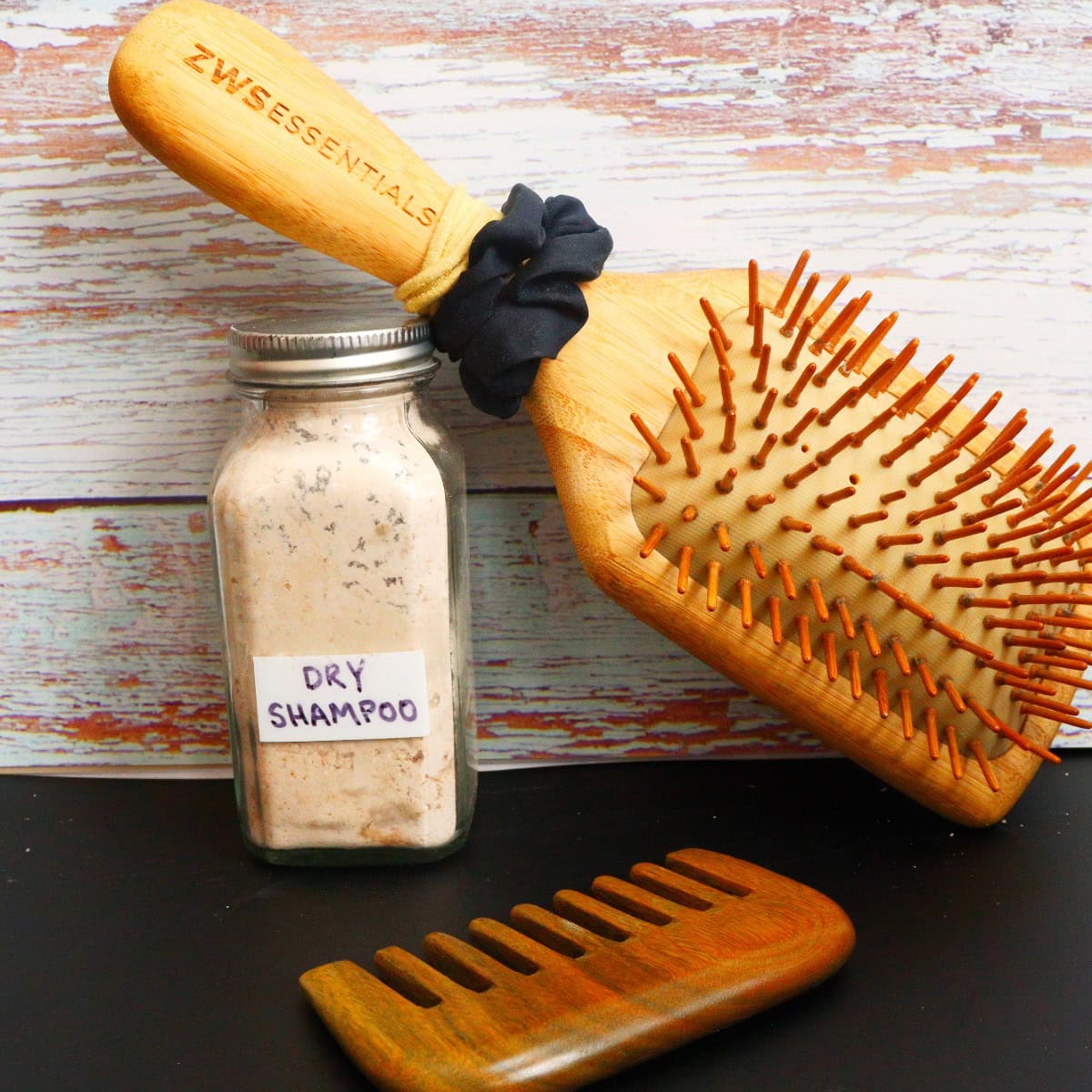
Even if you’re using a natural, eco-friendly shampoo that’s gentle on the scalp, washing your hair every day can still strip away its natural oils and cause unnecessary damage. Whereas using a DIY dry shampoo to reduce washing is a gentle alternative that relies on natural simple ingredients. It’s also surprisingly effective and not-to-surprisingly efficient!
But, instead of reaching for that drugstore aerosol can that’s filled with chemicals, rather make your own version using simple and natural kitchen staples that refresh your scalp, absorb excess oil, and leave your hair smelling great all day.
Both of these recipes can be adapted to match your hair color using minor alterations to work as a homemade dry shampoo for dark hair, blonde hair, red hair, and everything in between.
Index: Homemade Dry Shampoo Recipes
- DIY Dry Shampoo with Arrowroot Powder Jump to section
- DIY Dry Shampoo with Bentonite Clay Jump to section
- Cost Savings of Making Your Own DIY Dry Shampoo Jump to section
- Why Make Your Own DIY Dry Shampoo? Jump to section
DIY Dry Shampoo with Arrowroot Powder

This simple DIY dry shampoo with arrowroot powder uses natural ingredients to absorb oil and freshen up your hair without the need for washing.
Note that it may require some initial experimentation to get your hair color just right. Start small when it comes to adding colors, as you can always add more later. We recommend keeping careful track of your ratios in your initial attempts so that after you’ve found the perfect tint for you, you know exactly how much coloration powders to add for future batches.
Ingredients:
- Arrowroot Powder (2 tbsp): A great base for absorbing excess oil and moisture from the scalp without weighing hair down.
- Cocoa and/or Cinnamon Powder (1–2 tbsp, for darker hair): Cocoa provides color and helps blend the dry shampoo into dark hair. If you have red undertones in your hair, try cinnamon powder. For a DIY dry shampoo for light hair, you may be able to skip these altogether.
- Cornstarch (1/2 tbsp): Another oil-absorbing powder that helps to keep hair looking fresh.
- Baking Soda (1 tsp, optional): Adds extra freshness and absorbs oils, but use sparingly to avoid a chalky texture.
Instructions:
- In a bowl, mix together the arrowroot powder, cocoa powder, cornstarch, and optional baking soda.
- Add essential oils, stirring until the mixture is well combined and not too chunky. Adjust the scent strength by adding more or less oil.
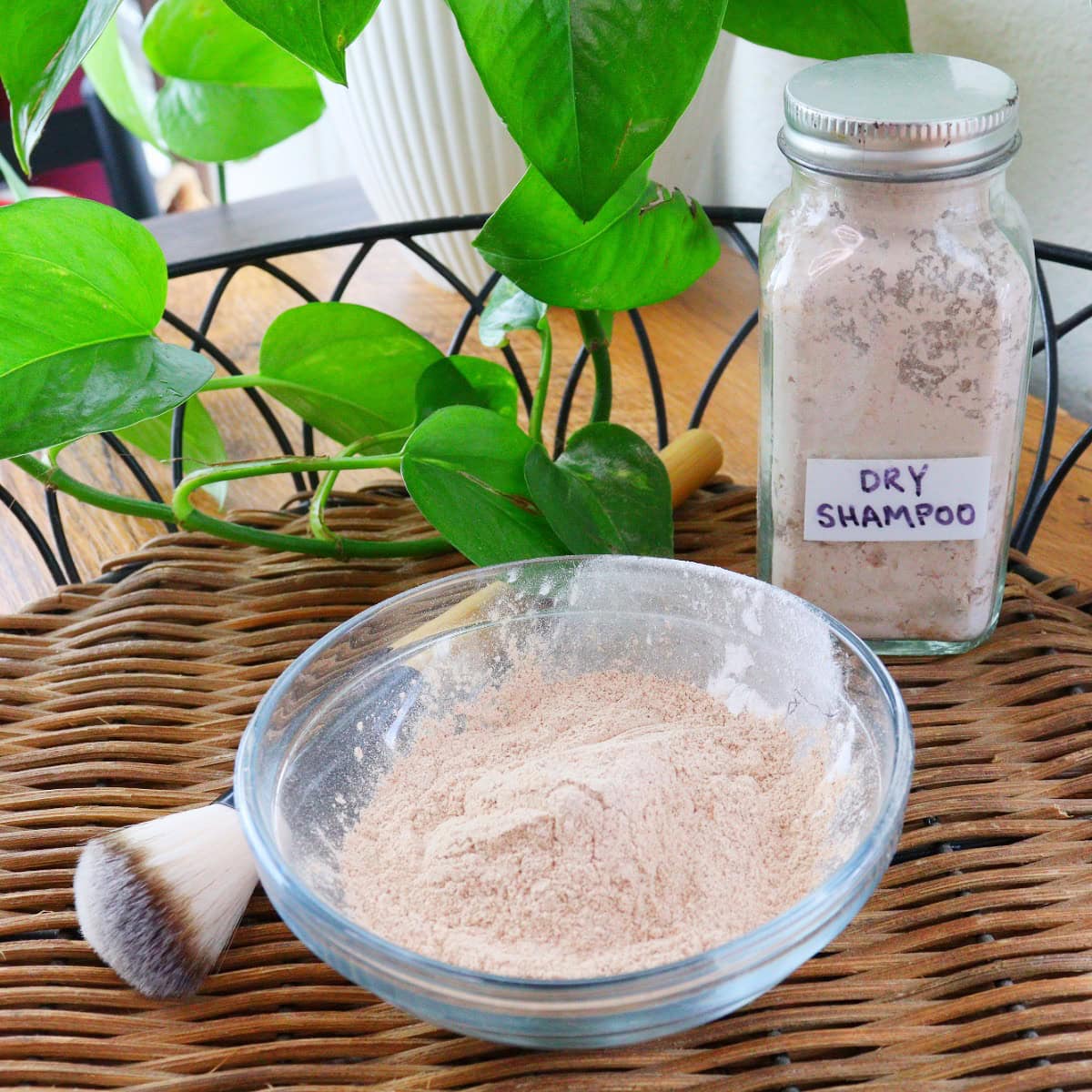
- Transfer the mixture into a clean shaker or a small container with a lid. We like to reuse old spice jars for easy application.
- To use, shake the dry shampoo onto your scalp where oil buildup occurs. Let it sit for a minute, then massage it in with your fingertips or a brush, and comb or finger-style your hair as usual. We recommend flipping your head upside down as you tease it in to help lift your greasy roots away from the scalp and add extra volume to your hair.
DIY Dry Shampoo with Bentonite Clay

Maybe you’re looking for a DIY dry shampoo without cornstarch—possibly because you know you have a cornstarch sensitivity or if you want to prevent any breakouts and inflammation that may occur from the fact that cornstarch can act as a food source for bacteria.
For that reason, this recipe has a longer shelf-life and we’ve personally been using the same bulk batch of this we made over four years ago! It still works just as well as when we first whipped it up.
If so, try this bentonite clay based recipe instead. Bentonite clay dry shampoos not only absorb excess oil without over-drying the scalp, but serve to draw out impurities in the scalp while enriching it with natural minerals to balance overall scalp health and pH.
Ingredients:
- Bentonite Clay (¼ cup): An oil-absorbing and detoxifying agent to give hair and light and lifted feel. Also balances slalp health with natural minerals.
- Arrowroot Powder (2 tbsp): Helps absorb oil and lighten the clay.
- Cocoa and/or Cinnamon Powder (1-2 tbsp, for darker hair): Cocoa provides color and helps blend the dry shampoo into dark hair. If you have red undertones in your hair, try cinnamon powder.
Instructions:
- In a bowl, combine bentonite clay and arrowroot powder. If you have dark hair, add cocoa powder to avoid a white cast.
- Drop in essential oils and stir well to distribute evenly.
- Transfer to a clean, dry container (like a spice shaker or jar with a makeup brush for application).
Cost Savings of Making Your Own DIY Dry Shampoo

Dry shampoo can be a lifesaver between washes, but the cost of a single bottle can range from $7 to $30, depending on the brand and formulation. DIY dry shampoo costs just a fraction of that. Let’s compare.
- DIY Dry Shampoo – Arrowroot Powder
- Arrowroot Powder: $6 for an 8 oz bag (~$0.38 for 2 tbsp)
- Cocoa Powder: $6 for an 8 oz container (~$0.75 for 2 tbsp, less for lighter hair)
- Cinnamon Powder: $6 for a 2 oz jar (~$0.05 for 1 tsp, depending on how much you use)
- Cornstarch: $5 for a 12 oz bag (~$0.10 for 1/2 tbsp)
- Baking Soda: $9 for a 16 oz bag (~$0.05 for 1/2 tsp)
Cost per batch: ~$1.33
Store-Bought Equivalent: ~$10+ for 1.8 oz aerosol spray or 1 oz powder
Savings per Batch: $8.67
- DIY Dry Shampoo – Bentonite Clay
- Bentonite Clay: $6 for a 4 oz bag (~$3.00 for ¼ cup)
- Arrowroot Powder: $6 for an 8 oz bag (~$0.38 for 2 tbsp)
- Cocoa Powder: $6 for an 8 oz container (~$0.75 for 2 tbsp, less for lighter hair)
- Cinnamon Powder: $6 for a 2 oz jar (~$0.05 for 1 tsp, depending on how much you use)
Cost per batch: ~$4.18
Store-Bought Equivalent: ~$10+ for 1.8 oz aerosol spray or 1 oz powder
Savings per Batch: $5.82
Why Make Your Own DIY Dry Shampoo?

Commercial dry shampoos are often loaded with synthetic chemicals that can irritate your scalp or damage your hair over time:
- Butane/Propane (in aerosol sprays): These are flammable propellants that are a source of VOCs that can irritate your skin and lungs and negatively impact indoor air quality. Butane and isobutane may also contain 1,3-butadiene, which is both extremely flammable (not something you want on your hair!) and a known carcinogen.
- Silicones (i.e. Dimethicone, Cyclomethicone, and Amodimethicone): These create a smooth texture and tame friziness, but can build up in your hair and lead to oiliness and dullness.
- Fragrance: Artificial scents that can trigger allergic reactions or scalp irritation.
- Talc: A controversial ingredient used to absorb oil but potentially contaminated with carcinogenic asbestos.
- Alcohol: A drying ingredient that strips moisture from your scalp and hair.
With DIY dry shampoo, you skip all these chemicals and instead use natural, gentle ingredients that absorb oil without disrupting your scalp’s natural balance. You can see why we’re big fans of DIY beauty products, you can make anything really like our homemade hair mask and DIY face mask.

Amber obtained Bachelor of Arts degrees in English, Creative Writing, and Psychology from The University of Oxford and Arcadia University. She is an avid crafter, gardener, quail farmer, wannabe novelist, and self-proclaimed eco adventurer. From living in a camper van to living in a tiny house, she is enamored by the small and self-sufficient; and aspires to one day become an off-grid micro-farmer, bridging sustainability with non-toxic living and eating. With a passion for outdoor sports like rock climbing, skiing, and travel, having already backpacked across 30 countries, she is always up for the next big adventure while seeking ways to minimize her impact along the way.