












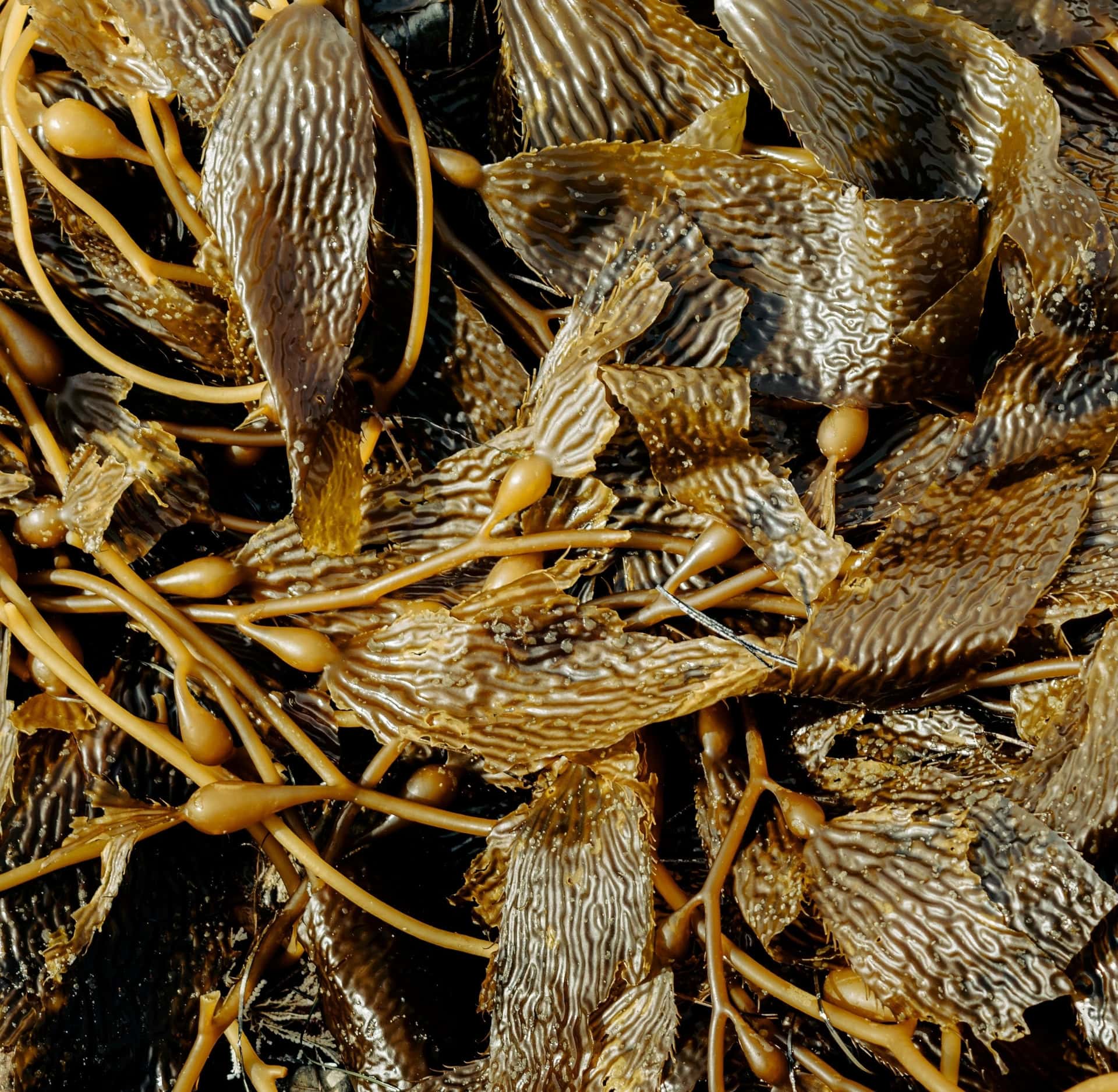
Seaweed is one of the planet’s most essential organisms, dating back more than one billion years. Loaded with trace elements, amino acids, minerals, antioxidants, and vitamins, humans harvest it for everything from medicine and food to fertilizer, fuel, skincare, and… seaweed clothing?
Saltwater seaweed may be “having its moment in the sun,” but it’s not the first time humans have donned kelp. In the 1600s, Japanese textile makers used seaweed to fortify clothing, and in Ancient Rome, it was used to dress wounds. Now, with a World Bank report estimating that emerging seaweed markets (including textiles) could reach $11.8 billion by 2030, the ancient marine plant is riding a serious wave.
But is seaweed fabric the real deal, or is the industry riding on unproven health claims and shiny marketing? Let’s deep-sea dive into kelp fabric and find out.
Related Guides: Sustainable Fabrics, Vegan Fabrics, What Is Lyocell?, Viscose Fabric, Sustainable Vegan Leather
Table Of Contents: Seaweed Fabric & Sustainability
- What Is Seaweed Fabric? Jump to section
- What Is Seaweed Fiber Used For? Jump to section
- How Is Fabric Made From Seaweed? Jump to section
- Is Seaweed Fabric Sustainable? Jump to section
- Seaweed Fabric Controversy Jump to section
- Seaweed Fabric vs. Other Sustainable Fabrics Jump to section
- Key Players in the Seaweed Textile Ecosystem Jump to section
- What to Look For When Buying Seaweed Clothing Jump to section
- FAQs on Seaweed Fabric Jump to section
What Is Seaweed Fabric?
As we’ve explored with the marine-based sustainable material fish skin leather, the crossover between sustainable fashion and food is becoming more commonplace.
Seaweed, also known as kelp, has long been linked to both sustainability and health benefits, thanks to its nutrient density and abundance in our oceans. Iron, calcium, iodine, vitamins A, C, E, and B12, plus antimicrobial and anti-inflammatory properties, make it a rich resource for human wellbeing.
But what exactly is seaweed fabric?
First, note that kelp fabric is not purely seaweed. It’s a semisynthetic fabric produced by spinning the natural cellulose of beech or eucalyptus trees together with seaweed to create a soft, stretchy, durable yarn that can be woven into textiles. Think of it as lyocell fabric with seaweed added for extra functionality.
Beech and eucalyptus trees (the same things used to make modal fabric and lyocell, respectively) are known for their regenerative properties and remain usable post-harvest, meaning they can be sourced again.
The seaweed used for fabric is usually brown Knotted Wrack (Ascophyllum nodosum) from Icelandic fjords, although some producers also work with Horsetail kelp or Sargassum. The resulting fabric is biodegradable, absorbent, soft, and breathable.
There are currently two main approaches to seaweed textiles, each with a different technology:
SeaCell™ Seaweed Fabric
The most established seaweed fabric on the market, SeaCell™ is produced by German company Smartfiber AG. It uses a modified lyocell process (the same closed-loop technology behind TENCEL™) to embed dried, powdered organic brown algae into cellulose fibers.
According to Smartfiber AG’s FAQ page, SeaCell contains roughly 4% seaweed by weight, and >85% cellulose.
SeaCell carries certifications from EU Ecolabel (held since 2014), OEKO-TEX Standard 100 (certified safe even for baby products), and TÜV Austria for compostability. Its manufacturing process won the European Business Awards “Process Innovation” under the Environment category. Smartfiber AG has also held a lyocell license from Lenzing Group, and SeaCell fibers are produced at Lenzing’s facilities in Austria.
Kelsun™ Seaweed Fabric
The newer player on the scene is Kelsun™, produced by North Carolina-based Keel Labs (formerly AlgiKnit, rebranded in 2022). Unlike SeaCell, which adds seaweed powder to a lyocell fiber, Kelsun takes a fundamentally different approach. It extracts alginate, a biopolymer found in seaweed, and uses a proprietary wet-spinning process to create fibers from that biopolymer directly.
Kelsun is 100% biobased and USDA-certified, biodegradable in wastewater, and designed as a “plug-and-play” replacement for conventional fibers on existing textile machinery. Keel Labs closed a $13 million Series A funding round in 2022 (with H&M Group’s Co:Lab among the investors) and scaled production 10x through 2024.
In October 2024, Kelsun was named “Innovation of the Year” by Textile Exchange at its Climate & Nature Impact Awards.
What Is Seaweed Fiber Used For?
Seaweed fabric is used primarily in sustainable activewear and loungewear, but is also finding its way into underwear, mattresses, home textiles like bedding and towels, and knitted garments. (We own a SeaCell sweater and love how it’s warm yet silkier to the touch.)
Baby clothes and undergarments are popular applications, since seaweed fabric is breathable, soft, lightweight, and moisture-wicking.
The main beneficial qualities of seaweed clothes include:
- Softness: SeaCell fibers are smoother and silkier than wool or organic cotton, making them gentle on sensitive skin. SeaCell clothing also moves moisture away from the body, helping to prevent bacteria growth.
- Breathability: Like other semisynthetics from the viscose family, seaweed fabric is highly breathable, making it ideal for summer and workout clothing.
- Moisture-wicking: SeaCell retains much of its dryness in wet conditions, keeping you warm when it’s cool and cool when it’s warm.
- Durability: SeaCell is reported to be stronger than cotton and viscose when both dry and wet, meaning you can machine wash seaweed fiber clothing without it losing shape.
- Biodegradable: When not blended with synthetic fabrics, seaweed fabric is compostable and biodegradable.
Note: Many brands also claim seaweed fabric offers UV protection, mineral transfer to skin, and antioxidant benefits. We address the evidence (or lack thereof) for those claims in the controversy section below.
How Is Fabric Made From Seaweed?
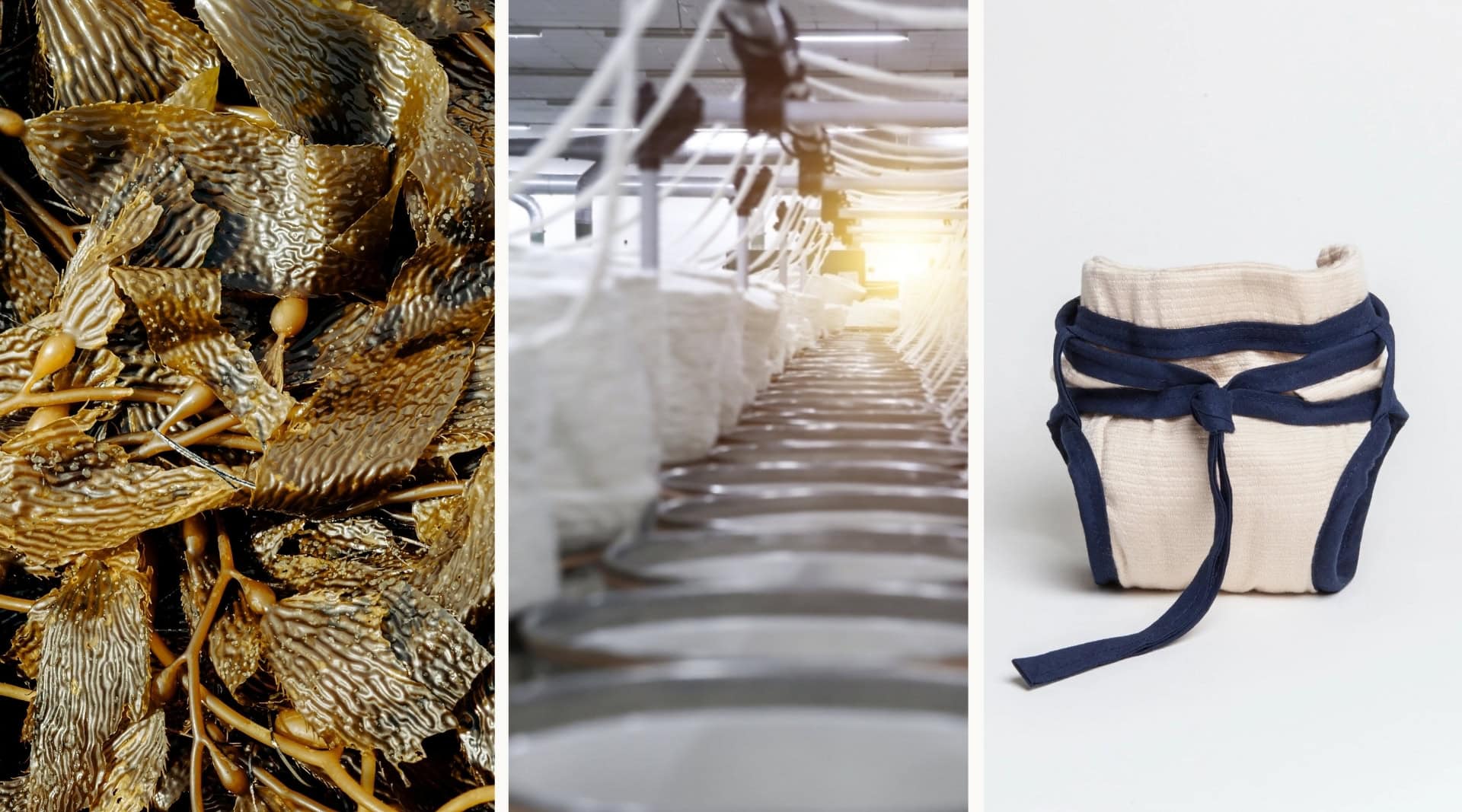
The production process differs depending on the type of seaweed fiber:
How SeaCell™ Clothing Fabric Made
SeaCell™ starts with sustainably harvested brown algae (Ascophyllum nodosum) from Icelandic fjords. According to Smartfiber AG, only the regenerative part of the plant is harvested (every four years) to minimize environmental impact. The seaweed is then dried naturally and chopped, with no chemical treatments applied, to preserve its naturally occurring substances.
The actual fiber production uses a closed-loop lyocell process. Wood cellulose (from beech or eucalyptus trees) is dissolved using an organic amine oxide solvent, and the powdered seaweed is added during the liquid stage. This solution is then filtered and spun through spinnerets to create fine filaments that become blended seaweed yarn.
The closed-loop system recycles approximately 99% of water and solvents, and the process is recognized by the FSC as non-toxic. This is the same fundamental technology used to produce standard lyocell (TENCEL™), with seaweed powder added as a functional ingredient.
It’s important to understand that seaweed is added to the wood-cellulose solution, which acts as the structural base. SeaCell is primarily a lyocell fiber with seaweed embedded in it.
How Kelsun™ Is Made
Kelsun™ takes a different route. Rather than adding seaweed to a wood-cellulose base, Keel Labs extracts alginate (a biopolymer naturally found in seaweed) and combines it with proprietary non-toxic additives and water to form a solution. This solution is then extruded through a wet-spinning process, where polymer chains link to create thousands of fine filaments. These filaments are stretched, rinsed, finished, dried, and spun into spools of fiber.
Kelsun can be blended with cotton or hemp and integrated into existing yarn and textile production systems. Current commercial products use blends (such as the 70% Kelsun/30% cotton T-shirt created with sustainable fashion influencer Aditi Mayer, or the Kelsun/organic cotton Blanket Shirt launched with Outerknown).
Is Seaweed Fabric Sustainable?
It’s no fanta-sea: seaweed meets many of the criteria for a sustainable fabric. But the picture is more nuanced than the marketing copy suggests.
The Good News
Raw material sourcing is impressively low-impact. Seaweed requires no freshwater, no arable land, no synthetic fertilizers, and no pesticides to grow. Certain species of kelp can grow up to 50 cm per day, making it one of the most rapidly renewable biological resources on the planet. Keel Labs claims Kelsun reduces water usage by 70x and eliminates land use entirely compared to cotton.
Seaweed cultivation can benefit marine ecosystems. Seaweed absorbs CO2 from the ocean (much as trees absorb it from the air), and seaweed farming can help reduce eutrophication by absorbing excess nutrients from water, a significant environmental issue driven largely by agricultural runoff.
Production processes are relatively clean. SeaCell’s closed-loop lyocell process releases no chemicals as waste, recycles solvents and water, and uses non-toxic solvents. This contrasts sharply with the harmful chemical processes used to make conventional rayon fabric.
The finished fabric is biodegradable. When not blended with synthetics, seaweed fabric is compostable, meaning it won’t contribute to the microplastics problem that plagues polyester and nylon-based textiles. It’s estimated that up to 500,000 tonnes of microplastics from textiles enter marine environments annually.
The Caveats
SeaCell is mostly lyocell. Remember that SeaCell contains roughly 4% seaweed by weight, with the rest being mostly wood-cellulose lyocell. The sustainability profile is therefore largely that of lyocell (which is already a well-regarded sustainable fabric), with a small seaweed addition.
Carbon sequestration claims need context. While seaweed absorbs CO2 as it grows, a 2024 study published in Scientific Reports found that the climate benefits of seaweed farming depend heavily on what the harvested seaweed is used for. Replacing carbon-intensive products with seaweed-based alternatives generates far more climate benefit than marine sequestration alone. Simply growing seaweed and leaving it in the ocean may actually generate more CO2 than it sequesters, according to the same research.
Scale remains limited. Seaweed textiles still represent a tiny fraction of global fiber production. The global seaweed fabric market is projected to grow at about 10.5% CAGR through 2031, but the infrastructure for large-scale seaweed farming and processing remains underdeveloped. Production costs are significantly higher than conventional fabrics.
Blending complicates end-of-life. Many seaweed garments are blended with cotton, spandex, or other fibers, which can complicate recyclability and reduce biodegradability.
Certifications to Look For
When buying seaweed fabric, the most relevant sustainability certifications include:
- EU Ecolabel: SeaCell has held this since 2014, confirming low environmental impact across its lifecycle
- OEKO-TEX Standard 100: Confirms the fabric is free from harmful substances (SeaCell is certified safe for baby products)
- TÜV Austria OK Compost: Confirms compostability
- USDA BioPreferred/Biobased: Kelsun carries this certification
FSC certification: Relevant for the wood pulp sourcing component
Seaweed Fabric Controversy
Not to krill your vibe, but we can’t ignore some red flags about this otherwise green material.
The Lululemon SeaCell Scandal
In 2007, Lululemon came under fire after a New York Times investigation found that its VitaSea clothing line, which it claimed contained SeaCell with anti-inflammatory, antibacterial, hydrating, and detoxifying benefits, couldn’t withstand scrutiny. Independent lab tests commissioned by the Times found no significant difference in mineral levels between the VitaSea fabric and ordinary cotton T-shirts.
Canada’s Competition Bureau instructed Lululemon to remove all unsubstantiated therapeutic claims from its product tags. Health Canada also asked the company to provide scientific data supporting its claims.
Today, Lululemon still carries VitaSea (now described as “seaweed-derived yarn blended with cotton and spandex”), but all health claims have been removed. The brand now focuses on comfort and breathability.
The Greenwashing Problem Persists
Despite the Lululemon debacle, brands and suppliers continue to market seaweed fabric with bold health claims that lack scientific backing. As a Glossy investigation in 2022 found, multiple companies have implied or explicitly stated that wearing SeaCell delivers vitamins and minerals to the skin, calms the nervous system, eliminates free radicals, or repairs cellular damage. A dermatologist consulted for the piece said there is no research backing up claims that wearing clothes containing processed seaweed delivers nutrients through the skin.
Smartfiber AG’s own website continues to state that SeaCell fibers are “”rich in antioxidants that protect against negative environmental effects” and claims it can “activate cell regeneration and have a detoxifying and purifying effect on your skin”. While seaweed itself does have documented wound-healing properties and is known to absorb heavy metals in its raw form, there is no peer-reviewed evidence that a fabric containing processed seaweed powder at a low concentration delivers these benefits through skin contact.
Regulatory Momentum Is Building
The EU’s Empowering Consumers for the Green Transition Directive, which EU member states must transpose into national law by March 2026 (with rules applying from September 2026), bans generic, unsubstantiated green claims, product claims based solely on carbon offsetting, and sustainability labels not backed by approved certification schemes. While the broader Green Claims Directive has been paused as of June 2025, the regulatory direction is clear: brands will need to substantiate environmental and health claims with verifiable evidence.
For consumers, this means the health-benefit marketing around seaweed fabric should be treated with healthy skepticism. The sustainability story is real. The “wearable wellness” story is not (yet) supported by science.
Seaweed Fabric vs. Other Sustainable Fabrics
How does seaweed fabric stack up against the alternatives?
Seaweed (SeaCell) vs. Standard Lyocell (TENCEL™):
SeaCell is lyocell, with seaweed added. The base sustainability profile is very similar. The question is whether the seaweed addition provides meaningful extra benefits (unproven for health, marginal for sustainability given the small percentage). Standard lyocell may be a simpler, equally sustainable choice for most consumers.
Seaweed vs. Organic Cotton:
Seaweed fabric requires dramatically less water and no agricultural land. It’s softer and more breathable. But organic cotton has a far more established supply chain, is easier to recycle, and doesn’t require chemical processing to produce fiber. For everyday basics, organic cotton remains the more accessible and proven choice.
Seaweed vs. Hemp:
Both are low-impact crops.
Hemp requires minimal water and no pesticides, but it does need agricultural land. Seaweed is softer out of the gate, while hemp softens with washing. Both are biodegradable. Hemp has a much more established textile supply chain and can be produced as a pure fiber (no blending required).
Seaweed vs. Bamboo:
Both are fast-growing and renewable. However, most bamboo fabric is processed into rayon/viscose, which involves harsh chemicals. Bamboo lyocell (the closed-loop version) is more comparable to SeaCell’s process, but bamboo fabric faces its own greenwashing controversies.
Key Players in the Seaweed Textile Ecosystem
This is a small but growing industry. Here’s who’s doing what:
Fiber Producers
- Smartfiber AG (Rudolstadt, Germany): The original and most established seaweed textile producer. Manufacturers of SeaCell™ (and also Smartcel™, a zinc-oxide functional fiber). Founded in 2005 as a spin-off of the Thuringian Institute for Textile and Plastic Research (TITK). Fibers are produced at Lenzing AG’s facilities in Austria. Works with supply chain partner PYRATEX (Madrid) for marketing and distribution.
- Keel Labs (North Carolina, USA): Producer of Kelsun™ fiber. Founded in 2017 as AlgiKnit, rebranded in 2022. Backed by $13 million in Series A funding (investors include H&M Group’s Co:Lab). Currently scaling from limited-edition collaborations toward broader commercial availability.
- Phycolabs (Brazil): Early-stage startup developing threads made purely from seaweed (without a wood-cellulose base), working with red seaweed varieties cultivated in warm Brazilian waters. Still pre-commercial but participated in events like Biofabricate and the Global Fashion Summit.
Other Seaweed Innovators
- Algae Scope (EU): Developing bio-based water and fireproof textile coatings made entirely from seaweed, positioned as a PFAS replacement. Received Horizon Europe funding and won recognition in multiple accelerator programmes.
- Zeefier (Netherlands): Developing artisanal and circular textile dyes from seaweed.
Brands Using Seaweed Fabric
SeaCell Clothing Brands:
- Another Tomorrow (100% SeaCell lyocell garments)
- CALIDA (underwear and loungewear)
- lululemon (VitaSea line)
- SPEIDEL (lingerie)
- FTC Cashmere (SeaCell-cashmere blends)
- WYLD1 (activewear/golf)
- Thought (basics)
- Oliver Charles (sweaters)
- Pangaia (SeaCell-cotton blends)
Kelsun Clothing Brands:
- Stella McCartney (featured Kelsun in Spring-Summer 2025 runway collection)
- Outerknown (first commercial Kelsun product: limited-edition Blanket Shirt with 30% Kelsun/70% regenerative organic cotton)
- & Other Stories (H&M Group; released Kelsun crocheted collection in 2025)
Industry Bodies & Initiatives
- Textile Exchange: Recognized Kelsun as Innovation of the Year (2024); tracks preferred fiber uptake globally
- Global Seaweed Coalition: Industry body working on sustainable seaweed standards
- Safe Seaweed Coalition: Works with FAO and WHO on safety and quality standards for seaweed products
What to Look For When Buying Seaweed Clothing
If you want to add seaweed fabric to your wardrobe, here’s how to shop smart:
Check the fiber blend: Look at the content label closely. A garment marketed as “seaweed fabric” might contain as little as 15-20% seaweed-derived fiber, with the rest being lyocell, cotton, or synthetic fibers like spandex. The more seaweed or seaweed-based fiber in the blend, the more you’re actually getting “seaweed fabric”.
Ignore health claims: If a brand tells you their seaweed shirt will deliver vitamins to your skin, calm your nervous system, or eliminate free radicals, that’s a red flag as the wearable wellness story isn’t supported by evidence. Look for brands that focus on comfort and environmental credentials rather than unsubstantiated therapeutic benefits.
Look for certifications: EU Ecolabel, OEKO-TEX Standard 100, USDA BioPreferred, and TÜV compostability certifications are real indicators of environmental and safety standards. Be wary of brands that rely on vague sustainability language without specific certifications.
Consider the whole garment: A SeaCell or Kelsun fiber blended with conventional cotton, elastane, or synthetic dyes loses some of its sustainability advantage. Look for garments that pair seaweed fiber with other sustainably sourced materials and use low-impact dyes.
Know what you’re paying for: Seaweed fabric is a premium product. If the price seems too good to be true, the seaweed content is likely minimal.
FAQs on Seaweed Fabric
Is seaweed fabric vegan?
Yes. Seaweed fabric is entirely plant-based (marine algae + wood cellulose), making it a vegan fabric. No animal products are used in production. Both SeaCell and Kelsun are vegan-friendly.
Is seaweed fabric biodegradable?
When not blended with synthetic fibers, yes. SeaCell clothing fabric is certified home-compostable by TÜV Austria. Kelsun is biodegradable in wastewater. However, many commercial seaweed garments include spandex, elastane, or synthetic blends that reduce biodegradability. Always check the full fiber content on the label.
Does seaweed fabric really deliver vitamins and minerals to your skin?
No credible, peer-reviewed scientific evidence supports this claim. While raw seaweed is indeed rich in vitamins, minerals, and bioactive compounds, independent testing has failed to demonstrate that a fabric containing limited amounts of processed seaweed powder delivers these substances through skin contact in any meaningful way. Buy seaweed fabric for its sustainability and comfort properties, not for unproven health benefits.
What’s the difference between SeaCell and Kelsun?
SeaCell (by Smartfiber AG) is a lyocell fiber with seaweed powder embedded in it (roughly 4% seaweed by weight). Kelsun (by Keel Labs) extracts the alginate biopolymer from seaweed and spins it directly into fiber. SeaCell is the more established product with wider commercial availability. Kelsun is newer, 100% biobased (no wood pulp required), and was named Textile Exchange’s Innovation of the Year in 2024.
Is seaweed fabric better than cotton?
In some ways, yes. Seaweed fabric requires no freshwater, no agricultural land, and no pesticides, whereas conventional cotton is one of the most water-intensive crops on Earth. Seaweed fabric is also softer and more breathable than conventional cotton. However, organic cotton has a far more established supply chain and is easier to recycle. They’re both good choices for different reasons.
How do you wash seaweed fabric clothing?
Most seaweed fabric garments can be machine washed on a gentle cycle with cold water. SeaCell is reported to retain its properties even after 50+ wash cycles, with only a 12-22% drop in effectiveness. Avoid tumble drying when possible, and use eco-friendly detergent. Always check the care label on your specific garment.
Is seaweed fabric expensive?
Yes, currently. Seaweed textiles are still a niche, premium product. Production costs are higher than conventional fabrics due to limited processing infrastructure and specialized manufacturing requirements. As the industry scales, prices should come down, but for now, expect to pay a premium for seaweed garments.
Can seaweed fabric replace polyester?
Not yet at scale, but that’s the ambition. Both SeaCell and Kelsun are positioned as alternatives to fossil-fuel-based synthetics. Seaweed fabric is biodegradable and doesn’t shed microplastics. But the global seaweed textile industry is still tiny compared to polyester production, which dominates more than half of global fiber output.
Final Thoughts on Seaweed Fabric
Seaweed fabric is a promising sustainable textile that deserves its place in the current conversation about fashion’s future. The raw material is abundantly renewable, the production process (for both SeaCell and Kelsun) is cleaner than most textile manufacturing, and the finished fabric is biodegradable. In a world drowning in synthetic microplastics, that’s nothing to get salty about.
But the seaweed textile industry has a greenwashing problem. Too many brands sell the sizzle of “wearable wellness” (vitamins! antioxidants! free radical elimination!) without the scientific steak to back it up. The 2007 Lululemon scandal should have been a wake-up call, but nearly two decades later, unsubstantiated health claims are still standard marketing fare for SeaCell products. As EU regulations around green claims tighten through 2026, we expect this to change.
Until the tide turns, don’t buy seaweed fabric because a brand told you their shirt will detoxify your skin. And keep an eye on Kelsun, the newer technology from Keel Labs!
The ocean has been kelp-ing us for a billion years. It’s about time we let it kelp our wardrobes, too. To help the process along, give this article a share, so more people can be on the lookout for seaweed clothes that make our world (and their closet) a greener place.
Editor’s Note: Originally published September 2023. Updated March 2026 with the addition of Kelsun™ by Keel Labs as a second seaweed fiber technology, expanded greenwashing analysis including EU regulatory developments, corrected SeaCell composition data (4% seaweed by weight per Smartfiber AG’s technical specifications), a new fabric comparisons section, and a fully updated ecosystem map of brands, manufacturers, and industry initiatives.

Joy has been a passionate advocate for the environment since she was a small child. She grew up in South Africa and has been lucky enough to be exposed to the wonders of nature not just in Africa but all over the world. She founded Sustainable Jungle (together with her husband Lyall) back in 2017 after becoming enraged by the devastating impact of palm oil. She then founded the Sustainable Jungle Podcast and together with Lyall interviewed remarkable people from all over the world who were finding ways to create positive impact. Outside of Sustainable Jungle, Joy has always worked in the corporate world, starting out as an auditor and later moving into management consulting. More recently she specialized in Climate Investing for the Asia Pacific region. Given her experience, her current passion is Brand Ratings. She is very much enjoying going deeper on what it really means to drive sustainability performance and true impact through business operations.