














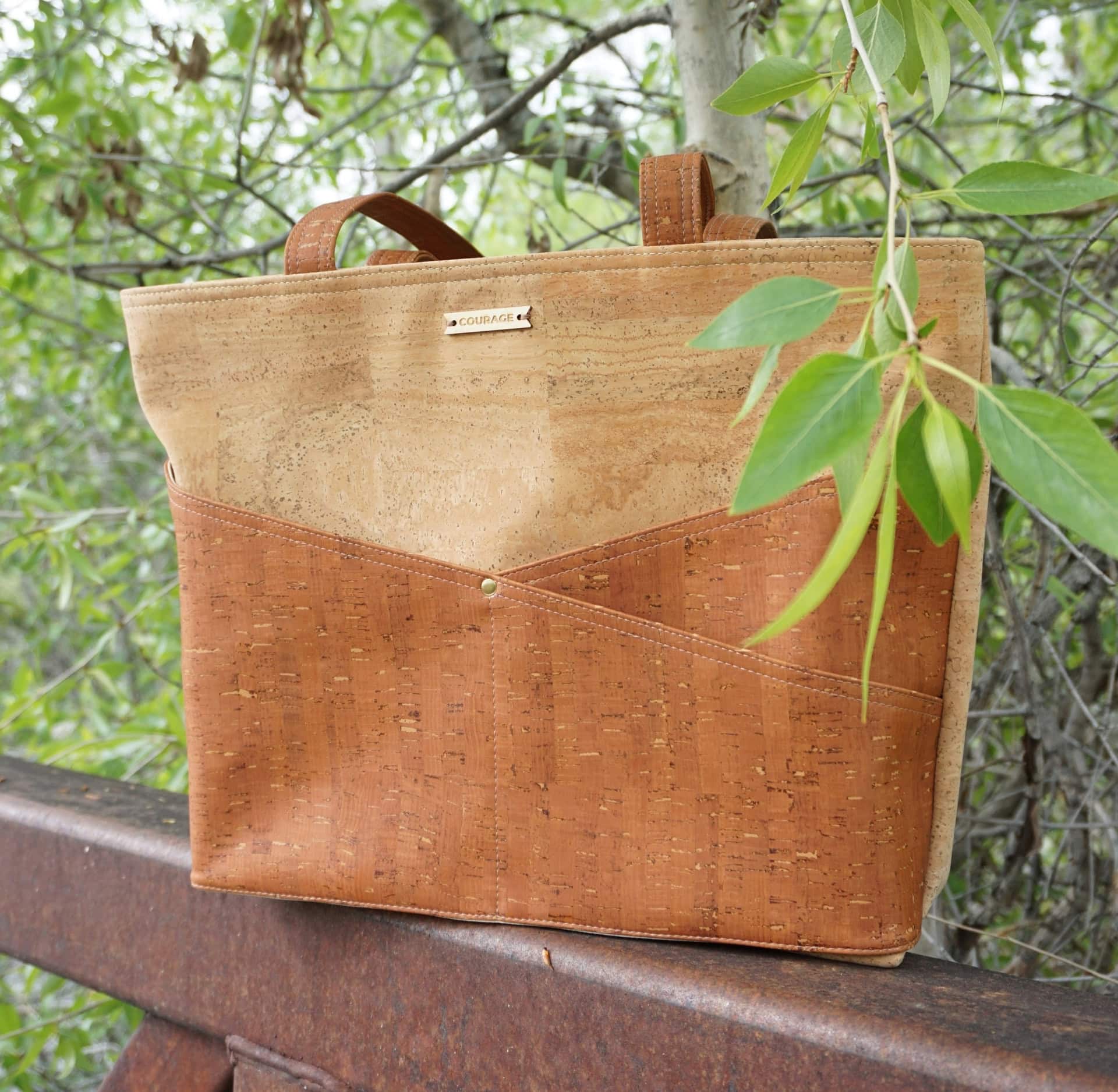
When it comes to fabrics, our faves are those that—like the Lorax—speak for the trees. So what better choice than a fabric that actually comes from them? We’re talking cork leather fabric.
Cork fabric is a tre(e)mendously useful material used for everything from bags and purses to yoga mats. But what is cork fabric, exactly, and is it as sustainable as we’ve been led to believe it is, or are ethical fashionistas barking up the wrong (cork) tree?
One of the great pleasures of researching cork is realising that almost everything you hope is true about it actually is. No (fo)rest for the wicked as we pop the cork on this wonderfully weird, genuinely tree-friendly material.
Related Guides: Sustainable Fabrics, Vegan Leather, Vegan Fabrics, Synthetic Fabrics
Table Of Contents: Cork Fabric
- What Is Cork Fabric? Jump to section
- How Is Cork Leather Made? Jump to section
- Is Cork Fabric Sustainable? Jump to section
- Cork Fabric Pros and Cons Jump to section
- Cork Material Properties & Care Jump to section
- Cork Leather vs. Other Plant-Based Vegan Leathers & Animal Leather Jump to section
- Key Cork Industry Players & Ecosystem Jump to section
- What to Look For When Buying Cork Jump to section
- Brands Using Cork Fabric Jump to section
- Frequently Asked Questions About Cork Material Jump to section
What Is Cork Fabric?
You may be well acquainted with it from your favourite bottle of Pinot Noir or the memo board pinning your endless to-do lists. Cork has been used for thousands of years for fishing tackle, cask stoppers, footwear, and building materials. While humans have long been fascinated by this natural material, using it as a pliable fabric for fashion is relatively recent.
Cork leather (also called cork fabric or cork skin) is made from the bark of the cork oak tree, Quercus suber. This evergreen tree is native to northwest Africa and southwest Europe, with Portugal home to the largest share: around 34% of the world’s cork oaks and over 720,000 hectares of cork forest. In 2023, Portuguese cork exports reached a record value of €1.2 billion.
Cork is used across industries: flooring, insulation, wine bottle stoppers, yoga mats, and increasingly, sustainable fashion items that trade animal hides for animal-free fabrics like cork material in bags, belts, and shoes.
How Is Cork Leather Made?
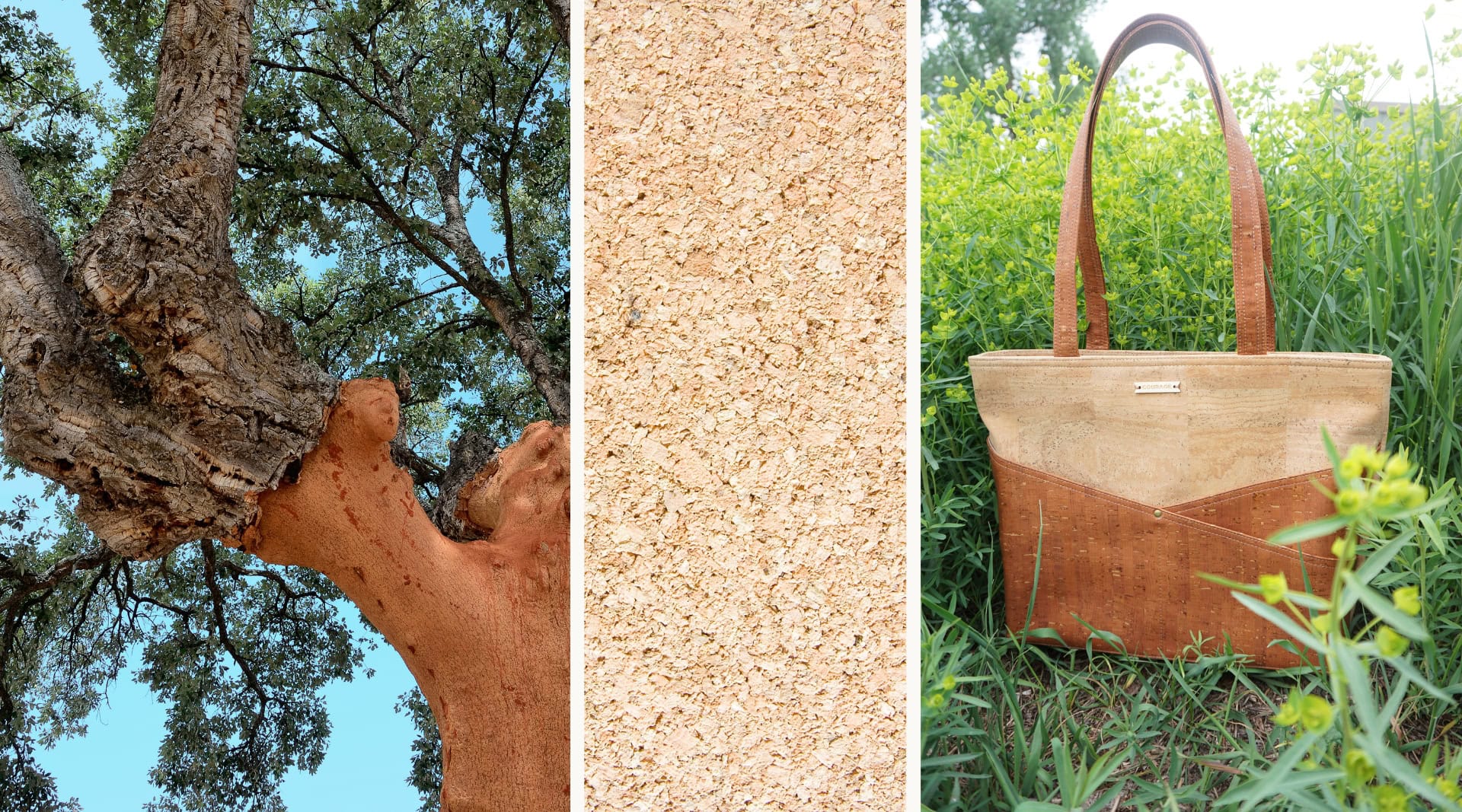
Cork leather starts with harvesting the bark. The outer section is manually stripped from the tree using a simple axe—no machinery required and no tree felling needed. Since the outer bark regenerates fully, this can be done without endangering the tree at all.
Once trees reach the age of 25, bark harvesting can take place every 9 to 12 years. The average cork oak lives for around 150–200 years, meaning its bark can be sustainably harvested up to 16 times over its lifespan. This makes cork one of the few raw materials where harvest actually benefits the source.
Processing Cork Into Fabric
After stripping, the cork is stacked and left to dry for roughly six months before being submerged in boiling water. This process cleans the cork and softens it, enhancing the material’s characteristic elasticity and making it easier to manipulate into thin sheets.
The dried, processed cork is then shaved into very thin layers (often around 0.5–1mm), which are bonded to a backing material to give the final fabric its structure and strength. The backing is the most important variable in terms of sustainability:
- Cotton backing (preferably organic) makes the final product largely biodegradable
- Recycled polyester backing is less ideal from a circularity standpoint but is commonly used
- Polyurethane (PU) backing is the least sustainable option and compromises biodegradability
A protective sealant may be applied after bonding to enhance stain resistance, though cork’s natural water-repelling properties (thanks to a waxy compound called suberin) mean this isn’t always necessary. Sealants and synthetic dyes can affect the material’s end-of-life options, so natural or water-based finishes are preferable.
Is Cork Fabric Sustainable?
Cork is one of those materials where the environmental story is positive, provided you understand where the caveats lie.
Carbon Sequestration
As with most tree-based materials, cork’s ability to remove and store carbon from the atmosphere is a major benefit. Unlike timber harvesting, cork harvesting doesn’t require tree felling, so carbon sequestration continues uninterrupted throughout a tree’s life.
Research by Portugal’s Instituto Superior de Agronomia (ISA) found that a well-managed cork oak forest can sequester up to 14.7 tonnes of CO₂ per hectare per year. Extrapolated across all cork oak forests in the western Mediterranean basin, cork forests have the capacity to sequester approximately 30.66 million tonnes of CO₂ per year.
More striking: when a cork oak’s bark is stripped, the tree absorbs more CO₂ as the new bark grows. According to Euronews, for each kilogram of cork produced, the tree captures 73 kg of CO₂. This puts cork in a rare category of materials where production actively enhances carbon sequestration.
Life cycle assessments (LCAs) conducted by EY and PwC on behalf of Corticeira Amorim (the world’s largest cork processor) found that cork products have negative carbon balances when accounting for the sequestration capacity of the cork oak forest, meaning more CO₂ is captured than is emitted across the production process.
Biodiversity
Cork oak forests (known as montado in Portugal and dehesa in Spain) are designated biodiversity hotspots on a level with the Amazon and Borneo. These agroforestry systems provide habitat for thousands of species, including the critically endangered Iberian lynx.
Well-managed cork forests are also natural fire barriers, with the agroforestry structure (open canopy, grazing livestock, low undergrowth) significantly reducing wildfire fuel load. This is increasingly important: Portugal experienced severe wildfires in September 2024, with around 110,000 hectares burned in a single week. Well-managed cork forest is part of the solution.
Minimal Chemical Processing
Unlike animal leather, cork leather requires no tanning, no chromium, and no toxic finishing chemicals. Wastewater from cork processing remains essentially clean, in stark contrast to the leather tanning industry’s known contamination issues.
There is also minimal material waste: scraps and residual cork from fabric production can be repurposed into other products (insulation, composites, wine stoppers). Corticeira Amorim reports a waste recovery rate of around 90% across its industrial operations.
Biodegradability
100% natural cork is biodegradable and compostable. However, this only holds true when the cork fabric is:
- Backed with a biodegradable material (e.g. organic cotton, not polyester or PU)
- Free of synthetic dyes and finishes
- Free of synthetic glues
If your cork product has a PU backing or a synthetic sealant coating, the full product won’t biodegrade cleanly. Watch out for these in product descriptions as brands using sustainable cork will usually specify the backing material.
The Climate Threat to Cork Forests
One emerging concern worth flagging: climate change is increasing wildfire risk and drought intensity across the Iberian Peninsula, and research from 2024 has found that 59% of Portuguese cork oak stands show no natural regeneration. Warmer, drier conditions are making it harder for seedlings to establish. Some producers have responded with irrigation in new plantations. This is a long-term threat to the cork supply chain and not a reason to avoid cork now, but it’s worth monitoring as a systemic risk.
Cork Fabric Pros and Cons
Pros:
- Renewable and harvested without felling trees
- Negative carbon footprint when forestry carbon sequestration is included
- Naturally water-resistant, lightweight, and durable
- No toxic chemicals required in core production process
- Biodegradable (when paired with natural backing and finishes)
- Supports high-biodiversity ecosystems
- Naturally antimicrobial and hypoallergenic
- Zero waste potential: processing scraps go back into other industries
Cons:
- Biodegradability depends heavily on backing material (PU backing is a problem)
- Glues and synthetic sealants can affect end-of-life options
- Cork/PU blended products are sometimes marketed as “cork” without specifying the polymer content which is greenwashing.
- Climate change poses a long-term supply risk to Iberian cork forests
- Quality varies significantly between producers. Cheap cork fabric may use processed cork waste rather than natural bark sheets
Cork Material Properties & Care
Cork’s main properties are why it’s found in both wine bottles and wallets: it’s lightweight, elastic, naturally water-resistant, and stain-resistant. The suberin content (a waxy, hydrophobic compound) repels water and contributes to cork’s durability as a material for high-wear accessories like sustainable sandals and handbags. Cork is also naturally antimicrobial, hypoallergenic, and doesn’t accumulate dust or dirt the way woven textiles do.
For care:
- Keep it clean. Regular wiping is all most cork products need.
- Spot-treat with a damp cloth, rubbing gently until the dirt or stain disappears. Avoid machine washing.
- For a larger mess, cork’s natural water resistance means it can handle a gentle hand wash in warm water with mild, eco-friendly dish soap.
- Air dry flat and don’t use heat.
- Avoid prolonged exposure to direct sunlight, which can cause discolouration over time.
With proper care, good-quality cork products develop character rather than deteriorating. It’s much more like leather than synthetic alternatives.
Cork Leather vs. Other Plant-Based Vegan Leathers & Animal Leather
Cork is arguably the most fully natural of the mainstream vegan leather options. Here’s how it compares:
Cork vs. Cactus Leather
Cactus leather (primarily Desserto’s product) is around 90% bio-based which is well above most plant leathers, and uses biodegradable PU along with organic dyes. Desserto holds an impressive suite of certifications including OEKO-TEX, USDA Organic, and GRS.
However, the added PU still inhibits full biodegradability. Cork, when properly produced, is closer to 100% bio-based with a cleaner end-of-life profile.
Cork vs. Piñatex
Piñatex (made by Ananas Anam from pineapple leaf fibre) is 80% plant fibre and 20% PLA (polylactic acid from cornstarch), coated with water-based PU resin.
Its base material is biodegradable under industrial conditions, and it has the advantage of upcycling agricultural waste. Cork still wins on simplicity and naturalness of production, and on its direct ecosystem benefits.
Cork vs. Apple Leather
Apple leather (such as Frumat’s AppleSkin™) typically blends 50% apple waste with 50% PU, backed with cotton/polyester. Again, the high synthetic content limits its sustainability credentials compared to pure cork.
Cork vs. Mycelium Leather
Mushroom/mycelium leather is the closest rival to cork on naturalness. It’s plastic-free and biodegradable. Two companies have led this space: Bolt Threads, whose Mylo material attracted Adidas and Lululemon; and Natural Fiber Welding, whose MIRUM material (which uses cork powder as one of its plant ingredients) was adopted by Allbirds, Ralph Lauren, and IWC Schaffhausen. Stella McCartney partnered with both.
Both have hit commercial headwinds. Bolt Threads paused Mylo production in 2023 due to scaling challenges. NFW announced a wind-down in September 2025 and came within hours of filing for bankruptcy before a last-minute investment rescued the company in January 2026, though it has since narrowed its focus away from MIRUM entirely.
The pattern is instructive as cork benefits from being a commercially mature, centuries-old supply chain that doesn’t require a startup to survive.
Cork vs. Animal Leather
Cork production requires no tanning chemicals, generates no toxic wastewater, involves no animal welfare considerations, and sequesters carbon rather than emitting it. Traditional leather tanning involves chromium and other toxic substances that contaminate local waterways; the ethical leather industry has been working to address this, but it remains a significant issue. For most end uses, cork is the clear environmental winner.
Key Cork Industry Players & Ecosystem
Major Cork Manufacturers
Corticeira Amorim is the world’s largest cork processing group, founded in 1870 and headquartered in Portugal. It controls multiple business units including cork stoppers, cork composites, flooring, and cork solutions for aerospace, automotive, and construction. The company claims around one in three wine bottles globally uses an Amorim cork stopper.
Corticeira Amorim reports that over 50% of its industrial units are FSC-certified, and more than 70% of its energy needs come from renewable sources. More than 50% of the energy for cork production comes from burning the cork dust and trimmings (a closed-loop energy loop).
HZCORK is a Chinese manufacturer specialising in wholesale cork fabrics and finished cork products, supplying brands in more than 30 countries. HZCORK sources FSC-certified Portuguese cork and holds BSCI and REACH SVHC certifications.
Corkor is a Portuguese brand that manufactures its cork accessories in-house, using FSC-certified cork sourced locally and backed with certified linings. Smaller-scale and artisan-focused, Corkor represents the direct-to-consumer end of the cork supply chain.
Certifications Relevant to Cork
- FSC (Forest Stewardship Council): The most important sustainable forestry certification for raw cork. FSC certification confirms the cork oak forest is responsibly managed, workers are fairly treated, and harvesting doesn’t damage biodiversity. Look for FSC-certified cork as a baseline for sustainable sourcing.
- OEKO-TEX Standard 100: Tests the finished product for harmful substances. Particularly relevant for cork fabrics that use dyes or synthetic backing materials.
- PETA-Approved Vegan: Confirms no animal-derived materials or testing. Note that PETA certification relies on brand self-declaration and doesn’t audit for environmental claims.
- REACH compliance: EU chemical safety regulation, particularly relevant for dyes, sealants, and backing materials used in cork fabric production.
- APCOR: The Portuguese Cork Association, which promotes quality standards and sustainability across the sector.
Cork Industry Context & Innovations
The broader non-animal leather landscape continues to evolve rapidly. Cork’s role as a component in next-generation materials means its properties are valued even beyond traditional cork fabric.
For example, a 2024 study in Sustainability journal explored cotton-cork blended fabrics (90% cotton, 10% cork), finding the blend outperformed pure cotton on wrinkle resistance and abrasion resistance.
What to Look For When Buying Cork
Check the backing material. This is the most important sustainability variable. Look for:
- Organic cotton backing (best)
- Recycled cotton (good)
- Recycled polyester (acceptable, but not fully circular)
- Avoid virgin PU or PVC backing
Look for FSC-certified cork. This confirms responsible forest management. Most premium cork brands will state this explicitly. If they don’t mention certification, it’s worth asking.
Check for synthetic sealants and dyes. Natural water-based or vegetable dyes won’t compromise biodegradability. Synthetic coatings will.
Watch for “cork” labelling on agglomerated products. Some cheaper products are made from cork dust or scraps compressed with synthetic binders (essentially a cork composite rather than natural bark sheet). It’s still a legitimate use of cork material, but the sustainability profile differs. Look for “natural cork fabric” or “cork leather from bark sheets.”
Beware greenwashing on backing. A product can legitimately be marketed as “cork” while having a fully synthetic PU backing. The cork component may be sustainable; the whole product might not be. The most sustainable fashion brands are transparent about all component materials.
Brands Using Cork Fabric
Cork is attracting a growing roster of sustainable fashion brands, particularly in bags, wallets, and footwear. A few worth knowing:
- Carry Courage crafts PETA-approved bags and purses from cork sourced from sustainable forests, lined with organic cotton. Carry Courage is one of our top rated brands which means they have been assessed on their sustainability credentials and awarded our top rating.
- Corkor is a Portugal-based brand handcrafting cork bags, backpacks, wallets, and belts using FSC-certified cork sourced locally. They’re PETA-Approved Vegan and use plastic-free accessories (zippers, buckles) throughout. A genuine benchmark for how cork products can be done well.
- Svala is a Los Angeles-based brand making elegant cork bags, clutches, and wallets with recycled polyester or organic cotton linings. All products are handcrafted in LA under fair-wage conditions.
- NAE Vegan Shoes (No Animal Exploitation) is a Portuguese footwear brand offering cork-upper shoes and sandals. Their cork is FSC-certified, their organic cotton is GOTS-certified, and their synthetic materials are OEKO-TEX Standard 100 certified.
- Eve Cork makes premium cork handbags lined with organic cotton, using natural vegetable dyes throughout.
- Scoria offers a range of cork and natural rubber-based non-toxic yoga mats and accessories.
For product roundups featuring cork accessories, see our guides to sustainable wallets and sustainable bags and purses.
Frequently Asked Questions About Cork Material
Is cork fabric vegan?
Yes. Cork fabric is 100% plant-derived. It comes from the bark of the cork oak tree, with no animal products involved at any stage of harvest or production. Many cork brands carry PETA-Approved Vegan certification to confirm this. Cork is one of the most commonly used materials in vegan shoes and vegan sandals.
Is cork leather durable?
Yes, more so than you might expect. Cork is naturally scratch-resistant, water-resistant, and compressive. It bounces back rather than creasing or cracking. High-quality cork leather products can last many years with basic care, aging with character rather than deteriorating. Its durability comes from suberin, a natural wax-like compound in the cell walls, which also makes it naturally antimicrobial.
Is cork material biodegradable?
Natural cork is 100% biodegradable and compostable. However, the full cork fabric product is only biodegradable if the backing material and any adhesives or finishes are also natural. Cork with a PU backing, synthetic glue, or synthetic sealant will not fully biodegrade. Always check the full material composition, not just the cork component.
Where does cork fabric come from?
Most cork fabric comes from Portugal, which is home to around a third of the world’s cork oak trees and is the global leader in cork production. Spain is the second-largest producer. The cork is harvested by hand from the cork oak (Quercus suber), processed, and then typically cut into thin sheets and bonded to a backing fabric. Portugal-made cork is generally the gold standard for traceability.
How does cork material compare to PU vegan leather?
Cork is significantly more sustainable than polyurethane (PU) vegan leather. PU is a petroleum-derived plastic that doesn’t biodegrade, contributes to microplastic pollution, and requires chemical processing. Cork, by contrast, is plant-based, requires minimal chemical inputs, sequesters carbon during production, and is biodegradable (when paired with a natural backing). The trade-off is that PU tends to be cheaper and more uniformly textured; cork has a distinctive natural grain.
Can cork fabric get wet?
Cork handles moisture well. Its natural suberin content makes it water-resistant rather than waterproof. It won’t be damaged by rain or accidental spills, but prolonged immersion (leaving a cork bag soaking in water) is not recommended for products with paper or card elements inside. For cleaning, a damp cloth is ideal for most situations.
What certifications should I look for?
The most meaningful certification for cork is FSC (Forest Stewardship Council), which confirms responsible forest management. OEKO-TEX Standard 100 on the finished product confirms it’s free from harmful substances. PETA-Approved Vegan confirms no animal inputs. For backing materials, look for GOTS (organic cotton) or GRS (recycled content). If a cork brand doesn’t mention any certifications, it’s reasonable to ask.
Final Thoughts On Cork Fabric
We’ve peeled back the layers, and cork holds up remarkably well to scrutiny. Shall we pop a bottle of champagne to celebrate cork fabric? We think so.
Among the many fabrics we cover at Sustainable Jungle, cork is one of the few where the environmental story is positive at almost every stage: no trees felled, carbon sequestered in the process, minimal chemicals, natural biodegradability, and genuine biodiversity support. It’s also been doing this for centuries without requiring a startup, a splashy rebranding, or a TED talk.
Just remember to choose cork backed with organic cotton rather than PU, choose FSC-certified sourcing, and avoid synthetic sealants if end-of-life circularity matters to you. The backing material is where “cork leather” can shade into “mostly plastic with a cork veneer” (so read the small print).
As for the greenwashing risk: cork is one of the more greenwashing-resistant materials in the vegan leather space, because its supply chain is established, its environmental claims are well-supported by independent LCA data, and the key variables (backing, dyes, sealants) are clearly identifiable.
If this relatively new and unique way to accessorize has sparked some fashion passion in you, be sure to spread the word!
Editor’s Note: Originally published November 2022. Updated March 2026 with current carbon sequestration data, new certifications guidance, an expanded brands section, and updated coverage of the plant-based leather landscape.

Joy has been a passionate advocate for the environment since she was a small child. She grew up in South Africa and has been lucky enough to be exposed to the wonders of nature not just in Africa but all over the world. She founded Sustainable Jungle (together with her husband Lyall) back in 2017 after becoming enraged by the devastating impact of palm oil. She then founded the Sustainable Jungle Podcast and together with Lyall interviewed remarkable people from all over the world who were finding ways to create positive impact. Outside of Sustainable Jungle, Joy has always worked in the corporate world, starting out as an auditor and later moving into management consulting. More recently she specialized in Climate Investing for the Asia Pacific region. Given her experience, her current passion is Brand Ratings. She is very much enjoying going deeper on what it really means to drive sustainability performance and true impact through business operations.












It’s eco-friendly in theory, but cork fabric is typically glued to some form of backing, usually polyester, polyurethane, or cotton. So it depends on what the backing is and what the glue is made from.
A very good point Misty. Like anything it’s important to think about the bigger picture when it comes to sustainability.
Some of the cheaper stuff seems to have a very fibrous nature, suggesting that it may be like ‘genuine leather’: offcuts, shavings and sawdust stuck back together with some form of glue – the equivalent of mdf for cork. Especially suspicious of the type with gold flecks, which obviously did not come from the original tree, and is most likely a plastic addition.