















By using simple, natural ingredients, you can create a homemade dishwasher detergent that cleans just as well as store-bought options without harsh chemicals or unnecessary waste.
Especially since many conventional dishwasher detergents contain ingredients like phosphates, chlorine, and polyvinyl alcohol (PVA), which can harm aquatic ecosystems and contribute to plastic pollution. We know they’re convenient, but is that worth their hidden environmental costs?
Unless you’re buying a non-toxic dishwasher detergent from selected brands, we don’t think so!
So to help you navigate the world of DIY dish detergents, we’re sharing 3 of our favorite go-to recipes we’ve been using for years. Specifically dishwashing detergent powder, liquid and pods (or tablets). These all strike a balance between performance (they’re super effective and you can tweak the ratios depending on your preference), sustainability and cost saving.
Whether you’re looking to reduce your household’s reliance on single-use plastics or avoid harmful additives, these recipes are a step toward greener cleaning—and you don’t even need to sink (pun intended) a lot of time into making them.
Index: DIY Dishwasher Detergent Recipes
- Homemade Dishwasher Detergent Powder Jump to section
- Homemade Dishwasher Detergent Liquid Jump to section
- Homemade Dishwasher Detergent Tablets Jump to section
- Cost Savings of DIY Dishwashing Detergent Recipes Jump to section
- Why Choose DIY Dishwasher Detergent? Jump to section
Homemade Dishwasher Detergent Powder
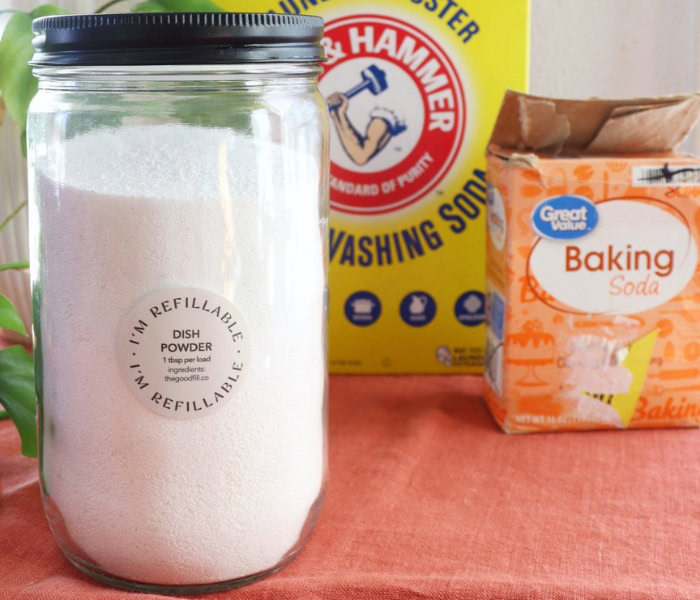
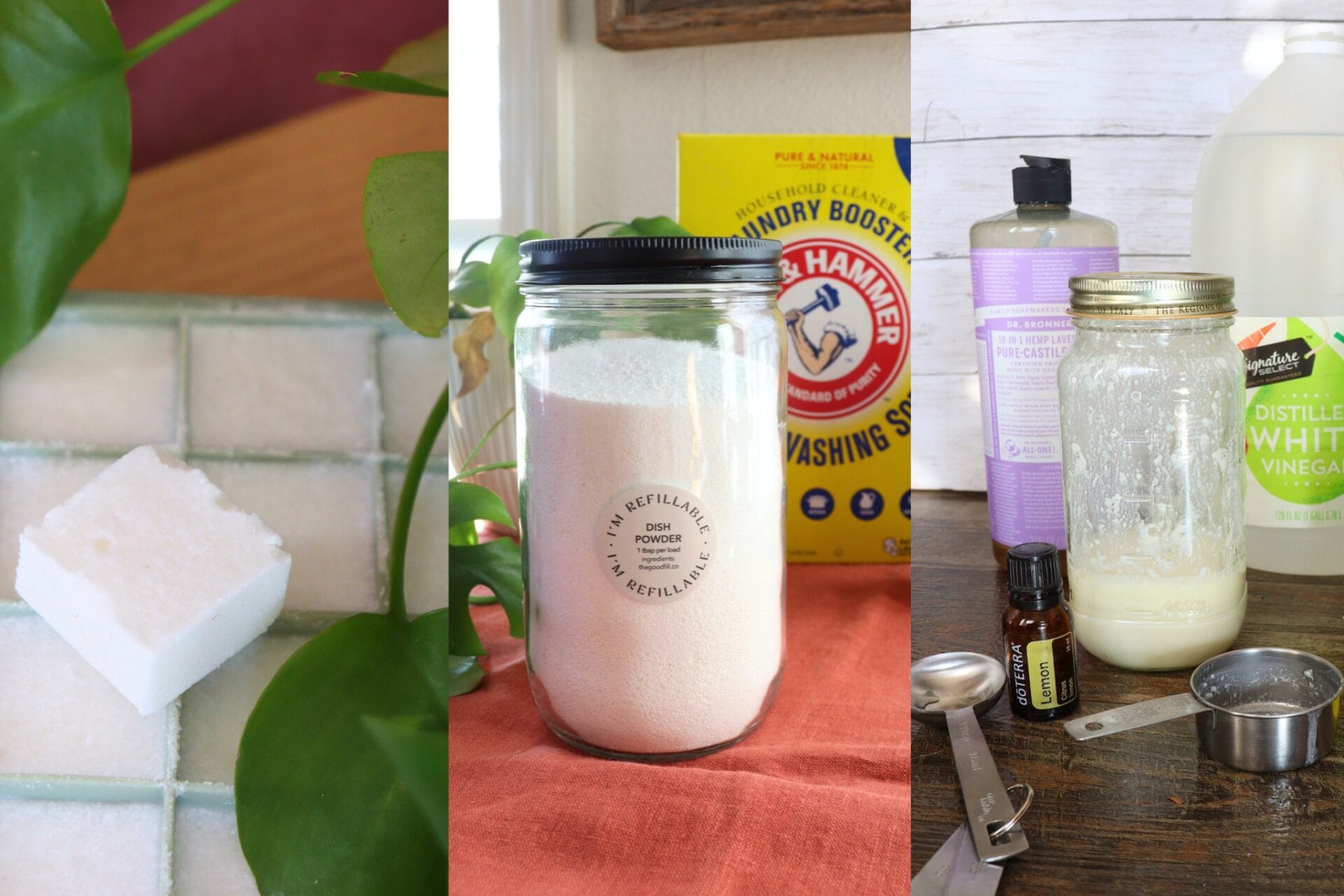
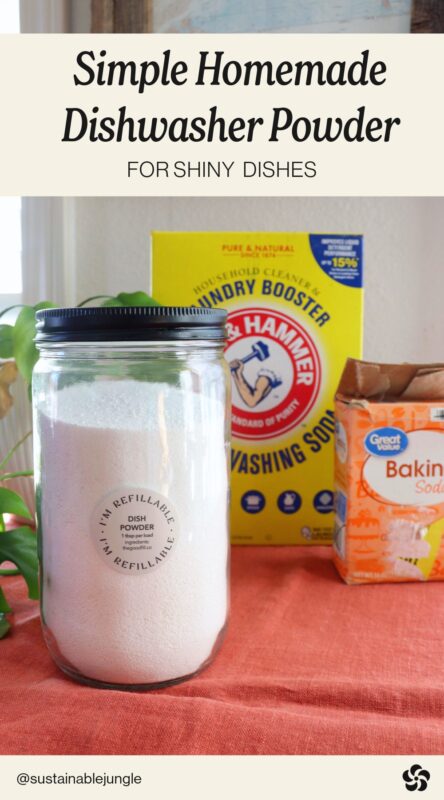
This simple DIY dish detergent powder is a cost-effective (but not as much as the tablets), low-waste option that’s perfect for everyday dishwashing. I use this recipe the most just because it’s the easiest out of the three to make.
This recipe makes enough for approximately 12 loads (or 6 very large, heavy soiled loads) but is also extremely easy to double or even quadruple if you want to make more at a time, as it’s shelf-stable.
Ingredients:
- 1/4 cup washing soda: Breaks down grease and grime. Note this is not the same thing as baking soda; it actually has more grease-fighting power. We suggest buying it in a cardboard box, like from Arm & Hammer.
- 1/4 cup baking soda: Adds a gentle abrasive for spotless cleaning.
- 2 tbsp. citric acid: Boosts cleaning power and helps prevent water spots.
- 2 tbsp. kosher salt: Softens water and aids in scrubbing. Note that Kosher or dishwasher salt is recommended as the grains of both are coarser, which will prevent any clogging of your dishwasher.
Recipe:
- Combine all ingredients in a bowl (can it get any more simple than that!?). Mix thoroughly to break up any clumps.
- Store the powder in an airtight container.
- Use 1-2 tablespoons per dishwasher load.
Homemade Dishwasher Detergent Liquid
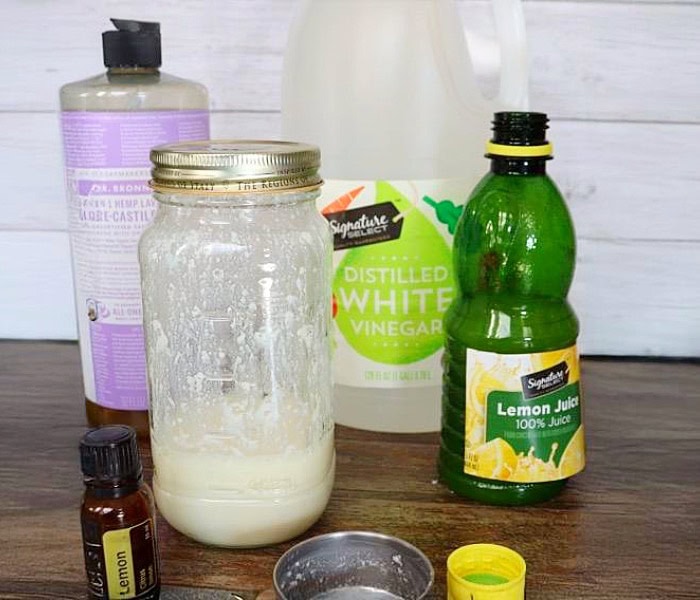
If you prefer a liquid detergent, this recipe is both effective and easy to mix. Though it costs the most to make out of all three options it does tend to have the best scent if you add the essential oil.
Ingredients:
- 1/2 cup castile soap: Cleans dishes gently but effectively.
- 1/4 cup white vinegar: Cuts through grease and removes water spots.
- 2 tbsp. lemon juice: Adds natural antibacterial properties and a fresh scent.
- 5 drops of essential oil (optional): If you’re interested in adding fragrance to this DIY dishwasher detergent liquid, we find lemon is a great addition for grease-cutting and complements the natural lemon juice in the recipe.
- 2 tbsp. water: Dilutes the mixture for easier use.
Recipe:
- Combine all ingredients in a jar or bottle. Stir or shake well to combine. It should result in a thick, paste-like consistency.
- Store in a sealed container; a wide mouth jar works best as the thick consistency means you’ll need to scoop rather than pour the liquid.
- Shake before each use and use 1-2 tablespoons per dishwasher load.
Homemade Dishwasher Detergent Tablets
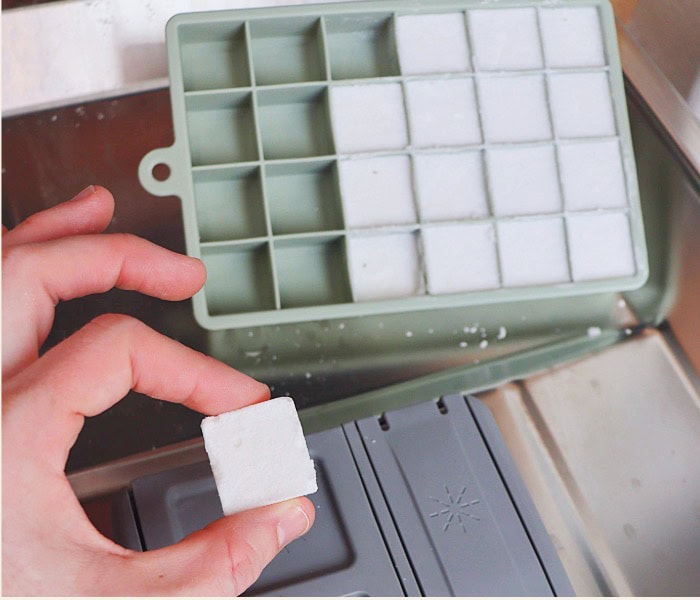
DIY Dishwasher pods are the most convenient to use for busy households. They’re not the easiest to make in this list but because you don’t need to measure out detergent every time you need to wash the dishes, they may end up saving you more time in the long run.
These are also much more environmentally friendly compared to most commercial pods which contain harmful ingredients, most notably polyvinyl alcohol (PVA), which is a plastic-like substance used to bind the pod together and dissolve in the wash. While PVA is designed to break down in water, it often doesn’t fully degrade in wastewater treatment facilities, contributing to microplastic pollution that can end up in our oceans and harm marine life.
By opting for truly plastic-free homemade dishwasher detergent cubes, you eliminate the need for PVA altogether, opting instead for ingredients that are biodegradable and environmentally friendly.
Ingredients:
- 1/3 cup lemon juice or white vinegar: Acts as a natural rinse aid and binds the mixture.
- ⅓ cup kosher salt: Softens water for better cleaning and helps reduce hard water stains and residue.
- ⅓ cup of baking soda: Aids in scrubbing and deodorizing.
- ⅓ cup of washing soda: Provides powerful grease-fighting action.
- 5-10 drops of essential oil (optional): If you’re interested in adding fragrance to these DIY dishwasher detergent tablets, we recommend lemon or tea tree oils for their grease-cutting and antibacterial properties.
- Silicone ice cube tray: We like using the mini ice cube trays because especially for our half-size dishwasher, a large cube is just too excessive.
Recipe:
- In a mixing bowl, combine the washing soda, baking soda, and salt. Stir to break up clumps.
- Slowly add the lemon juice or vinegar, noting that some fizzing is normal. Mix until the liquid is fully absorbed by the dry ingredients.
- Add essential oil if desired and stir again.
- Press the mixture firmly into a silicone ice cube tray, tamping down to eliminate air pockets.
- Leave the tray on the counter to dry for at least 12 hours or until the pods are completely hardened.
- Pop the pods out of the mold and store them in an airtight container. Use one pod per dishwasher load.
If you have more ice cube trays, just multiply this recipe as appropriate and you can make big batches of dishwasher tablets that will last you months and months—in just about 5 minutes of time!
Cost Savings of DIY Dishwashing Detergent Recipes
An obvious benefit of making your own DIY cleaning products (including dishwasher detergent) is the significant cost savings compared to purchasing conventional store-bought options. To illustrate the point, we’ve broken down the average costs of the three DIY dishwasher detergent recipes (and ingredients) and compared them with the price of your off-the-shelf conventional detergents.
1. DIY Dishwasher Detergent Powder (Ingredients and Costs):
-
- Washing Soda: $4.52 for 55 oz
- Baking Soda: $7.99 for 48 oz
- Citric Acid: $8.99 for 16 oz
- Kosher Salt: $12.99 for 48 oz
Cost per Batch:
-
- Washing Soda (1/4 cup = 2 oz): (2 oz / 55 oz) * $4.52 ≈ $0.16
- Baking Soda (1/4 cup = 2 oz): (2 oz / 48 oz) * $7.99 ≈ $0.33
- Citric Acid (2 tbsp ≈ 1 oz): (1 oz / 16 oz) * $8.99 ≈ $0.56
- Kosher Salt (2 tbsp ≈ 1 oz): (1 oz / 48 oz) * $12.99 ≈ $0.27
Total Cost per Batch: $0.16 + $0.33 + $0.56 + $0.27 = $1.32
Cost per Load:
$1.32 / 12 loads (you get approximately 12 loads, using 1-2 tablespoons per load, for this recipe) ≈ $0.11 per load
2. Homemade Dishwasher Detergent Liquid (Ingredients and Costs):
-
- Castile Soap: $16.99 for 32 oz
- White Vinegar: $2.50 for 128 oz
- Lemon Juice: $4.00 for 32 oz
Cost per Batch:
-
- Castile Soap (1/2 cup = 4 oz): (4 oz / 32 oz) * $16.99 ≈ $2.12
- White Vinegar (1/4 cup = 2 oz): (2 oz / 128 oz) * $2.50 ≈ $0.04
- Lemon Juice (2 tbsp ≈ 1 oz): (1 oz / 32 oz) * $4.00 ≈ $0.13
Total Cost per Batch: $2.12 + $0.04 + $0.13 = $2.29
Cost per Load:
$2.29 / 4.5 loads (or 3/4 cups which is the average for this recipe, using 1-2 tablespoons per load.) ≈ $0.51 per load
3. DIY Dishwasher Tablets (Ingredients and Costs):
-
- Lemon Juice: $4.00 for 32 oz
- Kosher Salt: $12.99 for 48 oz
- Baking Soda: $7.99 for 48 oz
- Washing Soda: $4.52 for 55 oz
Cost per Batch:
-
- Lemon Juice (1/3 cup ≈ 2.67 oz): (2.67 oz / 32 oz) * $4.00 ≈ $0.33
- Kosher Salt (1/3 cup ≈ 2.67 oz): (2.67 oz / 48 oz) * $12.99 ≈ $0.72
- Baking Soda (1/3 cup ≈ 2.67 oz): (2.67 oz / 48 oz) * $7.99 ≈ $0.44
- Washing Soda (1/3 cup ≈ 2.67 oz): (2.67 oz / 55 oz) * $4.52 ≈ $0.22
Total Cost per Batch: $0.33 + $0.72 + $0.44 + $0.22 = $1.71
Cost per Load:
$1.71 / 24 tablets ≈ $0.07 per load
Costs of Store-Bought Detergents
Commercial dishwasher detergents vary in price:
- Powder Detergents: Approximately $0.05 to $0.40 per load
- Pods/Tablets: Approximately $0.10 to $1.00 per load
Cost Savings:
- DIY Powder Detergent: At $0.11 per load, it’s comparable to the cheaper store-bought powder detergents.
- DIY Liquid Detergent: At $0.51 per load, it is on the higher end compared to store-bought options.
- DIY Tablets: At $0.07 per load, these are more cost-effective than many commercial dishwasher pods, especially premium brands.
Why Choose DIY Dishwasher Detergent?
Making DIY dish detergent isn’t just about saving money or reducing waste; it’s about making a safer choice for your family and the planet. Unless you’re specifically buying eco-friendly dishwasher detergent from vetted brands, almost all store-bought dishwasher detergents are loaded with toxic ingredients, including:
- Phosphates: While effective at cleaning, phosphates can irritate the skin and respiratory system.
- Chlorine Bleach: Often used for stain removal, chlorine bleach can release harmful fumes and cause skin irritation.
- Fragrances and Dyes: Synthetic fragrances and dyes, which offer no cleaning benefits, can trigger allergies, asthma, or skin sensitivities.
- Triclosan: Found in some antibacterial formulas, triclosan has been linked to hormone disruption and contributes to antibiotic resistance. The FDA has now banned it in soaps, but you may still find it in older solutions.
Phosphates in particular also pose a significant environmental threat when they enter waterways. Once released into the environment via wastewater, phosphates act as fertilizers, promoting excessive algae growth in aquatic ecosystems. This process, known as eutrophication, disrupts the natural balance of waterways.
Algae blooms grow rapidly, blocking sunlight from reaching underwater plants. When the algae die off, they decompose, consuming large amounts of oxygen in the process. This oxygen depletion creates “dead zones,” where aquatic life, such as fish and other organisms, cannot survive.
Eutrophication doesn’t just harm wildlife; it also affects humans by contaminating drinking water sources and disrupting fishing industries.

Amber obtained Bachelor of Arts degrees in English, Creative Writing, and Psychology from The University of Oxford and Arcadia University. She is an avid crafter, gardener, quail farmer, wannabe novelist, and self-proclaimed eco adventurer. From living in a camper van to living in a tiny house, she is enamored by the small and self-sufficient; and aspires to one day become an off-grid micro-farmer, bridging sustainability with non-toxic living and eating. With a passion for outdoor sports like rock climbing, skiing, and travel, having already backpacked across 30 countries, she is always up for the next big adventure while seeking ways to minimize her impact along the way.











Hello,
In the liquid dishwasher detergent recipe it lists “2 tbsp. cup water…”. Could you clarify the amount of water, should it 2 tbsp. plus a cup, just 2 tbsp., or something else?
Thank you!
Hi there! Deepest apologies for the typo; I can see the confusion that might cause! It should be 2 tbsp, NOT 2 cups. That would make it far too watery. We’ve amended the article to correct that and thanks so much for pointing it out!